
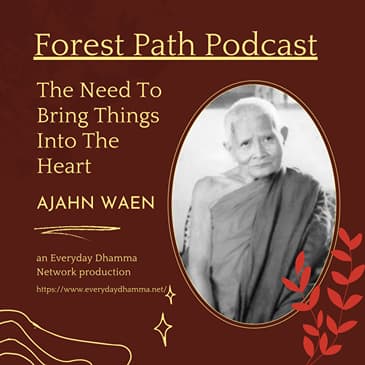
This episode is a talk given by Venerable Ajahn Waen Sucinno and is titled “The Need To Bring Things Into The Heart” . It was published as part of “The Life and Teachings of Luang Pu Waen Sucinno”. You can find links to the original text in the description below.
---
Links:
[00:00:00] - [Speaker 0]
Welcome to the Forest Path Podcast, a podcast sharing the teachings of awakened meditation masters of the modern era. This episode is a talk given by venerable Ajahn Wen Sicino. It's titled The Need to Bring Things into the Heart. It was published as part of the life and teachings of Lumpur Wen Sicino. You can find links to the original text in the description below.
[00:00:27] - [Speaker 0]
May you all benefit from hearing this gift of dhamma. Dhamma practice, the need to bring things into the heart by Yajan Wen. Question. Lumpur, does Lumpur have any words of advice for me? Answer.
[00:00:53] - [Speaker 0]
In your mind and in your heart, safeguard your going to the triple refuge well. Safeguard your going to the triple refuge throughout your life. Safeguard your body, speech, and heart, making them pure. At times when you are staying together with a lot of people, don't forget yourself. Bring things inwards to find the heart here.
[00:01:18] - [Speaker 0]
Take this heart as the one that knows. Take this heart as the one that sees. Take this heart as the one that abandons. Take this heart as the one that leaves things be. Practice with your body, speech, and heart, making them firm and strong.
[00:01:39] - [Speaker 0]
This body is external to the heart, but you have to investigate this body to know it clearly in this heart. Know it clearly. This heart is the substance of causality. Have this heart abandon. Have this heart leave things be.
[00:01:59] - [Speaker 0]
Have this heart withdraw. Withdraw everything in every way. Withdraw defilement. Withdraw it right here. Withdraw right here at the heart.
[00:02:11] - [Speaker 0]
Abandon right here at the heart. Be interested in safeguarding it. Safeguard the eyes, safeguard the ears, safeguard the nose, safeguard the body, safeguard your speech. These eyes here, when visual forms come in through the eye, know clearly by way of the heart. Whether they are satisfying or dissatisfying, use virtue to draw them completely out from your heart.
[00:02:42] - [Speaker 0]
Abandon them from your heart. Have this heart abandon them. Have this heart leave them be. Have this heart withdraw them. Make an end of them.
[00:02:55] - [Speaker 0]
When you go to see a lot of people, talking and chatting, it just leads to delusion and forgetfulness. Bring things inward to see this body first. The 84,000 aggregates of Dhamma teaching point inwards into this body. Our preceptor has taught us about this body: head hair, body hair, nails, teeth, and skin. The fivefold group of meditation themes culminating with skin, the meditation on the body.
[00:03:28] - [Speaker 0]
Investigate this body. This body here, know it clearly. Know it clearly by way of the heart. Have the heart abandon its moods and preoccupations, whether they're coming in through the eyes, coming in through the ears, in through the eyes, whether satisfying or dissatisfying, coming in through the ears, whether satisfying or dissatisfying, coming in through the nose, whether satisfying or dissatisfying, coming in through the tongue, whether satisfying or dissatisfying, coming in through the body, whether satisfying or dissatisfying. Use virtue to draw them out, or use your own discernment to draw them out from this heart.
[00:04:17] - [Speaker 0]
Withdraw them from this heart here. The heart is the one that abandons. The heart is the one that withdraws. The heart is the one that leaves things be. The cause of it has to be found right here.
[00:04:33] - [Speaker 0]
To find it anywhere else is not possible. Reminiscing about this, reminiscing about that. It's already drunk and dumber. Your past and your future. You have to abandon them completely.
[00:04:49] - [Speaker 0]
Cut your past and your future out and make an end of them. The past and the future have been around since time immemorial. Cut off the past and future, and the mind will plumb the present moment, know in the present moment, abandon in the present moment, leave things be in the present moment. Thus it will be budho, thus it will be dammo. Right here.
[00:05:19] - [Speaker 0]
In any other way, it can't be done. Safeguard the eyes, safeguard the ears, safeguard the nose, safeguard the tongue, safeguard the body, Safeguard the heart all the time. When you socialize with a lot of people, once you've stopped talking, bring things in to find the heart here, focused in every situation, every circumstance. Bring things in and focus on knowing your own heart. The five kinds of clinging and appropriation, the five kinds of uncertainty, they arise from this heart.
[00:06:00] - [Speaker 0]
Whether it's the five kinds of oppression, the five kinds of not self, it's the same. When you leave the five kinds of uncertainty be, certainty is established absolutely. When you leave the five kinds of not self be, self is established within that clear knowing. We keep relying on not self. Investigate the fivefold group of meditation themes culminating with skin, the meditation on the body.
[00:06:32] - [Speaker 0]
When you have the opportunity, sit down and cultivate a sense of calm. Suffering arises. It arises right here. It arises right here at the heart. Arm pain, leg pain, back pain, hip pain.
[00:06:49] - [Speaker 0]
Focus on suffering until you know it. Know its cause. Knowing its result. Knowing the cause means knowing what consistently brings in suffering. When you know equal to the cause, it ceases.
[00:07:06] - [Speaker 0]
Conditions cease. A vidja. Darkness just ceases. You have to be determined to safeguard this heart. Virtue, the Buddha described it with regard to this heart.
[00:07:20] - [Speaker 0]
Whether it's concentration or discernment, he described it with regard to this heart and this body. Just these two things. If you know the way of the body, you can completely leave it be. Knowing the way of the body converges and enters into this heart. Knowing the fivefold group of meditation themes culminating the skin is known right here in the heart.
[00:07:45] - [Speaker 0]
This heart is the cause. Have this heart abandon. Have this heart withdraw. Have this heart leave things be. Leave things be right here in this heart.
[00:07:59] - [Speaker 0]
Things will thus be possible. If you go and take other things apart from this, it won't be possible. Keep the map of Dhamma study in place for now, knowing the fivefold group of meditation themes culminating with skin. It's right here in this heart. Good thoughts, evil thoughts, this is the heart.
[00:08:24] - [Speaker 0]
Take up this heart. Have this heart leave things be. Have this heart withdraw. Go inwards, and the heart will gain strength. It can leave things be: knowing clearly, seeing truly.
[00:08:40] - [Speaker 0]
Practitioners bring things in to practice by way of body, speech, and heart to know things clearly, see truly. It arises in the sphere of the mind, the sphere of the heart. Safeguard the body. Safeguard your speech. Intention is the substance of kamma.
[00:09:00] - [Speaker 0]
Intention is the substance of good kamma. Intention is the substance of evil kamma. Bring things in to search for their foundation. They are established in a foundation. Take up just this much.
[00:09:16] - [Speaker 0]
You don't need to take up a lot. If you take up a lot, sometimes you will forget. If we speak too much, the heart goes out and reminisces about other things. Bring things in to enter the heart here, right in this present moment. If you take up a lot, soon you'll be reminiscing about other things.
[00:09:38] - [Speaker 0]
This mind, this heart, reminisces about things. Cut it out. When it's not thinking, not pondering, the mind is established in a state of normalcy. All five kinds of central preoccupations, let them come and go. Don't let them come in and take up residence in the heart.
[00:09:58] - [Speaker 0]
The eyes are already in a state of normalcy. The ears are already in a state of normalcy. The nose is already in a state of normalcy. The body is already in a state of normalcy. Let sensuality go to come and go, and the heart will already be in a state of normalcy.
[00:10:20] - [Speaker 0]
The eyes the eyes are their own thing. The eyes are not the heart. The ears are their own thing. The ears are not the heart. The heart is its own thing.
[00:10:32] - [Speaker 0]
Each thing in its own way. Retreat inwards. The eyes are already in a state of normalcy. The ears are already in a state of normalcy. The nose is already in a state of normalcy.
[00:10:45] - [Speaker 0]
The tongue is already in a state of normalcy. The body is already in a state of normalcy. The heart is already in a state of normalcy. The heart is not the eyes. The heart is not the ears.
[00:10:59] - [Speaker 0]
The heart is not the nose. The heart is not the tongue. The heart is not the body. Retreat inwards, and the heart will just be in a state of normalcy. It it hasn't ever gone anywhere.
[00:11:13] - [Speaker 0]
The eyes are in a state of normalcy. Sights, sounds, aromas, flavors, you have to abandon them. If they're good, you have to abandon them. If they're evil, you have to abandon them. If they're depraved, you have to abandon them.
[00:11:31] - [Speaker 0]
That's how it is. This is enough already. Take up huge amounts, and you'll forget. Be determined to practice. Relying on effort, do it a lot.
[00:11:44] - [Speaker 0]
In abandoning, have this heart abandon. Whatever is antagonistic in this heart, sacrifice it, relinquish it, completely give it up and give it back. Abandon here at the heart. When others speak wrongly, give their words up and back to them. We have our own.
[00:12:06] - [Speaker 0]
Delusion, greed, and anger abide right here, in our gut here. Evil, stupidity, or whatever, we have our own of every kind and every way. We don't need to have theirs. When they say something, sacrifice it, relinquish it, completely give it up and give it back to them. Don't let it come and reside in the heart.
[00:12:30] - [Speaker 0]
Withdraw it out from the heart. Question. Is Longpore able to speak about things that have passed? How past lives have brought me to this life? Will I be able to succeed in this practice?
[00:12:44] - [Speaker 0]
If Longpore can talk about these things, where does that knowledge come from? That is Vija Charana Sampanno. There are three Vijas that are brought to perfection through clear knowing. The first clear knowing is Puppe Nivasa Nusatiniyanana. Like Krupai Nivasanu who had established his mind in the path of Buddhahood.
[00:13:12] - [Speaker 0]
Pupai Nivasanu Sattinayana was his ability to recollect that he had died and been born in an unknowable number of states of being an unknowable number of lives, or for an unknowable number of eons. Drawing into the fact that after death is birth, after birth is death, Suffering is because of sensuality, happiness is because of sensuality. Seeing the breadth of the sky as completely filled with stars and planets, not knowing how much more he would have to be born and die. Born and then dying, born and then dying. Thus he made a vow to abandon the path of Buddhahood in order to realize Nibbana in the present.
[00:13:59] - [Speaker 0]
The second clear knowing is katupapatinana, knowing that beings are born here and pass away to here, or born there and pass away to there, or born there and pass away to here, or born there and pass away to somewhere else. This is the second clear knowing: the knowledge of the passing away and reappearance of beings. Asavakayanana is the third clear knowing: Knowing that you have made an end of defilement and are finished with it, it is knowing that you have brought the compulsions of defilement, defilement by way of body, by way of speech and by way of the heart, to an end and are finished with them. The defilements of the heart as well. They are completely finished and at an end.
[00:14:52] - [Speaker 0]
After the final aspect of the mind has ceased, one relies on five powers: the power of conviction, the power of effort, the power of recollection, the power of concentration, and the power of discernment. There is a brilliant, clear knowing throughout the extinguishment of the five aggregates. The threefold cycle of craving no longer exists. When there is just this, navang nati sambhavang, we no longer produce renewed states of being. The past is drunken dhamma.
[00:15:28] - [Speaker 0]
The future is drunken dhamma. The past is drunken dhamma. The future is drunken dhamma. The mind plumbs the present moment, knows in the present moment, abandons in the present moment. This is budho.
[00:15:47] - [Speaker 0]
Thus, it is dhammo. Take up the present moment. This is already enough. We don't have to say a single word about the past. Birth, aging, affliction, and death.
[00:15:59] - [Speaker 0]
Days, nights, months, and years are finished and at an end. Our age is finished and at an end. Be determined to persevere. If we are to do anything good, we have to be determined to persevere in our effort. Be determined to develop your mind and heart continually.
[00:16:21] - [Speaker 0]
When the four properties and the five aggregates break apart and cease, the property of earth is primordial earth, the property of water is primordial water, The property of wind is primordial wind. The property of fire is primordial fire. We rely on properties that are primordial things. They aren't the heart. Earth is not the heart.
[00:16:46] - [Speaker 0]
Water is not the heart. Fire is not the heart. Wind is not the heart. But the heart relies on them here. These are the endowments that we have received from our father and mother.
[00:17:00] - [Speaker 0]
This is na and mu. They are endowed in a good and useful nature. We rely on the endowments that we have received from our father and mother. The body and speech, they rely on these endowments from father and mother. When we want to create goodness through generosity, we rely on these endowments from our father and our mother as the place where that can be established.
[00:17:27] - [Speaker 0]
If we want to study the knowledge of the world, we rely on these endowments from our father and our mother as the place where that can be established. If we intend to develop in generosity, safeguard virtue, and cultivate the mind, we take up these endowments. This mass of nah and this mass of mo, nah and mo are one and the same thing. Question. Developing when there is an opportunity, I do this regularly.
[00:18:01] - [Speaker 0]
Is this related to Parami, spiritual perfections at all? Answer. Spiritual perfections and developing them have come from innumerable, uncountable past lives. Look right here. Look at these endowments.
[00:18:20] - [Speaker 0]
Eyes, ears, nose, tongue, and body, they are fully developed and complete. We are fully developed men and women already. Whatever it is, spiritual perfections have brought everything to be in every way. We have to keep developing continually. Whenever we have the opportunity, we have to do it.
[00:18:42] - [Speaker 0]
Establish integrity: integrity of body, integrity in speech, and integrity of heart. The spiritual perfection of patience: fully patient in body, fully patient in speech, fully patient in the heart. Having enduring patience is the foremost kind of spiritual perfection. That concludes the Dhamma teaching, the need to bring things into the heart, by the venerable Ajahn Wen. If you'd like to hear more talks by Arjun Nguyen and other meditation masters of the forest tradition of Theravada Buddhism, subscribe to the forest path podcast using your favorite podcast app.
[00:19:31] - [Speaker 0]
The Forest Path Podcast is part of the Everyday Dhamma Network. If you go to everydaydhamma.net, you can discover more about other podcasts on the network. If you'd like to support Everyday Dhamma Network, you can do that on the Ko fi creators platform or via everydaydhamma.net website. There are links in the description below. Thank you for listening.
[00:19:55] - [Speaker 0]
May you all experience insight and peace.