
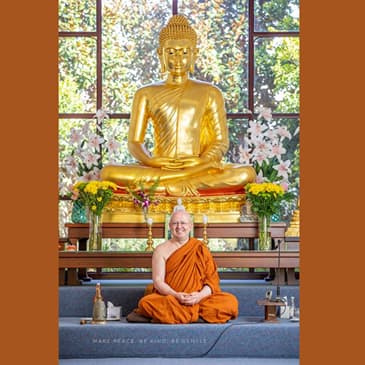

This guided meditation by Ajahn Brahm was originally recorded in 22nd May 2010. It includes a talk about some aspect of meditation followed by a 45 minute guided meditation.
This guided meditation has been remastered and published by the Everyday Dhamma Network, and will be of interest to people who have started meditation but are seeking guidance to take it deeper.
These talks by Ajahn Brahm have been recorded and made available for free distribution by the Buddhist Society of Western Australia under the Creative Commons licence. You can support the Buddhist Society of Western Australia by pledging your support via their Ko-fi page.
[00:00:00] - [Speaker 0]
Welcome everybody to this afternoon's meditation class. And as usual to give the instructions that those people who are coming to the Introduction to Meditation class, which is a series of four lectures for those who haven't meditated before. That class is being held in a small room to my right. And this is the class for the ongoing meditators. So if you think you can meditate for forty-forty five minutes this is a class for you.
[00:00:33] - [Speaker 0]
But if you haven't meditated that long, it's probably best to go to the other class. Otherwise during the middle of the meditation you tend to sort of fidget and disturb others. So this is a class for those who have meditated quite a long time before, so they can sit still for quite a long time. And at the beginning of this class for fifteen minutes, I usually talk about some aspect of meditation. And just one of the long term friends was asking me about a teaching which I've given about putting one's attention in between yourself and the meditation object.
[00:01:12] - [Speaker 0]
And that was a bit of a coincidence because last week I was in Melbourne teaching meditation there and somebody also asked the same question picking up from something I've given on the recorded talks. And it is a useful, skillful means. We call them skillful means because it's just not the only way to meditate, but one way to meditate which solves a lot of problems and gives you deeper peace in your meditation. So what many people do when they're meditating, they either look at themselves and see what you're doing, so the attention's on the observer. Or other times they put their attention on what they're supposed to be watching.
[00:01:55] - [Speaker 0]
And, you know, if you're lucky, you can be watching the breath, but many times you're wandering off or you're dull and sleepy, and that's what you put your attention on. And sometimes that causes a lot of problems. And it also misses that meditation, it is not really important what you are aware of. The object is not crucial. What really is important is the way you are meditating.
[00:02:26] - [Speaker 0]
What you are doing with what you are experiencing. Whether whatever experience is with you at that moment, Are you trying to hold on to that? Are you trying to reject it? Are you wanting it to develop? Are you wanting to be somewhere else?
[00:02:44] - [Speaker 0]
Are you content? Are you opening the door of your heart to that moment? Are you trying to get rid of it? Are you embarrassed by it? These are the important parts of the meditation.
[00:02:56] - [Speaker 0]
You might call it your reaction to what's happening right now. Because it's in that reaction, in softening that, in abandoning the negative reactions, and in their place developing the positive ones, the ones which will cause deeper meditation in the future. And by that I mean making peace, being kind, being gentle, being patient. And a skillful way to emphasize that it's not what you're experiencing but how you're experiencing it, is the skillful means of putting your attention in that space between you and the object of your awareness. Obviously this does take a bit of visualization, but not strong visualization, just a framework for experiencing whatever is 'me', the observed, and a space in between.
[00:03:55] - [Speaker 0]
Because once you put your attention, the space in between, you are taking away the attention, you know, from the self, from the 'me' who's doing this meditation. So straight away it takes away all this I'm good, I'm terrible, I can do this, I can't do this' because your attention is not in the self anymore, not about me anymore. And also it's not so much in the object. It means you're not really so caught up whether you have got the breath, the beautiful breath, the present moment, nimittas or whatever. That's not sort of your focus.
[00:04:31] - [Speaker 0]
Your focus is what's in between this. So number one, it takes you away from this sense of self or worry about where you are in the meditation. In other words, you know, what is the surroundings around you? Just like driving the car, you're not really concerned about sort of the landmarks around you and where you are in the journey. Nor you're really aware of you sitting in the car, the person, but you're aware of how you're driving.
[00:04:59] - [Speaker 0]
Making sure you're driving well, making sure the process is happening. And by putting the attention between you and the object, you take away from me and from the object, you put it into the place where the meditation is really important in the process of meditation. And once you put your object in that space in between, then you see that is where the action is. That is where meditation happens. And in that space between you and that object of awareness, in that space in between, you find that you can adjust that space.
[00:05:35] - [Speaker 0]
Sometimes you look in that space between you and the object, and there can be ill will between you object. You know, it might be, say, dullness. I don't want to be dull. I'm always dull. Hate this dullness.
[00:05:46] - [Speaker 0]
And it's as if you're putting that ill will in a space between you and the dullness. And if that's what you see, literally you just take that ill will out and put in some contentment. If you're dull, you know, it's because you've been working hard. Maybe you didn't sleep much last night. There's all sorts of reasons.
[00:06:08] - [Speaker 0]
Maybe you're just sick. So putting ill will between you and the object, you can replace that by just kindness, acceptance, all these positive, good meditation emotions. And if you put contentment, peace, kindness, gentleness, patience between you and that meditation object, say dullness, you will find that dullness doesn't last very long. At the same time, because you're making peace, because you're being kind, because you're being gentle, the meditation will be progressing incredibly fast, much faster than you'd ever imagined. Why?
[00:06:42] - [Speaker 0]
Because you're putting your attention where the action is. The place where you can really can tweak the meditation to make it work. And if you are meditating and maybe you get sort of another nice breath, breathing in and breathing out, but yeah, you you want it to go a bit further, want to get into sort of the nimitta realms. And then you actually can see that in the space between you and the object, yeah, you've got beautiful breath, delightful breath, that's wonderful. But then you put in this wanting and desire between you and that object.
[00:07:15] - [Speaker 0]
And you can notice that even though you're going very deep and things are going well, still you're making the mistake there because what's between you and the object is a negative. So very often if people say they've got sort of a delightful breath, yes, but what was between you and that object when that was happening? And you'll find that because you've got a negative quality between you and the meditation object, in this case the delightful breath, that's why it doesn't develop any further. That's where you've lost the attention, the place where you should have been watching, to take it even deeper. So that gives a much better way of, a very skillful way of developing the meditation because you're putting your attention onto the process of meditation.
[00:08:06] - [Speaker 0]
Not on the agency who's meditating you. Not on actually how far you've got, you know, the object of meditation but actually what you're doing about it. Not so much where you are or who's the driver but how you're travelling. And if as long as that way how you're travelling as well, then you're gonna make great progress. It's the same if you've got like pain in the body.
[00:08:29] - [Speaker 0]
You don't watch the pain, you don't watch me who's experiencing the pain. You're watching what's between me in that pain. And again when you sort of put the attention there it's amazing what you find. Because there you can find the negativity, you can find the fear, you can find the, you know, the lack of patience. I've been experiencing this for too long I can't stand it any longer.
[00:08:52] - [Speaker 0]
That's actually where you find the source of the problems. So can once you see what the source of the problems are, you can't change the pain, you know, this is you. But certainly you can do something in that space between you and what you're experiencing. There as if it were you have full charge, you know, of what you put between you and that object. And it is very similar just you can make different frameworks for understanding this principle.
[00:09:19] - [Speaker 0]
It's a different like changing your glasses. You have your black glasses, red glasses, your green glasses. And if I put my green glasses on, you all look green. If I put my black glasses on, you all look black. If I put my gold glasses on, you all look gold.
[00:09:34] - [Speaker 0]
So whatever I put between my eyes and you, the objects, it actually affects you. So it's as if I put my my peaceful glasses, making peace glasses on, I put my my being kind glasses on. And so when I'm looking, you're looking with kindness and I see just see you with a kind eye. And that idea of putting something between you and the object also does alter the way you look at things. And that's again what we really mean.
[00:10:02] - [Speaker 0]
And last but not least, as one person just reminded me, it's a very very good point, it also makes it very clear that this whole dhamma of meditation, this whole thing about you, that life is a process, not a thing. There's not a self inside, you don't exist out there. Life is a process and by observing this process in a proper way, it's not what you're experiencing, it's not where you are, it's not who you are, but it's the process. How this thing is traveling. How this thing is flowing.
[00:10:41] - [Speaker 0]
And so, it doesn't matter what the river is, whether it's clean or dark, it depends on where it's going. How it's flowing. And if you can sort of adjust the way this stream of consciousness is flowing, and this is how one does it, it doesn't matter where it is, where it happens to be right now, it's where it's going, how it's moving. The process is the most important part. So by putting that attention between you and the object, wherever you happen to be, you're really affecting this process.
[00:11:14] - [Speaker 0]
And also you understand that life is a process. Life is a relationship between you and the object. This is where life happens. It's not about self, it's not about me. It's nothing to do with you.
[00:11:25] - [Speaker 0]
It's always about us. And us I don't mean you and somebody else. I mean you and life. The process of the relationship between you and life, between you and happiness, and you and disappointment, between you and getting old, you and death, you and sort of eagles losing or winning, whatever you get into in your life. So this is actually where the action of life is.
[00:11:49] - [Speaker 0]
And so by putting the attention in the space between you and the object in meditation, not only does it give you direct access to the action in meditation, where you can actually do something, it's also a great way of learning how to live a very beautiful and wonderful life. If those of you who know traditional Buddhism know the enemies, the defilements, the hindrances, you know, where do they live? You know, they say that greed, hatred and delusion are three defilements. You've got the five hindrances. They don't live in the object which you're watching.
[00:12:29] - [Speaker 0]
They don't live in the breath. They don't live in the mindfulness. And the mind is supposed to be pure. But they live in the space in between. That's where defilements happen to be.
[00:12:40] - [Speaker 0]
It's not that you make me angry. It's not that I am angry. This anger appears in the space between us from now again. Just fear appears in the space between you and whatever you have to experience. So that's where all the defilements, that's where all the hindrances, that's where all the bad guys live.
[00:13:00] - [Speaker 0]
So if you wanna get the bad guys or the bad girls, let's not be gender specific. This is actually where the action is. So you put your attention there, and then you can make this space between you and whatever you're watching pure and beautiful and kind and lovely. You know all the positive stuff. Put it between you and the object, and you'll find the meditation takes off.
[00:13:26] - [Speaker 0]
So there we go. So now if you'd like to get yourself in a comfortable position, so you can start meditating. Now with your eyes closed, keeping the theme of this particular meditation, just the observer and the first object your body. What have you got between you and your body right now? What's in the space between the observer and the observed?
[00:14:39] - [Speaker 0]
In this particular case, your body. Is it control? Is it fear? Usually, those two go together. Or is it trust and kindness?
[00:14:55] - [Speaker 0]
So see if you can put kindness between you and your body. Put patience to allow this body time to find its optimum posture. And if you put patience and kindness between you and this object called your body, you will, by nature, you will move when you need to move. You adjust. You'll scratch.
[00:15:27] - [Speaker 0]
You'll relax. And you find the relationship you have between your body becomes less dysfunctional, less one of master and slave, are more of equals, of mutual respect, which means things get easier and more in harmony. And keep the patience up between you and this object called your body. Sometimes people rush body awareness, which means that later on in the meditation they have to move and fidget, simply because they never cared enough. They took their body for granted, put it in a posture, and left it, and find it hurts later on.
[00:17:34] - [Speaker 0]
There does come a time when the body is as relaxed as you're going to get it. It's a time just to let the body fade away. And where is your relationship with this present moment called now? Is there wanting between you and this moment? Are you trying to get somewhere?
[00:18:05] - [Speaker 0]
Is there ill will because you don't like me talking? What's between you in this moment? That's where the action is. Throughout the whole of this meditation, and I'm gonna be quiet now, throughout the whole of this meditation, focus on the space between you and whatever you're aware of. Getting very close to the end of the meditation.
[00:56:05] - [Speaker 0]
How do you feel? What's the end point of meditation like compared to the beginning? And why. So this reflection at the end of your meditation teaches you how meditation develops this deep state of peace and inner comfort, clarity and joy. I'm gonna ring the gong three times.
[00:57:05] - [Speaker 0]
The last ringing of the gong vanishes. It's a signal to come out from the meditation. And the third, resonance of the gong fading away. There we go. It's a very nice meditation.
[00:58:05] - [Speaker 0]
So again, just to sum up by putting your attention in that space. It's a constructed idea, but still it works between yourself and the meditation object, by making peace, being kind, being gentle. You do find that it creates the causes for deep meditation. As I said before about good meditation karma, just the intention where you're coming from, what you set in place, so the meditation can roll into a deep state of peacefulness. So all this letting go, letting go of the controller, being kind, being gentle, being patient, waiting in this moment, stopping all those beautiful ideas.
[00:58:54] - [Speaker 0]
If you put those ideas into that space, it becomes very, very effective. You're putting in the right place. Very often, whether it's a doctor trying to figure out what's wrong with the patient, or whether it's a mechanic trying to think why the car doesn't work, or whether it's a Buddhist society trying to figure out why the roof leaks, once you actually see the place, you find out that place, you put your attention around that place, the problem is solved. In meditation, that place, you can say that that's the space between you and your meditation object. That's where the action is.
[00:59:34] - [Speaker 0]
So, there's a question here. Somebody just posted it on one of these post it. It's a technical question, it's a question which is asked very often. It's what about the deep jhanas? Remember the jhanas?
[00:59:46] - [Speaker 0]
The stages of letting go. Just what happens when you really stop, when you make lots of peace, you're really kind, you're really gentle and things start to disappear. And he said: 'Is it possible to reach jhana by bypassing the nimittus, e. G. Through presence of just pure metta with respect?' Again, first of all, the very reason why people actually mention that is people always like shortcuts.
[01:00:16] - [Speaker 0]
Unfortunately, everything, that's really what it is. Instead of just following the ordinary path, want to make one's own path. It's also underlying that, is one of the problems which is inherent in a monk like me teaching these jhanas. Because you teach them and because they're very very high, very wonderful, they will inevitably give rise to what we call spiritual materialism, wanting these things because they're on offer that you want them. And so it's hard to get these things with any wanting.
[01:01:00] - [Speaker 0]
So yes, you want them, but you have to give up wanting to gain these stages. There are stages of letting go. You really have to let go more and more. And let go a huge amount to get these stages. So if you want anything, you won't get it.
[01:01:14] - [Speaker 0]
If you let go, they come to you. So instead of actually worrying about bypassing an imitates or just your pure metta, just even forget about that question. Just let go more and let go more and let go more and let go more and then the question won't even come up. But technically the answer is that it is just about possible but not recommended. The nimittas, especially the light nimittas, this is what happens in the deeper stages of meditation.
[01:01:49] - [Speaker 0]
Important skillful means that when the body disappears, when you can't hear, you can't sense anything through your physical body. In other words, the sense of touch disappears, the hearing disappears, sight, smell and taste have vanished, and with it all idea of your body. And when there's no thinking going on, then a beautiful light can appear in the mind. That light nimitta is the most important. It's so common for meditators who really get into the meditation deep, very deep and big time.
[01:02:26] - [Speaker 0]
It is something which happens. That nimitta has to be stabilized, so it's not moving around. It's just still just in front of you like a stationary light. Very brilliant, very bright, very beautiful. And when that happens, then you've worked with something.
[01:02:43] - [Speaker 0]
You understand that you have a good signpost there, that things are happening. And then that will take you into the jhanas. And if you do it that way, number one, you're very clear that yes, that you've gone that major direction. That once that nimitta has been jumped into, once it envelops you, that that would be a jhana, you can actually say, yeah, I've gone in the usual way, that must be the jhana. However, if you go through it through other ways, it's just far too much uncertainty.
[01:03:16] - [Speaker 0]
And because it's far too much uncertainty, it gives too much opportunity for wishful thinking to create Ajana when there really wasn't one there. And we've been talking about this recently in monasteries, just how when there's spiritual attainment of Ajana on offer, sometimes the psychology of wishful thinking of actually literally without you realizing it, you actually manufacture many of the qualities of ajana, and it's not the real thing. It's a delusion. The mind is very, very, very tricky. So if you go through the usual way of an nimitta, then you're really pretty certain that that was the real thing.
[01:03:58] - [Speaker 0]
So going through the other ways, it actually is possible, but it's not recommended. And the chances are you're just missing out on the real things. So just go the usual path. This meditation has been practiced over two thousand five hundred years. So this is the usual path.
[01:04:18] - [Speaker 0]
The reason why this is the usual path, because it works the best. So don't try and be different. Don't try and do it your own way. And sort of find the twenty first century Australian way of getting into jhana and patent it. So it's not about sort of being an individual.
[01:04:34] - [Speaker 0]
It's about your individuality fading away. So yeah, it's possible, but not to be recommended. So if you want those jhanas, just do exactly what we've been doing the last forty, forty five minutes. Just keep on. They happen by themselves.
[01:04:49] - [Speaker 0]
The limiters do come. When they do come, great. But if they don't come, great. Remember, the most important thing is the process. Not where you've got to, but the process.
[01:04:59] - [Speaker 0]
Make sure that you're just making peace, being kind, being gentle in this very moment. And if you don't even get into these jhanas, get so peaceful, it's so wonderful, that's good enough for you. And if you follow that, this is good enough for you, leave it down there. If that's good enough for you, if you develop that contentment, that's more important than the jhanas. The contentment, the letting go.
[01:05:21] - [Speaker 0]
So the lack of self and wanting, that's more important than anything else. Anjanas come as a byproduct of your ability to be peaceful, and not want things, and not try and take shortcuts. Just being simple, being peaceful, being free. That's the whole purpose of this meditation. So by focusing on the space between things, you're focusing in the correct position there.
[01:05:49] - [Speaker 0]
Okay. Any comments on that? Yes, not so Chris, go
[01:06:19] - [Speaker 1]
Straight. No. Go.
[01:06:26] - [Speaker 0]
Yeah. Which you do there
[01:06:29] - [Speaker 1]
in once? Very, very fast. Again,
[01:06:38] - [Speaker 0]
if it's a physical weakness, it's no problem at all. Because I mentioned, I don't know where this was, maybe to the monks, when an extreme example in my own life, having typhus fever for four weeks, and being just really incredibly weak, is not even being able to stand up under that incredible effort. And just to be able to walk was to go to the toilet. Ward full of about six beds on either side had to lurch to jump to the next bed. That's how you're tired you were, you know.
[01:07:13] - [Speaker 0]
This was third world hospital in a monk's ward thirty five years ago. And just really, really exhausted, and no energy at all, and being able to get into a very, very powerful deep meditation. So the physical exhaustion was not a problem at all. Because I knew just how to make peace with it, be kind with it, be gentle with it. But the emotional stuff, the mental stuff, now that could be a problem.
[01:07:36] - [Speaker 0]
So for all meditation, forget about the physical stuff. It's not really an obstacle at all. It's a great thing to know that, because when you're really sick, when you're old, when you're really really weak, you haven't got the strength anymore, which you had as a young man, you can still get into the deepest of drownedness. No worries at all. But the emotional stuff, if you're mentally sort of exhausted, in other words, there's just so much negativity, so much sort of fighting where you've been losing.
[01:08:05] - [Speaker 0]
And that's where you just learn how to let go. Yeah.
[01:08:14] - [Speaker 1]
There is more stuff.
[01:08:18] - [Speaker 0]
Why am I going to be that situation? And, it's quite challenging to pretty
[01:08:23] - [Speaker 1]
well. Yeah.
[01:08:32] - [Speaker 0]
Well, the thing is you just let it happen. Yeah, the thing is to do is just let it happen.
[01:08:45] - [Speaker 1]
Let it roll. Yeah,
[01:08:50] - [Speaker 0]
exactly. Wonderful. So it's not being scrambled, which is a problem. It's just, I don't want my mind to be scrambled. That's a problem.
[01:08:59] - [Speaker 0]
It's just the sense of judging that as a fault, as something which shouldn't happen. So if your mind is scrambled, I look at the space between me and the scrambled mind. So the scrambleness is not the object anymore. And me, this loser, meditator, is not the place I look at. I look at this.
[01:09:26] - [Speaker 0]
What am I doing with this? Am I sort of upset at this? Am I fed up with this? How can I just make peace with it? Can I be kind, but can I be gentle?
[01:09:35] - [Speaker 0]
That's the sort of great insight. I can make peace, be calm, be gentle with anything. So that means that you can always meditate. Sure it doesn't stop straight away. If you put forth effort, you can actually stop things much quicker, but that's not really healthy.
[01:09:52] - [Speaker 0]
It's just a forced stopping, which just creates more problems later on. That's what I would do. And just leave it alone. Scramble. Ingrid scramble.
[01:10:08] - [Speaker 0]
I like scrambled eggs. I like bored eggs. I like scrambled mind. Exactly. Well look, I'm talking about meditation, if you're just, you know, you're dealing with a patient, or you're driving, or you're actually making scrambled eggs, and if you've got a scrambled mind, you forget the recipe and you don't know what you're gonna make.
[01:10:36] - [Speaker 0]
But I'm talking about meditation. In meditation, it might be scrambled. You know, if you're actually working, then you do have to put forth effort into the work. You've just got to focus. If you've got somebody that's paying you how many dollars an hour, they want some reward for the money they give you.
[01:10:54] - [Speaker 0]
And if you're already scrambled and you don't perform, it's not very good for them. So effort when you're working, but meditating, that's when you just totally let go. So remember, I make a big distinction here. Your meditation time is a rest time. It's not work time.
[01:11:12] - [Speaker 0]
It's when you let go of all this self and all that, what you think you should be, and have a bit of freedom. Oh yeah, that's great. Great question, and it's a certain answer. That's what I always do. I'm sometimes really tired.
[01:11:29] - [Speaker 0]
Just get into some meditation. Your emotional resources, the peace, the power, the insights, the clarity, the joy, the ability to engage, that increases enormously. Why? Because you've rested your mind. And that resting everything, you rest your body and you're fit to work the next day.
[01:11:51] - [Speaker 0]
And sometimes if you exhaust your body, you just get up in the morning, you just can't drag yourself to work without three cups of coffee, I don't know what you use. But if your mind is very still and peaceful, it has a huge source of energy. Not just sort of the clarity, but the emotional energy and the resourcefulness of being able to see things in unique ways. This meditation is a... It is snake oil.
[01:12:17] - [Speaker 0]
You know, it just fixes up so many problems. And we don't sell it. It's for free. That's one of the nicest things. No GST on it, no tax, no super tax.
[01:12:34] - [Speaker 0]
I'm sure that if Mr. Vad knew about the powerful deep meditations, he'd put a super tax on jhanas. Why don't you get up to that level? Do long sits, yeah, and just do patient sits. Yeah, if you can.
[01:12:56] - [Speaker 0]
So just allow it to get very deep. Okay, last question from me before we stop, yes? Chris? You could change, but sometimes it's better just to realize the mind's being scrambled. That's old karma, old meditation karma, that you have to deal with the scrambled mind.
[01:13:34] - [Speaker 0]
And if you understand the law of karma, it means the best thing to do is just to make peace with it. Be kind, be gentle. And that's the best thing you can do, which means that you're making now good karma for peacefulness, for unscrambledness. But doing something, trying to get rid of things, sometimes just makes things worse. It's not as efficient as just stopping and leaving it alone.
[01:13:58] - [Speaker 0]
Okay, we've gone past the time, so maybe you can ask the question personally after... Oh yeah, I was going announce that, yes. There is a Sutta class on Sunday at 03:00. I might be ten or fifteen minutes late because there's also a committee meeting on that day. And the Sutta class is on number 30.
[01:14:18] - [Speaker 0]
The Chula Saropama Sutta. So that one. Okay. It has to be done... We have to do it next week because we're out of time.
[01:14:33] - [Speaker 0]
Okay. So for those of you who put a question in the basket, we had too many questions here already, so it'll be dealt with next week, I hope. So let's all now pay respect to Buddha Dhama Sangha.