
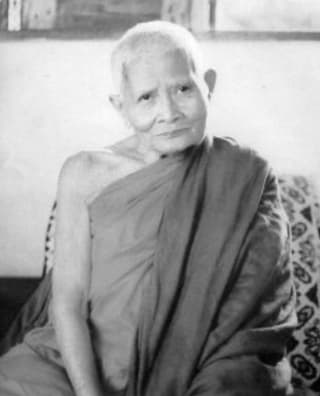
Luang Pu Waen Suciṇṇo (1887–1985) was a renowned Thai Buddhist monk of the Forest Tradition, celebrated for his ascetic wandering practices, profound meditation teachings, and reclusive lifestyle that emphasized direct insight into the present moment and the impermanence of the body.[1] Born as Yaan on February 16, 1887, in Na Pong village, Loei Province, Thailand, to a rural blacksmith family, he was ordained as a novice at age nine in 1896 at Wat Pho Chai under his uncle's guidance, fulfilling his dying mother's wish for him to pursue the monastic path.[1] He later received full bhikkhu ordination in the early 1900s at Wat Saang Taw near Ubon Ratchathani, where he studied Pali texts before embarking on a life of tudong (wandering asceticism).[1]A pivotal encounter in 1918 with the influential meditation master Phra Ajaan Mun Bhūridatto transformed his practice, leading him to adopt rigorous forest meditation under Mun's guidance and become one of his earliest disciples.[1] From the 1920s through the 1930s, Luang Pu Waen undertook extensive travels on foot across Thailand, Burma, Laos, and India, visiting sacred sites such as Benares and the places of the Buddha's birth, enlightenment, and parinibbāna, while overcoming temptations and illnesses like malaria through meditative resolve.[1] In the early 1930s (sometime between 1921 and 1931), he reordained in the stricter Dhammayuttika Nikaya at Wat Chedi Luang in Chiang Mai under Tan Chao Khun Upālī Guṇūpamājahn, further deepening his commitment to the Thai Forest Tradition's emphasis on solitude and direct experiential knowledge of the Dhamma.[1]Despite his preference for isolation in remote forests and caves, Luang Pu Waen's reputation grew in his later years, particularly after settling at Wat Doi Mae Pang in Chiang Mai in 1962 at the invitation of fellow monk Phra Ajaan Noo Sucitto, where he resided until his death.[1] He was a favorite monk of King Bhumibol Adulyadej (Rama IX), who visited him multiple times, including shortly before his passing, and supported the temple's development; a 1971 account of Luang Pu Waen levitating during meditation, witnessed by a Thai air force pilot, further amplified his fame among lay devotees.[1] His teachings, often delivered sparingly but with piercing clarity, centered on "straight Dhamma"—abandoning attachments in the present moment through contemplation of the body's 32 parts and the four elements (earth, water, fire, air)—contrasting it with "drunken Dhamma" preoccupied by past and future, as he stated: "Knowing the present moment, abandoning the present moment, is ‘straight Dhamma’".[1]Health challenges, including chronic wounds from past karma and falls in 1977 and 1979, confined him more to Wat Doi Mae Pang, yet he continued instructing visiting monks, scholars, and royalty until his hospitalization on April 14, 1985, at Maharaj Hospital in Chiang Mai.[1] Luang Pu Waen passed away peacefully on July 2, 1985, at age 98, surrounded by disciples; his royal cremation on January 17, 1987, at Wat Doi Mae Pang drew thousands and prominent Sangha leaders, solidifying his legacy as one of the 20th century's most revered forest arahants in Thai Buddhism.[1]
Related Episodes
How The Body Is Where Dhammas Arise | Ajahn Waen Sucinno
This episode is a talk given by the forest meditation master Ajahn Waen and is titled “How the body is where Dhammas arise” . It was published as part of “The Life and Teachings of Luang Pu Waen Sucinno”. You can find links to the original text in the description below. --- Links: Forest Path Podcas...