
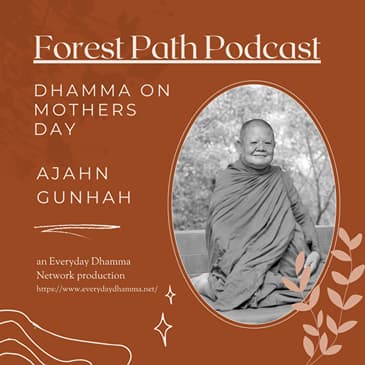

This episode is a talk given by the forest meditation master Ajahn Gunhah Sukakhamo and is titled “Dhamma on Mother’s Day”. It was published as part of Jai Dee - Jai Sabai - Delivery 42. You can find links to the original text in the description below.
--
[00:00:00] - [Speaker 0]
Welcome to the forest path podcast, a podcast sharing the teachings of awakened meditation masters of the modern era. This episode is a talk given by the forest meditation master, Ajangana Sukakamo, and it's titled Dhamma on Mother's Day. It was published as part of Jaydee Jayasabai delivery 42. You can find links to the original text in the description below. May you all benefit from hearing this gift of dhamma.
[00:00:40] - [Speaker 0]
Dhamma on Mother's Day by Ajang Ganha. Today is National's Mother's Day. May everyone remember their mother. A mother is a precious person, a giver who gives by body and heart. A mother is like an arahant, a Brahma or a Deva for a child.
[00:01:02] - [Speaker 0]
This is the virtue of being a mother. She is a role model both in body and mind. Some mothers are also grandmothers. Some people are not mothers yet. Some people will be mothers in the future.
[00:01:18] - [Speaker 0]
All goodness comes from the mother, if someone has a good mother who dwells in the virtue of being a mother. Today is National Mother's Day. It is for us to recall the good deeds of our mother. When we are born as children, we are mainly takers. We take when we are in our mother's womb.
[00:01:40] - [Speaker 0]
After leaving the womb, we continue to take from the mother. Even when we grow up to be a young man or woman, we still take from our parents. The Lord Buddha wants you to recall the good deeds of your mother because your mother is old. Some people are very old already, not like they were before. It is your burden, your duty to support and look after your mother.
[00:02:07] - [Speaker 0]
Both by looking after her body, by making her comfortable and at ease and by looking after her mind. If you don't have a mother, then you don't have anything. Your wealth, belongings, money and everything, including your standing in society, all this originates from your mother. You have duties, have work to do and a family, but it is important that you don't cast aside and forget your mother. Some mothers live in a different province or in the countryside, but they love you, worry about you, and miss you.
[00:02:44] - [Speaker 0]
On this National Mother's Day, there are various events throughout the country to arouse awareness and stimulate the arising of virtue. It is excellent that you have come to stay at the temple and make merit. It is the right thing to do. May you always recall: We shall do good for our mother. We arouse goodness, and we give good things for our mother.
[00:03:11] - [Speaker 0]
Some people are still children. They are not mothers yet. Some people see the danger in samsara like this. Getting married is a burden. It is a way of creating more problems for myself.
[00:03:24] - [Speaker 0]
But may you also see it like this. I will have the chance to do good, be a role model, an example for my family, society, and country. Because society and humankind need good people, need good role models. A human being is precious. To be human means to have an elevated heart that inclines and leans towards doing only good deeds for oneself and being a role model, an example for the family and society.
[00:03:57] - [Speaker 0]
The Lord Buddha is a supreme being who was born as a human being. He determined to practice, to develop goodness and parami and got enlightened by himself to be the teacher of devas and humans. He took the dhamma he had awakened to and taught us its essence and conventions. The four kinds of samana are in the dhamma vinaya of the noble Sama Sambhuta. That was completely explained by him.
[00:04:29] - [Speaker 0]
Outside of this dhamma vinaya, it may not be possible to reach true happiness and the ending of suffering. You can practice it at all times in all eras. It is up to date and not old fashioned. You can apply it in your daily life while doing your duties and work. The Lord Buddha wants you to adapt yourself to find the dhamma.
[00:04:53] - [Speaker 0]
Don't adapt the dhamma to suit yourself. You still have wrong view and understanding. Your thinking is not far seeing nor circumspect. You are weak hearted and feeble. Therefore, it is necessary to make the Lord Buddha your refuge and example.
[00:05:11] - [Speaker 0]
You have to make the Dhamma your code of practice. The five precepts are everyone's code of practice. The eight precepts are the next higher step. The 10 or 227 precepts are the sealer for monastics, for those who are ordained, who must conform to shaving their head and wearing robes. These precepts are the principle that leads you towards becoming happy and making an end of suffering, namely, nibbana.
[00:05:43] - [Speaker 0]
You don't love Sila, don't like it, and don't want to keep the precepts because you are following your desires. You are putting your wants and needs in charge. Your wants and needs are like a moth that is flying into a fire. You are creating problems for yourself and for other people because of your wants and needs. You even gain things by oppressing others and use your cleverness to make a living on other people's hardship, but you still see yourself as a good person of good conduct.
[00:06:17] - [Speaker 0]
The Lord Buddha wants you to incline your heart towards seela. That makes you wonder, if I keep the precepts, how can I be happy? How can I become rich? People who keep the five precepts, who are honest and trustworthy, are not rich. They are poor.
[00:06:35] - [Speaker 0]
I can't practice like this. Only people who leave the world behind can do this. This way of thinking is not right yet. The Lord Buddha taught that people who attain happiness and the ending of suffering won't follow the chalasis. They don't let the chalasis burn their heart while they are still alive.
[00:06:56] - [Speaker 0]
You haven't yet died, but you are getting burnt alive by the chalasis. Reflect on and contemplate this. If you are rich, a millionaire, but your heart is not peaceful, where are you going to find happiness and the end of suffering? Because true happiness and the end of suffering are in a peaceful heart that has sila and dhamma. It's as if you have a family that is complete in the sense of having money, a house, a car, gain, fame, and praise, but your family is not peaceful because these things are only material goods.
[00:07:32] - [Speaker 0]
The essence of peace is the absence of wants and needs in the depth of your heart. The Lord Buddha wants you to practice and develop the heart so that you don't get burnt alive by the chalices. He wants you to be givers, renunciants, so don't take. Your mothers have to be givers who don't take. Then they will be happy.
[00:07:55] - [Speaker 0]
If mothers are takers and still want to be like this or like that, they will get burnt alive too because they have desires. If there is wanting, it will attack you. If there is not wanting, it will also attack you. You don't want to get old, sick, or die. You don't want your offspring to be bad.
[00:08:16] - [Speaker 0]
There are many things you don't want. The Lord Buddha came to make you let go of wanting and not wanting. You don't have to want anything. Just be a giver. You are very selfish.
[00:08:31] - [Speaker 0]
If you can't be a taker, you don't want to do anything because you won't get anything, don't have anything, and aren't anybody. May you understand this? You have to practice and renounce. You have to increase diligence, endurance, and renunciation in yourself to develop your Indriya. Then wealth will come your way because you like the Dhamma.
[00:08:57] - [Speaker 0]
Material goods will arise for you, but that is not all. The noble treasure will also appear through seela, dhamma and virtue. You will gradually arrive at happiness and the end of suffering. As a result, your family will also be increasingly happy because delusion is not burning you. Use the physical body as a tool for the mind to accumulate goodness and parami.
[00:09:23] - [Speaker 0]
It is necessary for you to develop satti sampajanya, mindfulness and discernment. Losing satti for one minute can be regarded as being crazy for one minute. The arahants have complete satti sampajanya. They don't lose satti. They are here to lead you towards developing satti.
[00:09:43] - [Speaker 0]
When you walk, make the mind stay with the walking. Take the various postures for training and practicing dhamma. Start using your work and duties as objects for practicing dhamma. Before you were working to have and to be, now you are working to renounce. You will both achieve something in the dhamma and in the work that earns you money.
[00:10:06] - [Speaker 0]
In your life, there will be more happiness and less suffering. You don't have to look for dhamma anywhere. You can find it in your duties and your daily life. The Lord Buddha wants you to improve your heart and adjust yourself to enter the dhamma. Because your problems are in your heart, you have to resolve them in your heart so that you don't have any dukkha.
[00:10:30] - [Speaker 0]
The Lord Buddha wants you to build up goodness and parami like this. The more you are a person of the new generation, the new age, the more you apply the dhamma combined with technology to make it better and make more of it. You cannot abandon the dhamma. If you abandon the dhamma, it will lead to dukkha immediately. If you take the dhamma, you will be at ease and happy.
[00:10:57] - [Speaker 0]
Why is a sotapana happier than a rich person who is a millionaire? Because his or her heart is only getting a little bit burnt by the chalices, and even less if you are a noble one of an increasingly higher stage. Your heart will be even happier. The lord Buddha doesn't want you to wait to enter Nibbana until you are dead. He wants you to be happy in your daily life.
[00:11:23] - [Speaker 0]
Your heart is not peaceful. It is unfocused, has doubts, thinks and ponders all the time. You have to stop yourself, come to a halt. You have to lift the dhamma into your heart. The Lord Buddha wants those who are attached, have preferences, and are deluded, for example, by watching a play on television, to stop themselves.
[00:11:47] - [Speaker 0]
When you stop, your wants and needs will get angry, confused, nervous. You want to watch. You want to listen. The Buddha wants you to abstain and and endure. If you can't endure, your Indriya and Parami won't ripen.
[00:12:05] - [Speaker 0]
May you abstain and endure. After as little as seven days, the wanting in your heart will become weaker and cool down. It will become equanimous. Then it doesn't matter if you watch something or not. If you know that something is not good, then don't think, say, or do it.
[00:12:25] - [Speaker 0]
When you practice the dhamma, you must have resistance and endurance. Knowing and understanding is not enough, not sufficient. Your heart has to be in it too. Strictly, don't let it follow its desires because your heart is still a worldling. It is not the heart of an arahant.
[00:12:45] - [Speaker 0]
The Lord Buddha taught, when you use patient endurance, the issue may improve within seven days, or on average within seven months, or within seven years at most. Your Indriya and Parami have to be strong. When someone's Indriya and Parami are immature, it's because they don't abstain and endure. You have to know for yourself in which aspects you have to improve and adjust yourself. The Lord Buddha wants you to improve yourself by having Sati Sampajanya and endurance and seeing the danger in Samsara.
[00:13:23] - [Speaker 0]
You have to improve and adjust your heart to enter the Dhamma. You don't have to improve anything far away. Improve it internally. Then everything will be fine because there is no greed, hatred, and delusion in your heart. May you understand yourself in this way.
[00:13:41] - [Speaker 0]
I still have little and weak Sati Sampajanya. My Samadhi is weak and unstable. It doesn't take much to become destabilized by problems. Your problems are mainly caused by weak Samadhi, and your wisdom can't help you either. Today is Mother's Day.
[00:14:02] - [Speaker 0]
We remember and make merit for our mothers. We will develop ourselves and look for Maga, Pala, and Nibbana for our mother's sake. On the occasion of this Mother's Day, may you be blessed and take the Dhamma of the noble Sama Sambuddha that was explained here as your principle. May you practice to turn your birth as a human being into a precious life. By the power of Lord Buddha, the Dhamma, and the Noble Sangha, may you be blessed, and may everyone who follows the Buddha experience only happiness both in body and mind, and reach Maga, Pala, and Nibbana without exception.
[00:14:52] - [Speaker 0]
That concludes the Dhamma teaching, Dhamma on Mother's Day by the venerable Ajahn Ganha. If you'd like to hear more talks by Ajangandha and other meditation masters of the forest tradition of Theravada Buddhism, subscribe to the Forest Path Podcast using your favorite podcast app. The Forest Path Podcast is part of the Everyday Dumba network, and if you go to everydaydumber.net, you can discover more about the other podcasts in the network also. This podcast is produced and narrated by me, Solhannah. If you like these audio resources that I'm making available for free in a convenient podcast format, you may wanna become a supporter of of the Everyday Dumber Network on the Ko fi Creators platform.
[00:15:39] - [Speaker 0]
There are links in the description Thank you for listening. May you all experience insight and peace.