
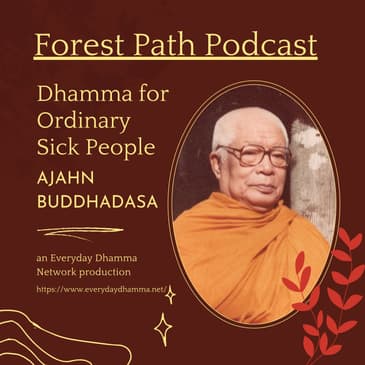
Welcome to the Forest Path Podcast - a podcast sharing the teachings of Awakened meditation masters of the modern era.
This episode is a talk given by the forest meditation master Ajahn Buddhadasa and is titled “Dhamma for Ordinary Sick People” . It was translated by Venerable Santikaro and published for free distribution.
May you all benefit from hearing this gift of dhamma by an meditation master of the Thai Forest Tradition.
This work is licensed under the Creative Commons Attribution–NonCommercial–NoDerivatives 4.0 International License
---
This Dhamma talk is for stimulating the intelligence of people who are ill. Please read carefully and consider thoroughly.
––––––––
Illness Is Ordinary and Natural
Illness ought to be seen as natural occurrences for all physical saṅkhāras (bodies), whether humans or other animals, because saṅkhāras undergo change.2 Whenever there is change, it can be up or down. Upward change feels comfortable and healthy. Downward change creates illness. When physical saṅkhāras get successively older, most of the change is painful and ill. This fact needs to be seen as it truly is: all saṅkhāras are just like this. In short, pain and illness are normal and natural for physical saṅkhāras.
––––––––
Illness Reminds Us to Be Clever
Let us examine the reason why this illness happens. We ought to consider in a beneficial direction, that is, to see that this illness occurs to warn us. Illness doesn't exist to make us suffer or be sad. There's nothing about it to be sorry for or suffer over, which have no benefit because physical saṅkhāras are just like this. Rather, illness is to warn us and teach us to be more intelligent, rather than suffer. Illness informs us to be ready for the ultimate quenching without remainder of dukkha. If we as yet spin around in saṃsāric cycles we necessarily suffer with birth, aging, illness, and death. If you don't want birth, aging, illness, and death to occur, then don't spin around in cycles of saṃsāra.
––––––––
To Go beyond Dukkha, Must Quench without Remaining
Now, illness and fever have arrived to caution you, to demonstrate how life is. If you wish to be free of this sort of existence – namely, illness – you must prepare yourself for quenching without anything left over. This remainderless quenching is the cooling of saṅkhāras that leaves no fuel behind for further birth. Even though the body isn't ready to break up, the heart volunteers for dissolution. To put it directly, we are fully willing to be without Ego from this moment. We volunteer to be free of Ego right now. Our hearts release regarding everything and give up all matters concerning saṅkhāras. End all matters concerning these saṅkhāras so that there's no thinking in terms of Ego and Mine remaining. We are aware that insisting on wandering around within saṃsāric cycles leads to being like this (sick). There's no end to it. If you wish to stop being like this, then quench the feelings of saṅkhāras as being Ego and Mine. With no more feeling that anything is me or mine there's quenching.
––––––––
Don't Take Saṅkhāras Personally
Saṅkhāras naturally get sick. If we cling to them as ‘our saṅkhāras,’ the pain and illness become ours, too. So we suffer, we're sad or disappointed. If we are uncompromising with a new intention, with intelligence and mental fortitude, we commit to letting the saṅkhāras be their own story. Let the saṅkhāras happen according to their own business; don't hang on as ‘mine’ or ‘ours.’ The story of saṅkhāras is they don't last; they're impermanent. Saṅkhāras are dukkha, stressful, and undependable. Saṅkhāras are anattā, without essential or lasting selfhood. What we wish for is stopping, quieting, and cooling, which is the story of nibbāna.
Release Mind into Freedom
Mind must look to see in this way so it doesn't grasp physical matters as being mine or about me. Let physical saṅkhāras get sick or decay naturally, so that they aren't clung to as my pain, my illness, or my death. Mind won't be bound up with illness and death. Instead, mind is freed from pain, illness, and death. In this freedom there's no going and returning within the cycles of saṃsāra.
This is the warning that illness brings us, so that we will be smarter. Illness doesn't visit to make us suffer. It doesn't demand that we suffer. It merely reminds us to be fully prepared for remainderless quenching of feeling there is Ego and Mine. It challenges us to quench Ego and Mine. It doesn't tell us to hurry up and kill ourself, which would be pointless. Instead, it reminds us to quench clinging to ‘me’ and to quench clinging to anything as ‘mine.’ This is what I mean by warning us to quench without remainder. When clinging to ‘me’ and ‘mine’ is quenched, there is nobody to be born, age, feel ill, and die.
––––––––
Preparing Oneself for Remainderless Quenching
Now we will explore in more detail how to prepare ourselves for quenching without remainder. I will divide our preparation into three parts or stages.
Stage One: Review your life and consider how you have completed all the many worldly things that were your role in the world. You did what you needed to do for livelihood, raising children, friendships, and caring for parents. You have finished all your worldly duties. This part of life is completed.
Stage Two: Recollect all the good and wholesome things that you have done in life. You have given gifts and donations, you lived ethically, you cared for and served other beings, you contributed to the public good, and so on. Things of a good and wholesome nature have been accomplished in line with your station and abilities. You fulfilled the opportunity of having been born human. The goodness you could do in life has been completed.
Stage Three: Reflect how that's enough of cycling through such conditions over and over again. That's enough! That's enough of wandering in saṃsāric cycles. If born human, you will go through all the same stuff yet again. Enough then! Even if born a devatā, you will still have to die again, will still go through the anxiety and suffering due to kilesa, no better than humans. That's enough of being born, whether devatā or human. If one accomplishes the goodness and wholesomeness necessary for devatā birth, it's certain that one will be born devatā. However, birth as devatā doesn't mean the end of suffering. There will still be the devatā kinds of kilesa and these cause suffering, too. There will be fear and mental illnesses from kilesa oppressing the heart. That's enough of doing good for the sake of being born as devatā.3
Even if there's birth on a higher level, if occasionally born as a brahma god, there's still ‘self,’ still Ego and Mine, subject to birth, aging, illness, and death yet again. Even brahmas cling to Ego, in fact, more so than ordinary people. That existence is so comfortable and easy that the avoidance of death is more intense. The clinging to Ego and Mine is intense. The more they don't want to die, the more they fear death. These brahmas suffer because of death, although they live for eons.4
Recycling in births as this and births as that – let it go. Whether human, devatā, or brahma, that's enough of saṃsāric migration. Rebirth as human is ‘too much,’ rebirth as devatā is ‘too much,’ and rebirth as brahma is still ‘too much.’ So enough of saṃsāric cycles.
Please reflect along these three lines. The worldly business that a good citizen ought to do, I have done. The goodness and virtue, I have done. Cycling around through saṃsāra, I've had enough. That's enough. Now for quenching without remainder. Time to stop.
Let's review once again that establishing in remainderless quenching and realizing peaceful happiness involves being mindful of and contemplating that all worldly matters – in, of, and for the world – have been completed by you. Second, all the goodness for the sake of birth in another world is also accomplished by you. Then there are no further reasons for being born again. That's enough with saṃsāra and its cycles, enough of all the endless wandering.
All three of these reviews demonstrate ‘that's enough!’ That's enough of worldly activities. That's enough of good and generous activities for the sake of another world. That's enough of transmigrating due to the power of karma (volitional action). Don't cling to karma; don't cling to its fruits; seek only quenching without any remainder. That's enough of enduring the torment of birth, aging, illness, and death yet again. Just stop. That's enough of recycling between death and birth. Volunteer for remainderless quenching, radical calming without any Ego and Mine left over, thoroughly cooled in nibbāna.
Now it's very clear that illness and death are dangers that menace us. We receive them as ours and so they threaten and bite us. These ungrateful beings that we take on as ours then turn around and bite us. If we don't take them as ours, they won't bite us. To conquer these illnesses and death, we must relinquish all clinging in this world. If we continue to like and hope for things of this world, illness and death will continue to threaten us. They will squeeze and torment us, causing us to be afraid, to regret, and to suffer. If we toss them away, no longer nurturing them, such clinging won't be able to squeeze us anymore. Should illness and death threaten us with fear, we won't be afraid. When they come to make us regretful or frustrated, we won't be sorry. When they come to make us suffer, we won't suffer.
Please observe with care that we suffer because of hoping to be in the world, still caught in the world, still caught in the beautiful things that we love and that make saṃsāra pleasing for us. Once we can see that these are temporary, illusory things that trick us into suffering, we won't hanker after such bait, such pretty things, such deceptions, again. We no longer will wish to consume the bait, to enjoy the pleasures and fun of the world, or heavens, or wherever. There's no wish to be born as anything no matter where. They're just illusory stuff that tricks us time after time.
Whenever there's seeing that nothing is worth having or being, whether in this world or others, whether this kind or some other, without exception, the heart naturally inclines to enter santi (peace). This is the calm quenching without remainder, because there's nothing lovely and satisfying to cling on. It doesn't see anything worth wanting or taking. It naturally inclines to remainderless quenching. Please observe well how greatly nature helps us let go.
Right now, examine in your heart that there's nothing in this world or any other worth having and nothing worth being. There's nothing worth taking as ‘me’ or ‘mine.’ There's only one thing worth having or being – the peaceful well-being of calm citta (psyche), quenched without remainder. Mind is cool in nibbāna because mind doesn't cling to anything to create kilesa or anxious agitation. It lets go of all clinging that creates agitated friction. This is the meaning of liberated mind, peaceful heart, and cool nibbānic psyche.5
Nibbāna is experienced and clearly known as this heart cooled because there's no heat in citta, there aren't any kilesas of citta, there's no clinging to cause any kilesas. This absence of heat and fire, and of wandering in cyclic existence as this and that, is the coolness of nibbāna. However change occurs, no birth, no aging, no illness, and no death occurs. There's no birth, aging, illness, and death that's Mine, because there's no Ego. Quenching Ego is to thoroughly quench in coolness. Ego is where heat sets up shop. Quenching Ego is coolness.
Look well into how illness has come to warn us: that's enough. That's enough of wandering around in saṃsāric cycles. Seeing the danger in illness, seeing the danger in death, don't fall for the bait that causes illness and death. That is, don't cling to anything; don't hope for having anything as Me or Mine in the world. Look forward only to peace, the calming and cool quenching of nibbāna. No more transmigrating again.
This is the supremely appropriate time for cultivating clear, bright understanding that is correct concerning saṃsāric cycles. This is the opportunity to know birth, aging, illness, and death thoroughly. Recall the Buddha's words, ‘Relying on us as kalyāṇamitta (splendid, noble friend), transcend birth, aging, illness, and death.’ How does one transcend birth, aging, illness, and death? No Ego. No Mine to take birth, aging, illness, and death as Mine. Release birth, aging, illness, and death into quenching as nibbāna. No more saṃsāric cycles. Please make the most, the highest benefit, of this time.
This concludes a Dhamma teaching for reminding those of us who are seriously ill.