
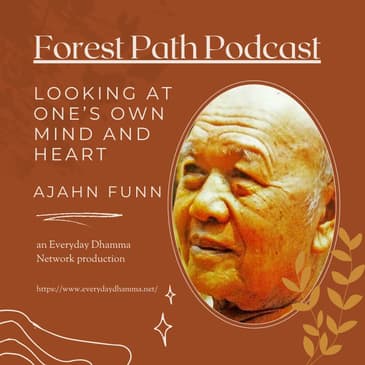
This episode is a talk given by Ajahn Funn Ācāro and it’s titled “Looking at One’s Own Mind and Heart”.
---
[00:00:00] - [Speaker 0]
Welcome to the forest path podcast, a podcast sharing the teachings of awakened meditation masters of the modern era. I wanna start this episode by saying thank you to everyone who has been supporting the podcasts in everyday dumber network via the Ko fi donation platform. That's both our regular donors from month to month and our once off donors. It's really helped keep things going, and it's really worthwhile offering a donation this way. During July 2026, we had 35,845 downloads, so these donations are going a long way to sharing Dharma with other people.
[00:00:43] - [Speaker 0]
This week's episode is a talk given by Ajahn Fang Acharo, and it's titled looking at one's own mind and heart. May you all benefit from hearing this gift of dharma. Looking at one's own mind and heart by Lumpur Van Aacharo. Sit and make yourself comfortable. Sit in meditation posture, your right leg on top of your left leg, your right hand on top of your left hand.
[00:01:21] - [Speaker 0]
Establish your body in comfort. What we want is a state of pleasure and ease. Let go of posturing and predilections and make yourself at ease, dignified and majestic, happy and clear. You don't have to push or pull, let go and be at ease. Once our body is at ease, let the heart go into a state of ease.
[00:01:50] - [Speaker 0]
When our heart is at ease, recollect the qualities of the Buddha, the qualities of the Dhamma, and the qualities of the Sangha in the heart, firmly confident right there. Thus, you can reflect on the meditation words Buddho, Damo, Sangho, Buddho, Damo, Sangho three times. Then reflect on the single word: Buddho. Buddho. Close your eyes.
[00:02:29] - [Speaker 0]
Close your mouth. Recollect in the heart. Buddho is knowing. And where does knowing abide? Our eyes focus on the place that knows Buddho.
[00:02:45] - [Speaker 0]
Look intently at what we want to know. The ears go down to listen at the place of knowing. Our mindfulness is fixed on contemplation. Look at the knowing right there. Don't send the heart out ahead or bring it back behind, to the left or right, above or below.
[00:03:08] - [Speaker 0]
Establish it right in the midst of the knowing. Where does knowing abide? We're focused right there. You don't have to search for it. Let everything go.
[00:03:23] - [Speaker 0]
We're looking at that knowing. Right here. We will thus know what our refuge is. When our minds are peaceful in concentration, established completely within, clear, we feel light, lightness within ourselves. When the mind is peaceful, having dispelled suffering and difficulty, having dispelled oppression and irritation, there is only lightness, there is only ease.
[00:03:56] - [Speaker 0]
That is our home. This here is called wholesome kamma. When our mind has a sense of lightness and ease, it will bring forth happiness and development. It will gain skillful means in discernment. Knowledge and intelligence arises right there.
[00:04:17] - [Speaker 0]
In that state of rest, we will gain strength. Our mindfulness, our concentration, and our discernment arises from that. They don't arise from some other distant place. We know right here. Our minds are dark, obscuring that which knows.
[00:04:40] - [Speaker 0]
Buddha translates as that which knows. We want to know how it is that which knows is dark. It's there. It's dark. We grasp and take up that darkness as ourselves.
[00:04:57] - [Speaker 0]
If it's bright, we grasp and take up that brightness as ourselves. Here, this is how it is. When it is suffering, we actually grasp and take up that suffering as ourselves. We don't establish that 'that which knows suffering' is there. Suffering is one thing.
[00:05:19] - [Speaker 0]
That which knows is another thing. It's relaxed. There is that which knows, relaxed and indifferent. That which knows can't really be anything. Like Buddha is that which knows.
[00:05:36] - [Speaker 0]
It is above everything in every way. This kind of knowing. If there is darkness, it knows. If there is delusion, it knows. Tanachan man, he used to say he used to proclaim it really loudly.
[00:05:52] - [Speaker 0]
He would say, whoever studies and learns up to the point of avija will come to the point of stopping. Up to the point of avija, whoever has arrived at avija he would talk like this: Whoever which knows avija. There, this is the arising of vija, clear knowing. Avija is not knowing. Vija is knowing, seeing truly.
[00:06:28] - [Speaker 0]
Here, it's like this. We focus in on looking at that which knows. This knowing isn't something that can break apart or be destroyed. It is not something that can disappear. If you know it a little bit, you know it thoroughly.
[00:06:45] - [Speaker 0]
Thus, it is said that Buddha is that which knows. We want to know how it is. If there is pleasure, we grasp at the pleasure. There is that which knows pleasure. If there is suffering, we grasp at the suffering and take it as ourselves.
[00:07:04] - [Speaker 0]
There is that which knows suffering. We are people who grasp and take up everything. Here, that's why it's said that we want to know how things are. Everything there is, nobody makes it or creates it for us. We create everything for ourselves: happiness, suffering, good and evil.
[00:07:26] - [Speaker 0]
Like the doctor says, we don't have a chance. Right now, what do we have? Sitting here right now, we have nothing but complete opportunity. Just look at this single heart. Here, this is where you have to look and listen.
[00:07:44] - [Speaker 0]
Where does it get stuck, this heart of ours? Bhave Bhava Sambhavanti. We know our state of being, our place of abiding. Bhava translates as state of being. We develop our state of being in this meditation.
[00:08:04] - [Speaker 0]
Bhava translates as state of being. Lesser states of being or greater states of being wherever we go and grasp. There, states of being abide right there. Grasping at pleasure, right there, it is a state of being. Grasping at suffering is a state of being.
[00:08:25] - [Speaker 0]
Grasping at goodness is a state of being. Grasping at evil is an evil state of being. Grasping at pain and suffering is a painful state of being. Grasping at pleasure and happiness is a pleasurable state of being. This is our place of abiding.
[00:08:43] - [Speaker 0]
Ata no nato. Oneself is one's own refuge. When our mind is at ease, we obtain a refuge that is at ease. When our mind is not at ease, we obtain a refuge that is not at ease. Here, it is like this.
[00:09:02] - [Speaker 0]
You should know this and see this. A practitioner knows themselves, sees themselves. It's not somebody else who sees. We are the ones that see. Know and see with clarity of vision.
[00:09:17] - [Speaker 0]
You will thus dispel doubt in states of being. Lesser states of being, greater states of being, those near and far, within and without, this person here is absolutely the one who grasps, this person here is absolutely the one who clings. Know this. Hell doesn't exist with regards to tree or mountains, in the earth or in the sky. Hell means suffering.
[00:09:46] - [Speaker 0]
What is suffering right now? If our mind is suffering, just that is the substance of hell. Hell means suffering. One state of being is like that. Heaven means happiness.
[00:10:01] - [Speaker 0]
If our mind is happy, we obtain a mainstay that is happy, at ease and cool in the heart. Having dispelled suffering, dispelled difficulty, dispelled hardship and aggravation, Without danger or ill will, without evil states, there is only lightness, ease, and clarity within that which knows. Release from suffering. We want release from suffering. We have to know that whatever things are suffering, those things are not ourselves at all.
[00:10:33] - [Speaker 0]
We go and grasp at them. If we want release from suffering, focus and look. If our mind experiences suffering, we are not released from suffering. A mind released from suffering does not suffer, that is, it has completely abandoned and given things up. When it has abandoned and given things up, just that is released from suffering right there.
[00:10:58] - [Speaker 0]
It doesn't get released anywhere else. This person here is suffering. We should all focus and look in order to know. Focus right down. Bring things right down to certainty.
[00:11:12] - [Speaker 0]
Bring things right down to confidence. A practitioner knows themselves, sees themselves. How could we not see? Our mind, when we are at ease, we know. When we are not at ease, we know.
[00:11:31] - [Speaker 0]
Ow. Now each person, each listener, how have our hearts gotten the message? Investigate in order to know. When we hear any sounds, know that those things don't pose any danger, then we won't get agitated. Be determined to look at that knowing of ours.
[00:11:51] - [Speaker 0]
If we want happiness, let our mind go into a state of ease. These fabrications are all things that are uncertain. Fabrications are simply oppressive. We focus our mind only on the single that which knows. Here, our inner essence is that which knows.
[00:12:11] - [Speaker 0]
That which knows that consciousness does not create states of being and birth. Where are they created? Wherever we have gone and grasped at things, that's where they arise. All we have is this moment right now. To experience happiness or suffering, they have to be built up right now.
[00:12:32] - [Speaker 0]
We can only act right now. Because of this, we will sit in meditation and see that our mind has fallen into some level or plane, like wholesomeness within the realm of sensuality. The central realm is differentiated into two sorts. It is differentiated into the plane of deprivation as one and to the six heavens of the central realm as the other. How can we know that we have differentiated ourselves into the plane of deprivation?
[00:13:02] - [Speaker 0]
Our mind is suffering. Our mind is not good. Our mind is tarnished and sullied. Our mind is chaotic. This here is the path to the plane of deprivation, the path to hell.
[00:13:17] - [Speaker 0]
Our minds are clear. There is an expansiveness with happiness and delight. This is the six heavens of the central realm. At this point, we should These things are not certain. These things are oppressive.
[00:13:32] - [Speaker 0]
They are not self, not our identity. We only see the externals. There is no essence to these things, no fundamental core. We can abandon them. We come to see the fabrications of the physical body just like this.
[00:13:48] - [Speaker 0]
We come to see only this form, feeling, perception, fabrications, and cognizance. Come and see the body of this individual state. It all arises from this. We come and investigate the fabrications of this physical body of ours, this namo. It doesn't have an essence.
[00:14:10] - [Speaker 0]
It doesn't have a fundamental core. Na, that is, things like pitang semhung pupo lohitang sedo medo vasa kalo synganika lassica and muttung These things are all garbage. They aren't desirable things. The fabrications of this body of ours aren't an essence or a fundamental core. There's just a pile of oppression.
[00:14:49] - [Speaker 0]
It is not a self or an identity. It is not a being or a person. It is not us or them. We abandon the state of being connected with form, bringing us to a formless state of being. All that remains is a single mind.
[00:15:05] - [Speaker 0]
We see only a single mind, clear and completely empty. That is called the formless state of being, a level of Brahma. If we know that these three states of being are still suffering states of being. We abandon defilements, abandon craving, lust, and greed even if they grasp things only a little bit. In these states of form, the mind will completely let go.
[00:15:37] - [Speaker 0]
There's not even a little bit of anything left. Darkness and brightness don't exist. This is vimutti, complete liberation and release. There, we enter into parinibbana. There is no birth, there is no ageing, there is no affliction, there is no death, there is no suffering.
[00:15:58] - [Speaker 0]
There isn't anything. Fabrications don't exist. We have brought things to complete cessation already. There isn't anything. Issues of conventions or suppositions don't exist.
[00:16:11] - [Speaker 0]
Thus it is said that vimutti translates as complete liberation and release. This point is something that one has to know within oneself. To keep describing it like this, it's only convention. This here is convention. You have to know the way of the path.
[00:16:30] - [Speaker 0]
The ultimate fruit is vimutti, liberation and release. Now sit and look at your mind, dwelling in whatever level and plane. If I keep describing things, all you get out of coming here is the sound of my voice. That concludes the Dhamma teaching, looking at one's own mind and heart by the venerable Ajahn Phan. If you'd like to hear more talks by other meditation masters of the forest tradition of Theravada Buddhism, subscribe to the forest path podcast using your favorite podcast app.
[00:17:12] - [Speaker 0]
The forest path podcast is part of the everyday dhamma network. If you go to the everydaydhamma.net homepage, you can discover more about the other podcast on the network. This podcast is produced and narrated by Solhana. If you like these audio resources that I'm making available for free in a convenient podcast format, you may wanna become a supporter of the Everyday Domain Network on the Ko fi Creators platform. There are links in the description below.
[00:17:43] - [Speaker 0]
Thank you for listening. May you all experience insight and peace.