
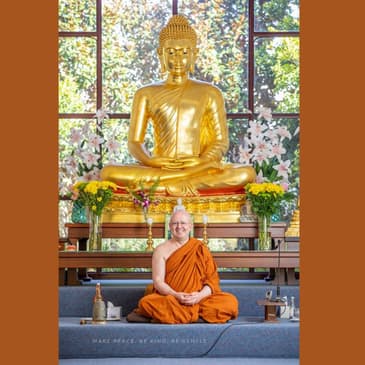

This guided meditation by Ajahn Brahm was originally recorded in 2nd January 2010. It includes a talk about some aspect of meditation followed by a 45 minute guided meditation.
This guided meditation has been remastered and published by the Everyday Dhamma Network, and will be of interest to people who have started meditation but are seeking guidance to take it deeper.
These talks by Ajahn Brahm have been recorded and made available for free distribution by the Buddhist Society of Western Australia under the Creative Commons licence. You can support the Buddhist Society of Western Australia by pledging your support via their Ko-fi page.
[00:00:00] - [Speaker 0]
This is the ongoing meditation class. The introduction to class is in the room to my right. Because in this class, we usually sit for about forty-forty five minutes and that's a tough ass for someone who's just starting. And also that it's helpful to get the fundamental teachings of meditation in your head first of all because in this class we just take one particular aspect of meditation, focus on that and so you come week after week after week you hear something different every week and that will actually enhance the depth of one's meditation. The last time I was here about a couple of weeks ago or three weeks ago, so I'd just been off teaching a meditation retreat in Penang.
[00:00:39] - [Speaker 0]
I was talking about why it is the mind wanders off to some other things because we don't put sufficient value in our chosen meditation object. In other words, you can start with the present moment, but if you don't really value it, then you get involved in the past and the future because you think the past or the future is more important. That's why the mind goes to the past or future. Or say on the breath, the reason why you can't stay on the breath is because it's just the breath. So what?
[00:01:07] - [Speaker 0]
These other thoughts, feelings or whatever you feel are more important for you. That's why you can't stay. Whatever you find more important is where your mind naturally will stay. But I've already talked about that. I'm gonna talk about another angle of how to stay in the chosen meditation object.
[00:01:27] - [Speaker 0]
How to give things more value. How to cultivate the mind in a skillful way. To be able to keep the mind still without keeping it tense. And that is the magic ingredient of kindness. Now one of the things I noticed in my early meditation practice, I looked back about on it and thought how stupid I was, is that I always thought I was the master of my body, the master of my breath, the master of my mind.
[00:01:57] - [Speaker 0]
So to me, I regarded my body as a slave, my mind as my servant, and my breath is something I could put under my control completely. And that was a big mistake. Because if you treat your mind, body, or say your breath like that, it will rebel after a while. Just the same if someone treated you like that. You don't want to be told what to do and how to do it.
[00:02:23] - [Speaker 0]
And actually neither does your body, your mind, or say the breath. So when I looked at how I was treating these meditation objects, I realized that regarding them as a slave, being a power broker over these things, controlling them was not the way to keep them in your mind for a long period of time. In the same way, if you try and control your partner, control your friend, they will run away at the first opportunity. Just as you don't like being told what to do, neither does your breath, your mind or your body. But of course, there's another way of creating friendships that last.
[00:03:10] - [Speaker 0]
Having people around you for a long, long, long time arises because you are kind and warm and respectful to your friends. If you're kind and warm and respectful to the people you meet, they do become your friends and they last as your friends. So I use the same analogy to learn how to create this stillness in the mind. At the beginning of my meditation, instead of trying to dominate my body, I regard my body as a friend, someone I have to work with rather than something I have to control. So I'm kind and considerate to my body.
[00:03:51] - [Speaker 0]
I value it enough to ask how it is. And actually I've taught that on some of these Saturday meditations. You close your eyes and you ask your body: how are you? What do you need? Now the legs, how are you going down there?
[00:04:06] - [Speaker 0]
No back, how do you feel? So you don't tell the body this is how you're going to sit. You ask it and cooperate with it because you know sometimes your body feels it really needs to be straightened up. That's the body tells me, yeah, please straighten me up because that's how I feel good. Sometimes, no.
[00:04:24] - [Speaker 0]
He said, my body wants to slump. He said, body, if you want to slump, that's fine with me because I am not going to be your boss and controller. I'm going to treat you as a friend. And when I'm kind to my body like that and treat it with respect, my body usually cooperates. You know, it is nice and still and peaceful and usually trouble free.
[00:04:46] - [Speaker 0]
But if I'm fierce with my body, and say I'm going to sit like this and I'm not going to move for forty five minutes, that's when my body gets very tense and it does hurt. So just treating my body like a friend, like I would treat any of you. I never tell anyone in this meditation class, 'be straight, don't lean forward, don't lean to the side, come on.' So meditate more strongly. I don't order people around I don't order my mind around and my body around. I just work with it, be kind with it.
[00:05:19] - [Speaker 0]
And then I find my body relaxes. Have you ever been with someone who's a control freak, maybe your boss at work always tells you what to do, you get tense in their presence. So you can imagine when the body gets tense in your presence because you want to tell it what to do and how to do it. So when you're kind to this body, as I say, ask it questions. How are you feeling?
[00:05:42] - [Speaker 0]
Do you want to sort of move your legs more forward? Or backwards? Or do you want to scratch me? Or do you want to do something else? Do it.
[00:05:49] - [Speaker 0]
Treat your body as a friend. And then once the body settles down, as it does very quickly with that type of attitude, Then you start looking at your mind. Example, the present moment. This obviously I keep on saying this is one of the first and most important stages of the meditation. A platform for where the other meditation states can grow.
[00:06:11] - [Speaker 0]
In the present moment, again why can't we be in the present? It's not just we don't value the present moment, it's because we're not kind to it. So I look at this present moment just like a being. And I don't try and control the present moment, especially don't try and control the contents of the present moment. You'll be aware of this, you'll be aware of that, you'll do it this way, you'll do it in that way.
[00:06:32] - [Speaker 0]
And I'm just kind to this present moment. I look upon this present moment like a really good friend. And here's my present moment again. Wow, we've had such great times together. Come on, let's hang out together.
[00:06:42] - [Speaker 0]
And when I don't control the present moment, I have this beautiful feeling of kindness and friendship towards it, it stays a long time. It doesn't run away from me. I'm not its master. I'm its friend. And just that very attitude changes a lot of how the meditation feels and how it progresses.
[00:07:06] - [Speaker 0]
It really is like a companionship, me and my present moment. Of course, the present moment isn't a living being, you know, like your pet dog or like a friend or like a dear relation. But you can actually anthropomorphize. You can regard it and put a perspective. This is my friend to my present moment.
[00:07:27] - [Speaker 0]
And if you can develop that attitude, you find meditation gets much easier. The present moment stays because you're regarding in a very beautiful way. And just as I said a couple of weeks ago, when you give value to something it stays. Friends are valuable. You love being around them.
[00:07:45] - [Speaker 0]
So your breath becomes something you just love being around and therefore it does stay. And even things like silence. Silence is just a fragile thing when it arises in the mind that too often that people tense up around it. At last they're quiet, they're not thinking, and they grasp onto that silence and try and control it. Remember, all control is a sign of a master slave relationship.
[00:08:10] - [Speaker 0]
And so if you regard any of these meditation objects, you know, it's yours to wreak your will on, you know, yours to control and do what you wish with, it's never going to work. You're controlling, you're not relaxing, you're not letting go. So the idea of this is the friend and companion, the silence, It's just a very delightful friend who sometimes only visits rarely, but wow, I really love this guy or this girl. Regarding it as a friend means you relax in its presence. It relaxes in your presence too.
[00:08:46] - [Speaker 0]
And you find that the silence could stay a long time. But you never try to master it. You befriend it. And of course, that's even more important with your breathing. You befriend the breath, rather than try and hold on to it, control it as if it is a possession, which you have full rights over.
[00:09:09] - [Speaker 0]
You give rights to your breath to come in and go out the way it wants, to come in fast or come out slow, whatever it wants to do, to hang out with your breath as you enjoy each other's company as you do with an ordinary friend. But you don't try and master the breath. You don't sort of stop, you know, your friend going away for a few minutes if he wants to. If he wants to go to toilet or wants to go somewhere. So if it disappears, you don't get angry with it.
[00:09:40] - [Speaker 0]
Now your stupid breath, your stupid mind, you haven't been watching properly. You haven't been mindful. You allow all these things to be. And with that feeling of friendship towards your breath, no control, but just hanging out together as you do with real friends, you will find that the breath will stay with you far longer. Until you do get to that, I keep on calling the tipping point, Because you relax and you're enjoying the company of a good friend, your old breath, it does turn into the enjoyable or delightful breath.
[00:10:19] - [Speaker 0]
And once that happens, there's an intrinsic value in your meditation object. It holds you. You don't have to put any effort into holding it. The friend is so delightful, so wonderful, you can't keep your eyes off her or him. That is actually how the meditation works.
[00:10:37] - [Speaker 0]
And it's also like getting this wonderful attitude, not of control, but of befriending. The beautiful Buddhist attitude of freedom, no control or craving, being kind, befriending, and using compassion as a glue which sticks not just people together, but sticks together you and your meditation object. It's a way of friendship. So that's another angle on the meditation which you can experiment with today. And each of these different aspects of meditation, when they all combine together, make you a very skilled meditator, and someone who can enjoy the beauty and peace of meditation when it really works.
[00:11:19] - [Speaker 0]
Any comments or questions? Okay. So let's give it a try. So closing your eyes, becoming aware of your body and its physical feelings. And it's like you and your body have just met.
[00:12:07] - [Speaker 0]
Yeah. You've had your body a while. We've been busy doing other things. So now you ask your body, how are you going? How are you?
[00:12:15] - [Speaker 0]
And just listen to what your body asks of you. You can even inquire more specifically, body, legs, are you happy down there? And just like a friend, if a good friend comes to see me and say, do want a cup of tea? How do you how are you? Where do you want to sit?
[00:12:35] - [Speaker 0]
Ask your body what it needs as you treat your body like a dear old friend. And of course, if your body says, yeah, want to be moved. I want to be fidgeted. Then do so. You are not the master or mistress of your body.
[00:12:55] - [Speaker 0]
You are its friend. How's the bottom on the cushion or the chair? What about your back? It's amazing because we ignore parts of our body. That's where they a) can get sick.
[00:13:12] - [Speaker 0]
So pay attention to, say, your back and shoulders. Anything I can do for you? Ask to help your dear friend. Your arms and hands and fingers, are you being friendly towards those, paying attention to them, and seeking to find out what they need and give it to them. And even your head and your brain, These are your friends, not your tools or your master your your servants.
[00:13:59] - [Speaker 0]
So that way you have this beautiful attitude of mindfulness, attention to your good friend, kindness, and just happiness, happy to be together. So you're happy to be with your body in these first few minutes. Just hanging out together. When the body's comfortable, and turn to the present moment, this wonderful friend called now, asking how are you now, I'm not trying to control the present moment, but just delighting in its company. Doesn't matter what you're experiencing now, my voice, other sounds, heat, cold, pain, pleasure.
[00:16:42] - [Speaker 0]
Treat all this as a friend, with all its idiosyncrasies. Someone not to control, but to be kind to. I'm paying so much attention to your friend, the present moment. The past and the future just vanish. If you go into the silence, befriend the silence.
[00:21:13] - [Speaker 0]
As you go into the breath, make friends with the breath. Making friends mean you value and are kind to these things, and that's how they stay. It's getting very close to the end of this meditation session. How's it work today? Did the perspective unfriendliness help when it was applied?
[00:55:29] - [Speaker 0]
How peaceful are you, And what does that feel like? As you learn in the last minute or two of meditation, the insights which come from the experience of peace and freedom and the insights which come from understanding how does peace and freedom come about. I am now going to ring the gong three times. Please listen to every sound from the gong. When the last ringing of the gong fades away, open your eyes to end the meditation.
[00:57:16] - [Speaker 0]
Okay. There we go. So hopefully for some of you, that little extra trick of treating every moment like a friend rather than a slave may have helped you as long as you kept it in mind and didn't go back to old habits. If meditation is about the art of being still, then for stillness we may need to find a method of not needing to move. Not forcing oneself to be still, but holding oneself rigid is very uncomfortable.
[00:57:54] - [Speaker 0]
But not finding any need to move is incredibly free and liberating. So be able to find that cause for non movement is in contentment in the moment, which is born of the friendliness and kindness which one gives to whatever one is experiencing now. The letting go means not being in control. And a beautiful way of achieving that is to make friends with things, and never regard them as your slave. So, are there any questions or comments about the meditation today?
[00:58:35] - [Speaker 0]
Just to let people know that because I have to go after another appointment, leaving at 04:30, I won't have much time to answer personal questions after the meditation session is finished. So know that very often you ask for questions at the end of a talk or a meditation session, and no one puts their hands up, no one's got any questions, and as soon as we finish, there's a whole line of people wanting to ask their questions. So if you have a question, please ask it in front of everybody, rather than person, because I won't have the time today. So they all understand how to meditate. So when it's very hot, like it is today, are you darling sleepy?
[00:59:22] - [Speaker 0]
Remember, like yeah. You got a question I'll ask. Yeah. Settle down. That's a very interesting experience.
[00:59:44] - [Speaker 0]
For those who didn't hear him, he said when he decided to friends and just let his mind go, it ran around a bit. And then when it sort of tied itself out, it settled down. It was pretty peaceful. Did I get that right? That's a great experience because that is exactly what happens.
[00:59:59] - [Speaker 0]
You've all heard me, seen me do this before. Keeping the glass of water still, if you hold it, it'll never get still. But watch carefully. When I put it down, see how still it is now? When I put it down, it always moves a bit more.
[01:00:13] - [Speaker 0]
So when you do let go, you can always expect a little bit more restlessness, more restlessness than usual, you know, when you control things. So that when you do let go, you could expect a bit of running around, a bit of restlessness. But I call that the result of old karma. You've been busy, busy, busy. You're holding it back and now it has to, like a spring, go off and do what it needs to do.
[01:00:35] - [Speaker 0]
But because you're letting go, because you're allowing it to be, because you're being a friend, are, while the mind is running around like that, you are creating the causes of future stillness. After a while, the mind settles down and becomes very, very peaceful. That's what I always find. If I sort of try and control my mind, it's very easy to stop the mind wandering, but it gets very stiff. But if I just let the mind go, making peace, being kind to it, being a friend to it, When you meditate, it runs around a little bit, but not that long.
[01:01:04] - [Speaker 0]
And it gets slower and slower and slower and slower, until it really does settle down. So we're good. Get insight from that experience, because that's a powerful way of meditating. Let the thing be. Yeah, sure it runs around a bit, or it's a bit sleepy for a while, but then it wakes up.
[01:01:22] - [Speaker 0]
And when it does wake up, or when the resistance does disappear, because you're a friend, everything gets calm and peaceful. You can get great meditations that way. Any other questions? Yeah, so even if it's physically uncomfortable, like it's too warm or too cold, You can again be a friend to the heat, a friend to the cold. Because if you can't change it, you know what they always say, if you can't beat them, join them.
[01:01:55] - [Speaker 0]
If you can't change the cold or the heat, be a friend of it. And this is what I was taught as a young monk. Some of you know these old stories. About Jia Cha's monastery during the hot season, maybe we'd get up to the low thirties, never get up to forties outside. But after our one meal of a day, we didn't have breakfast in those monasteries, one meal a day of sticky rice and usually rotten fish curry.
[01:02:26] - [Speaker 0]
You know, you had to eat quite a lot, put a lot in your stomach, because it had to last you twenty four hours. And after we finished the meal, maybe about 10:00, 10:30, we ate very early, then we all had to put on not just this robe, but our spare robe, double thickness robe, and go and sit, meditation for two hours after lunch, in what used to be called the Old Hall, the Old Sala. Which was a building maybe about, well maybe only about a tenth of this size, with a low metal roof with no insulation. The sort of place like the Japanese will put their prisoners of war during the second world war to torture them. You're sitting there, sweat pouring off you, it's just so hot.
[01:03:14] - [Speaker 0]
But after experiences like that, you never feel afraid of heat in Australia. Because it just what he's doing, they say, oh, yeah. See, some people love doing that, you know. They go they call it saunas. So anyway, what you were doing said that you can't fight it.
[01:03:33] - [Speaker 0]
You can't sort of get angry or argue with a person like Atento. So what can you do? Just make peace with it and be friends with it. And if you're friends with it, it's not that bad. Or sometimes you've been in very cold countries.
[01:03:46] - [Speaker 0]
Even just last October, I think we went to Oslo for teaching for a day or two. And that was, I think, zero degrees in the middle of the day. And it's really cold. So what can you do? You can't do anything except make friends with the cold.
[01:04:01] - [Speaker 0]
And when you make friends with the cold or friends with the heat, it doesn't affect you so much. But when you're an enemy to it, I don't like the heat, I hate the cold, then of course you're creating tension. And that's the worst problem. Sort of making friends with the tiredness in your body, the heat outside, the noise of actually the dogs are very quiet today. Whatever it is, make friends with these things, and then they're no longer a problem to you.
[01:04:30] - [Speaker 0]
And then you can stay without being restless. Okay? Make sense? Okay. This is the last chance for any questions.
[01:04:44] - [Speaker 0]
Going. Going. Okay. Gone. Okay.
[01:04:50] - [Speaker 0]
We finished five minutes early. I know you have some questions, so finish five minutes early so you can come up and ask them personally. Okay. We'll pay this veto for the Dhamma Sanghana.