
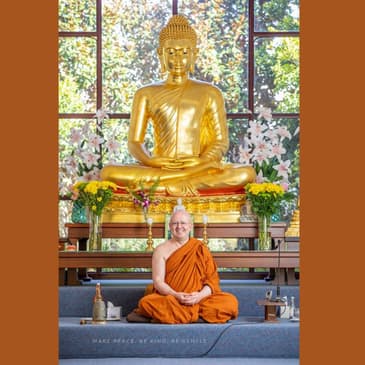

This guided meditation by Ajahn Brahm was originally recorded in 14th July 2007. It includes a talk about some aspect of meditation followed by a 45 minute guided meditation.
This guided meditation has been remastered and published by the Everyday Dhamma Network, and will be of interest to people who have started meditation but are seeking guidance to take it deeper.
These talks by Ajahn Brahm have been recorded and made available for free distribution by the Buddhist Society of Western Australia under the Creative Commons licence. You can support the Buddhist Society of Western Australia by pledging your support via their Ko-fi page.
[00:00:00] Welcome everybody to the Southlands Meditation class. And as usual, anyone who's coming for the Introduction to Meditation class, the one where you learn meditation at the very beginning, that class is held in the room to my right. This is the ongoing class. And many people, when they start learning meditation,
[00:00:23] meditation, sometimes they begin with doing mindfulness of the body practices. Mindfulness is obviously the awareness to see exactly what is going on, the awareness to the reality in front of you, which sometimes gets obstructed because one is thinking of something else, or that one is dull and one can't see clearly. And some of those meditations on the body can be confused.
[00:00:53] It's what people call insight practice, you know, just when you're lifting up something, you know you're lifting it up. But really that's, I always call that like a mindfulness of the body, to know how the body is moving, to know how the body is sitting, to be able to feel the body, to use the sensations in the physical body, focusing on those to make yourself aware of the body. I always take those, and I think in my tradition of Ajahn Chah, they take such things as mindfulness of the body,
[00:01:22] because it's the body which is moving, the body which is picking things up. And you know exactly what you're doing by recognizing the sensations, the physical sensations. And it is a very good beginning to one's meditation practice. It's certainly not the end, because you do get a certain amount of stillness by being mindful of the body. But you need to go much deeper to get the stillness of the mind.
[00:01:50] But we can never get any stillness of the mind until we have the mindfulness as a basic power, a basic force with which we can guide our meditation. Now one simile for mindfulness is like going in the car, and it may be a dark night, and you may also have a dirty windscreen. If your windscreen is dirty, and it's dark, and your headlights aren't working, of course you can't see where you're going.
[00:02:19] And of course if you can't see where you're going, you know you can crash into things, you can take wrong turns, you can get lost. And that's what happens when you're meditating, you're not getting anywhere, you know you're getting even more tense, or whatever, but you're not going in the direction which meditation is supposed to be taking you, in the direction of peace and stillness, and alertness and happiness. So what one must do is to make sure that one's got a clean windscreen,
[00:02:48] and that the headlights are on, so you can see what's happening, see where you're going. And that ability to see where you're going is what mindfulness, what its job is. The clarity of your awareness, so you can see whether you're going this way, whether you're going that way, see where you are, see how things are happening, to be able to assess what's going on. Now the problem is, so we all start meditation with a dirty windscreen. It could be thinking about so many things.
[00:03:18] and we're dull, our mind isn't bright yet, the headlights, the battery is pretty weak, it needs to be charged. So it does take a time to actually empower the mindfulness enough to see where we're going. I know when I first started teaching meditation, you just start straight on the breath, okay, close your eyes and watch the breath go in and watch the breath go out. But I've found that many people, their mindfulness is not sufficient to be able to watch that breath.
[00:03:47] with the ordinary mindfulness they use in daily life. They can only watch one or two or three breaths at most and then they start thinking about all sorts of things, drifting off, even falling asleep because the windscreen isn't clear enough, the headlights are just too weak. And the mindfulness of the body is a great way of increasing the power of your headlights and wiping the windscreen clear of all that grime and dust so you can see clearly
[00:04:16] what's going on. It's a gradual process of becoming aware of how you're sitting, becoming aware of the feelings and sensations in the body. It gives you something solid to look at which can be interesting. There's many things going on there. Unfortunately, if you do have bodily sicknesses, sometimes that can cause you problems if you focus on a sickness or a pain or an ache which has been there a long time and it's hard to get rid of,
[00:04:45] sometimes that's the last thing you want to do when you meditate because you're aware of that ache and pain all the rest of the day. But for people who haven't got such chronic problems or difficulties, the mindfulness of the body is a great place to start because it gets your mindfulness started. It's mindful of something which is more solid, more interesting. The breath can sometimes just be too refined at the beginning. So understanding that,
[00:05:15] for many years now I've asked people when they sit down, when they close their eyes to be mindful of your body first of all, how you're sitting, where the legs are, where the hands are, how the back feels, how the head feels, whether you're smiling or whether you're frowning, to actually get to know these sensations in the body. Enough to become aware of them. Now this starts to establish mindfulness. And it makes it interesting
[00:05:44] because there's always something going on in your body and each here and eight there. And as one does become mindful, say in each, and I've got an inch on my nose, as soon as you become a bit of mindfulness on the body, it's contagious, nose itchy, someone else has cut the nose on the head. And as soon as you become aware of that body, first of all, the mindfulness
[00:06:13] starts to get focused. And it's a focusing of mindfulness on one thing or the small area which actually gives it strength. It's what starts to increase its power. So, at the beginning of our meditation, we do the body awareness and it's not just to say, oh, I've got to be sitting comfortably and let's make sure I'm sitting comfortably. It's not just for the sake of comfort during the meditation period that you put the first few minutes
[00:06:42] on your body. The purpose is that but it's also establishing a beginning point of mindfulness on your body, feeling its sensations, knowing how you're sitting, knowing where your toes are, where your knees are, where your butt is, how your back is, whether you're leaning back or leaning forward, how your arms are, where your fingers are and even where your head is positioned. You start to become aware of that.
[00:07:13] As you become aware of that, it's enough there to interest you. It gives time for mindfulness to focus and also build up its strength. And it is true that you all notice this when you close your eyes, when you first look at the body. not much to see, so you think. But after a few minutes of focusing and actually looking at your body, you start to feel it with more clarity. You start to see more things going on there. You become more sensitive
[00:07:42] to the feelings in the body and the position in the body. What's happening there is your mindfulness is increasing in its power. And another thing that you can do when you do this beginning of mindfulness of the body, is not just knowing what's going on. If you find any ache or pain in the body because you're in a bad posture, that you haven't put your bottom comfortably on the chair, or you have got an itch somewhere, or a little bit
[00:08:12] of a pain because you have a belt which is tightened too hard, too tightly, if you notice something, you do something about it at the beginning of the meditation. And even if you can't physically do something about it, even wishing goodwill, happiness, relief to an ache or a pain in the body can be very, very effective. Now just remember that sometimes when you go and sit for many, many hours in meditation,
[00:08:42] sometimes, you know, I'm getting old now, my joints aren't as loose as they used to be, you can still focus on a part of the body so your knee is aching and you can just put attention down there and just not with hard will but with kindness, you just almost like massage it with your mindfulness and just as the pain disappears and there is strong mindfulness. And that's, you may not be able to do that much but at least you can ease the aches and pains in the body simply by focusing on them,
[00:09:12] being aware of them, filling your mind with just that feeling and adding the ingredient of kindness, compassion, care to that part of the body. And it works, it eases the body. So that beginning of mindfulness to the body starts to build up mindfulness, starts to include the attitude of kindness and care and at the same time it relaxes the body, it comforts many of the aches
[00:09:42] and pains, it brings a greater sense of ease to the body and by the time you finish with the body after maybe five minutes or maybe more depending on you. Then when you go to the next stages you have more mindfulness, more awareness, you find you can do it. So when I say the next stage is to watch the present moment, let go of the past or the future, your awareness is strong enough, the lights of your car are bright enough, the window is being cleaned well enough, you can
[00:10:12] actually see this present moment because the mindfulness is strong enough. And as you focus on something more refined than the body, just this moment right now, the contents of this moment, it can be a physical feeling, it can be a sound, it can be a thought, whatever it is, as long as it's happening now and has nothing to do with the past, nothing to do with the future, then you're on the track for present moment awareness.
[00:10:43] And as you focus mindfulness more and more, now you're focusing on this gap between the past and the future, this timeless now, because you're focusing, the mindfulness builds up its power. I think already the screen is clear, but now the batteries or the solenoid of your car is pumping more electricity into those light bulbs in your headlights, you can start to see more.
[00:11:13] As you start to see more, the mindfulness becomes increasing, it becomes easier to watch the present moment. And that stage I keep calling the silence in the present moment, when you're not giving things names, when you just know without saying anything, that really is just a refinement of the present moment. As I've noticed, when you're so in the present moment, really right here now, you simply do not have the time to say anything.
[00:11:44] You're so alert to every moment which is happening, there's so many moments and there's so much going on in every moment, that you haven't got the opportunity to say something. You know what it's like sometimes when someone's talking to you and they're rabbiting on and on, you haven't got time to say anything, you haven't got a space between their words to interrupt them. That's what life is like sometimes in present moment awareness. So much going on, you can't
[00:12:14] get a worded. You're so alert and so aware of the process of events. Your mindfulness is starting to increase. You start with the body to build up this mindfulness, your present moment awareness and silence, and then when you have the mindfulness done on the body strong enough, done on present moment silence, strong enough, and you have to feel the measure
[00:12:43] of enough. I can't tell you that except by saying that if it is enough mindfulness, that when you start to watch the breath, it is easy to do. You don't go wandering off. Simply because by this time, your headlights, your wind screen is clean enough, your headlights are strong enough, you can see the path. You can see the breath fully. And then as you focus more and more,
[00:13:13] mindfulness gets stronger. You don't tend to wander off the path. And you get into this beautiful automatic phase of meditation. I always call it the snowball effect. The more it rolls downhill, the faster it goes and also the more snow it accumulates and it gets bigger and bigger and bigger. The snowball effect is just the automatic process. Once you get to a certain stage in meditation, it takes over all by itself and you get more and more peaceful. As you get more peaceful,
[00:13:43] the mindfulness gets more strong. As you get more strong in your mindfulness, it's easier to be more peaceful. Therefore, your mindfulness grows in its intensity and the mindfulness and the stillness get stronger and stronger, feeding on each other until it gets to incredibly powerful states of mind. It's only fear and excitement which stops you going deeper, which stops the snowball rolling all down the hill. But this is where we start from, the awareness of the body. And the benefits of the awareness of the body
[00:14:13] are great. Not only is it a great prelude to the deep meditations, not only is it a great way of establishing your mindfulness, but it also means that you are much more aware of how you use your body and the feelings within it. So you tend not to trip over things, you tend to not to bump into things, you tend not to allow the body to be hurt, either physically or through
[00:14:42] eating wrong foods or putting yourself in uncomfortable positions or even just straining the body with working too hard. You become more sensitive to your body. And the usual result of that is greater health. Simply because you can feel what the body is doing, you can know what it's telling you, you can listen to it, and when you listen to it, you can hear what the body needs.
[00:15:12] And as you hear what the body needs more and more, with the kindness, you can do something about it, and thereby you can avoid many, many stress-produced illnesses and diseases. So mindfulness is an important part of our meditation. Start at the beginning to feel our body, feel what everything is, to know what we're doing, where we are. Start from there and mindfulness can grow. Any comments
[00:15:41] or questions about what's just been said? Okay, good, let's get going then. So for those of you who have been sitting a long time before I come in, please adjust your body, you can just move things around, stretch things, if you even want to stand up and just wiggle your extremities, to make sure everything is nice and comfortable.
[00:16:35] Very close your eyes, your eyes closed, start to build up body awareness, just to know where you are, know where you're sitting, and know how
[00:17:02] you're sitting, to know any sensations in your body right now. One thing I do is to ask myself, what is the most pronounced sensation in my body right now? And is that because I am in the wrong posture? Is there something I can do to ease that sensation?
[00:17:33] Is there something I can do physically? I do that. If it cannot be altered physically, I send caring attention and massage that ache, that pain, just with my caring attention.
[00:18:19] Once that most pronounced feeling is addressed, what's the next most pronounced feeling? How can I ease and bring comfort to that part of my body? Either by moving, adjusting the body, even by a scratch, or just by caring attention. You have to sustain that caring attention,
[00:18:49] not just for a few seconds. sometimes for a minute or maybe more. As you're doing this, you're also building up your mindfulness, using body awareness to increase its power.
[00:19:19] You know where the body is. You're aware of its sensations, aware of the configuration of your face, whether you're frowning, whether you're smiling. You notice whether your eyes are screwed down tight or whether they're almost open.
[00:19:51] Feel the muscles in the neck, you know where each finger is. It doesn't have to be in a particular place, as long as they're comfortable. You become more alert to the more refined feelings in your body.
[00:20:22] And for me, I always like to finish off with imagining I'm sitting like a being in the middle of my body, as if my body is a vehicle, like a car, and I'm in the middle of it, and I can feel everything. Feel the body like a shell, and I can perceive all the sensations at once, sensations on the surface of my body,
[00:20:51] calming them down, alert, mindful, and my body, compassionately mindful, until my alertness, my awareness is strong enough. But when I say now be aware of the present moment,
[00:21:21] just now, I can do it. The lights are bright enough to be alert to everything which is happening in this moment, to be alert that I don't linger on the past or run off into the future, but I stay still with the content of now.
[00:21:52] And I use mindfulness to the present moment. What does it feel like now? What's happening now? It's my focus.
[00:26:03] See if you can go so close to the present moment, but you can't get a thought in. If you start to lose the meditation, go back to the physical sensations in your body. You build up more mindfulness. How am I sitting? Where are my feet? Where are my hands?
[00:26:28] And when you're ready, take awareness of the breath as your object. So you know the experience of breath going in. When the in-breath ends, you know it's ended. So you can perceive the space between the breaths.
[00:26:58] In-breath ended, out-breath yet to begin. See the space between the out-breath and the in-breath. You build up your awareness so strong you can see the whole of the breath from beginning to end until it pushes out all other thoughts and concerns. Filling your mind with the experience of breath without
[00:27:29] force. At least.
[00:57:39] Closely in the meditation now. How do you feel? It's time to notice how far into peacefulness, into stillness, into inner happiness we've come.
[00:58:08] Just to stop the journey and see where we are. And also it's a time to look back at what we've done. So we learn what worked and what didn't.
[00:58:32] I will now ring the gong three times to end the meditation.
[00:59:03] Please listen to every sound from the gong and then end of the third ringing of the gong. Come out from your meditation.
[01:00:11] So little by little as we learn our meditation, we find we get deeper and deeper, more and more peaceful. And after a while it gets so nice, so peaceful, so beautiful, you become an addict of meditation. And it's not a bad thing to become. You're an addict of peace and stillness. Although sometimes people say, oh you're just, you should be a Buddhist, you should be non
[01:00:41] attached to things. And the answer is this is non attachment. This is what non attachment feels like. You can never be attached to letting go. It's an oxymoron. When you let go, you become still. And when you become still, you become at peace and safe. I don't know when, the last time I gave that simony of the bird on the tree, the reason why they
[01:01:10] don't fall off at night when they go and roost on the tree, is to see the birds, at night time they go up onto the branches and twigs of a tree to sleep all night. No matter how windy the night is, they never fall off the branches or the twigs. And the reason is because when birds relax, their claws close. The more relaxed, the more closed they are. So the more they relax, the
[01:01:40] more they cling to the tree and the safer they are. If the bird tenses up, the muscles actually push the claws apart. So the more tense and worried the birds are, the less they can be stable. The more they worry, the more likely it is they fall off. Similar to riding a bike, a bicycle, the more tense you are, the less possibility it is you adapt to the corners and
[01:02:10] to the road. The more loose you are, the more you stay on. Much like in meditation, you tense up, and then you keep falling off. You relax, you let go and you are still and stable like the bird on the tree at night time. So it is a nice little simile that you can't really say the bird is attached to the tree. Okay, it is attached, it stuck to the tree but it is not doing that through force, it just relaxes and lets go and has a good time.
[01:02:40] And the more it relaxes and lets go, the more still it becomes. Same in our meditation. The more we relax and let go and do nothing and just watch, the more still and stable we become. There is all this doing and trying which makes us fall off the branch, fall off the tree. Whether that branch is the breath or even
[01:03:09] deeper states of meditation, you stay there. You are at peace. There is nothing going on simply because you let go. So when you do get into nice states of meditation, don't worry, oh should I enjoy this, should I not enjoy this. Just stop all of that thinking and worrying and just let it happen. And the more you let these things happen, the more you just be the
[01:03:39] passive observer, the silent witness, the more the meditation gets deeper and deeper and the more fun it becomes. But when the meditation starts to fall apart, then just go back to things like body awareness. Go back to present moment awareness. Come on, let's get into this moment. Forget about what's happening later on this evening. Forget about what happened earlier. Shh, be quiet. As you go back
[01:04:08] and reaffirm the basic structure structures of mindfulness, then you can go, okay now let's go back onto the breath again and you start to build up steam again. And that way you become a very skillful meditator. You always know what to do. But in the end it's that mindfulness is one of the most important parts. Because if you don't know where you are, if you don't know what you're doing, then of course you're liable to get lost and go around in circles.
[01:04:38] When that mindfulness is clear, see exactly how you feel, what's going on, how much peace, and what your attitudes of mind are, how you're actually doing the meditation, that without degree of mindfulness, you're away. Away into the deep meditations. Okay, so any comments or questions about the meditation today? Yes? Well,
[01:05:09] that, well, I'm not quite sure exactly the meaning of your question, but I'll try and see if I think I can understand what you're meaning. Is it the subjectivity, the idea of somebody knowing something, can that disappear? And it certainly does disappear.
[01:05:41] And this is an interesting part of meditation. The more you get still, it's almost as if the less you know, but the less you know, the clearer that area of knowledge becomes. So the idea of a subject disappears very quickly, even the idea of being in the moment disappears very quickly, until you actually ask yourself, where am I? I'm in this moment. But you're not paying attention to the moment because you're paying attention to the stillness now.
[01:06:12] Now you're paying attention to the breath, and the breath disappears. Things disappear stage by stage and the subjectivity disappears. Even you might think I'm watching the breath in the moment. That might be your framework, but after a while that framework vanishes. Just with the breath, without that idea, I'm watching the breath in the moment. And afterwards when you review your meditation, you say, I was just in this moment with the breath, so peaceful, so nice.
[01:06:44] You start with these, almost like with your road map. You know, I'm going to watch the breath in the moment, or I am watching the breath in the moment. But that support disappears after a while, and you're actually with the breath in the moment. Sometimes watching the breath in the moment becomes a signpost. When you're at the destination, you don't hit a signpost anymore. Now during the meditation, did you always think that you were in the Dhamma
[01:07:13] Loka Buddhist center in Nolamara? Once you arrived here, you don't need to think that anymore. But you've always been here. You haven't gone anywhere else. But, you know, on your way here, you think, yeah, I'm going to Nolamara this afternoon. And even just as you drove around the corner, you say, I'm going to the Buddhist center. But once you're here, that idea doesn't need to be there anymore. So once you're in the present moment, the idea of being in the present moment, the
[01:07:42] idea of it is not necessary and it disappears. A little description of what happens. Present moment awareness. Once you're in the present moment, you're here. And that doesn't need to be said anymore. Understand? Sort of? Okay, it's always good when you give
[01:08:11] explanations to try and create similes from real life. And then actually you understand roughly what's going on. And the journey to this center here is a good description, a good metaphor. Has anyone else got any comments or questions about the meditation today? So, yes, sir.
[01:08:44] Yeah, I get the review at the end. For those of you who don't know this, the reason why I do this was an experience which I had. I don't know how long I've been meditating. But the first couple of years, I was very serious and really into it. But just, you know, as a student and there's many other things you're interested in. And, you know, sometimes, well, there's a party tonight or Doctor Who's on the TV. I watch that instead of meditating.
[01:09:13] And, you know, my meditation started to slip away. And I remember, I don't think I was, I don't know where I was, but I just remember in this cafe having a cup of tea and talking to this young German guy. And I just, he said, oh, you meditate. Oh, yeah, I meditate. And how much? Well, maybe once a week. And he said, well, that's not really enough. I said, well, yeah, but I don't think I'm really getting anywhere. And then he gave me a little tip which I'm just so grateful for. Otherwise, I
[01:09:43] wouldn't be here as a monk. All he said was, you probably are getting it somewhere, but you're not realizing it because you're not asking yourself at the end of the meditation how you feel and what's happened. And that was an important step in my meditation progress. And I tried that out. And the reason I wasn't meditating as often as when I started, because I thought I wasn't getting anywhere. But once I reviewed at the end of the meditation, I thought, yeah, actually, I am getting anywhere, somewhere.
[01:10:13] Every meditation was a good one. And that actually gave me an encouragement. It's like a bit of praise, like a sweet or a pay paycheck at the end of your work. Yeah, you've been meditating for 30, 40 minutes. How do I feel? I feel good. I feel really peaceful. Actually, this is nice. And that was an encouragement, a bit of positive reinforcement. And then I just started meditating more often. And then look at me now, just this is what happened.
[01:10:45] So, from my own experience, I really value that review at the end. How do I feel? It reinforces the fact that meditation works. Otherwise, you meditate and afterwards, you go off and do other things. And you don't realize the benefits, because you never asked or reviewed what those benefits are. And the second part of it, I got into thinking, well, this was a really nice meditation, a really, you know, better than average. Why? What did I do? And sometimes, well, it
[01:11:15] didn't really work so well this time. Why? Why? And that's how you learn about how to meditate. Sometimes it's the case where, you know, I was tired. I had a tummy ache. Or, you know, I was just so busy beforehand. You say, yeah, that's why. And you meditate long enough, you can start to figure out how it all works. Now, you know, you've got to have the right conditions if you're really tired. You know, you can't do that type of meditation. You can do this type of meditation. It works much more effectively.
[01:11:45] If you've been very, very busy, you have to be a bit more patient. If you're very sick, body awareness seems to work for me. So you understand what works for you. Say, what did you do? Did it work? Did it not work? You know, some of the stuff which I say here afterwards, you say, no, that didn't work. And the things you should do yourself, your strategy, say, well, that really works. And so it means you learn quickly about what
[01:12:14] works for you in your meditation and what doesn't work. And my job, or Sister Wayama's job, or any other teacher here, is to give you all these different strategies. So you try and find out which ones are good for you, which ones don't work. And after a while, you come here and you've got all these tools which you learn here. Some which you learn here don't work for you. Just drop them. And some you learn here they do work. You keep those and you become a very skillful meditator.
[01:12:44] So it's only a last minute or two. I know that sometimes I don't like doing that because you get so peaceful and so nice. I don't want to disturb this. But it's worthwhile doing it. It's one or two minutes. How do I feel? Yeah, this feels really good. I'm not trying to watch my breath or go into an imitant as I go any deeper and just think, how do I feel? Even how my body feels. It always feels more relaxed. My mind feels more bright. Get more energy. I feel good.
[01:13:15] How? What did I do? What did I not do? That's how you learn what meditation is. As I said many times, my whole purpose of teaching here is to get rid of each one of you. To teach you so much. Give you so much experience. You never need to come and listen to a talk or meditation ever again. That's what teaching is. Teaching is to empower
[01:13:44] a person to be independent of the teacher. So I'm also teaching how to learn. Does that make sense? Any other questions or comments? Okay, it is actually 4.15 now. I've just gone past. So we might as well pay respects and then we can go and have a cup of tea or if you have any personal questions you can come up
[01:14:14] and ask them personally. So thanks for coming today to the meditation class. for the meditation and then let's give us some like make Thank you.