
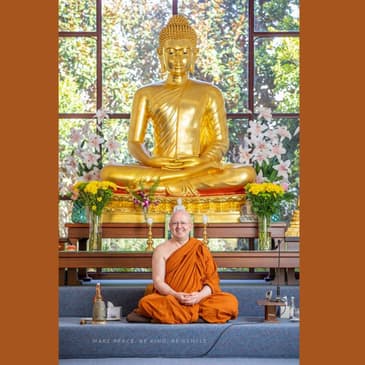
This guided meditation by Ajahn Brahm was originally recorded in 12-05-2007. It includes a talk about some aspect of meditation followed by a 45 minute guided meditation.
This guided meditation has been remastered and published by the Everyday Dhamma Network, and will be of interest to people who have started meditation but are seeking guidance to take it deeper.
These talks by Ajahn Brahm have been recorded and made available for free distribution by the Buddhist Society of Western Australia under the Creative Commons licence. You can support the Buddhist Society of Western Australia by pledging your support via their Ko-fi page.
[00:00:00] - [Speaker 0]
Welcome to this afternoon's meditation class. And as usual, if there are any meditators here who are coming for the introduction to meditation class, That is the room on my right between here and the reception area. And that is the class where people learn the basics of meditation and only sit for short periods of time. But here we sit for about forty minutes or maybe forty five minutes sometimes. And in which, before we start the meditation, we usually talk about some aspect of meditation.
[00:00:34] - [Speaker 0]
And just half an hour ago someone handed me an email that a conference I'm going to be teaching in Sydney in early November. And there they I'm supposed to be speaking on the obstacles to meditation. So it's a great thing to talk about now. How to overcome some of the obstacles in meditation. And of course the first obstacle in meditation to overcome is actually wanting to meditate.
[00:01:00] - [Speaker 0]
And to get on the cushion. And this obstacle is overcome just by experiencing the joy of meditation. And those of you who have meditated with me long enough now know that at the end of every meditation I usually ask you to pause and reflect on how you feel at the end of each meditation. And I do that on purpose because when you experience even meditations which you don't think are so successful, where you pause and feel how you are and you'll naturally compare it to how you were when you began the meditation, You find that 99% of meditations, if not 100%, you always feel much better towards the end than you did when you started. So that recognizes the value and the worth of meditation.
[00:01:51] - [Speaker 0]
And if you keep on reflecting on what meditation does to you again and again and again, that will overcome the first obstacle is wanting to meditate. Because you'll recognize the benefits of meditation. You recognise not because it gets rid of problems or gets rid of blood pressure or relieves cancers and stuff like that, but the sheer joy of it, the happiness of it. So after reflecting many many times on meditation you just want to meditate. Like you want to watch your favorite movie or you want to listen to your favorite music or you want to go to your favorite beach.
[00:02:30] - [Speaker 0]
You go there because you like it. And there's that reflection at end of the meditation which sees the worth and value in every meditation. Even the so called not so good ones, let alone the really deep ones. That is what overcomes the obstacle of wanting to meditate. And of course once you're down there on your seat, the next obstacle for many people is the dull mind.
[00:02:56] - [Speaker 0]
And that dull mind is because you have been working hard, struggling, thinking, controlling, trying to get here in time. And by the time you get on the cushion, you know, you're already sort of, you know, pretty worn out. Now one great way of overcoming that is if you are going to meditate and you know you're coming to say a Saturday afternoon meditation, just check the fifteen or twenty minutes, you know, before you get here. Give yourself enough time so you don't have to rush. Because if you rush in here and come in late, and then you're really sort of stressed out because of running to come in here.
[00:03:31] - [Speaker 0]
And of course it will take a long time to settle down. Or if you go and sort of have an argument with someone or have three or four cups of coffee, so your eyes are bulging out, then of course that's not going to help you. You need to sort of prepare yourself beforehand so you can just calm down and calm and calm down. If you can start to remember that, then you're unlikely to be so tired when you sit in meditation. But of course there will always be some tiredness there when you start.
[00:04:05] - [Speaker 0]
And the only way to overcome that tiredness really depends on how much time you have to meditate. And I always say in retreats when we've got lots and lots of time, the best way to meditate is to actually to allow that sleepiness to be, to make peace with it, just to embrace it and to allow it to work itself out. Because the nature of that tiredness, it's a dull mind, a mind which just lacks energy and the more you struggle with that mind, the more you do and control and try and get rid of that sleepiness, usually the longer it lasts. So if you can have the time just to bear with that sleepiness and allow the first five or ten minutes of the meditation to be a bit dull, that's not so bad because it will build up steam afterwards. And that's number one way of overcoming the sleepiness, just to leave it alone and allow the whole process just to grow.
[00:05:00] - [Speaker 0]
Number two way of overcoming sleepiness is actually because if you only got a short period of time then you can't really afford just to fall asleep for the whole forty minutes, which means you have to really start to arouse some energies. I certainly remember there are times when you were meditating in the jungles of Thailand. I remember one morning getting up at 03:00 in the morning and as I put my little jacket on, my little undervest on, I noticed in the darkness there was something crawling on my breast and it was a centipede which had crawled into the robe at night and now was on my chest. And those centipedes in Thailand, they are vicious, they go for you, they attack and when they bite, oh they really hurt. I still remember, who was it, what's his name, called one of the monks who teaches in The United States.
[00:06:01] - [Speaker 0]
He got bit by his centipede once and he took himself to hospital and to this day he calls that the worst pain he's ever had in his life, the worst night. And even the villagers would say the centipede bite hurts more than the snake bites. And there was one on my chest, ready to bite. It's amazing how quickly I got rid of my sleepiness. I was fully awake.
[00:06:26] - [Speaker 0]
And even though I very carefully took off my vest and the centipede had called into the vest rather than onto my skin so I could actually take it outside. But for the whole morning I was really alert. So that's another way of overcoming sleepiness. The Buddhist Society of Western Australia should invest in a snake, a nice sort of tiger snake, and let it loose in here. And then I think no one would have slotted topper.
[00:06:55] - [Speaker 0]
However that's going a bit extreme we'll probably get sued for that but in the meantime just you can arouse a bit of urgency and there are many many methods in meditation to arouse urgency. Just to think of how old you are and how much time you've got left and don't just think of the old auntie in the front there. She will probably last another ten or fifteen years and you'll probably die before her. Who knows? So when there's a sense of urgency there you think well I can sleep when I'm in my coffee but now I'm gonna be alert alive.
[00:07:33] - [Speaker 0]
So it just gives a bit of importance to this moment. A bit of vitality to the moment because some sleepiness is not really coming from the fact you've been working hard it's just basic dullness. So use a bit of sort of urgency there and if not urgency again just put some more fun in the meditation because again if one is bored and tired again that tiredness that dullness increases. So you've got to use some meditations which arouse energy. And you know sometimes doing like counting meditation and breathing in one out one in two out two and so on.
[00:08:10] - [Speaker 0]
Or know doing my backwards breath meditation or just doing something which arouses the energy of the mind and gives a bit more interest. Another thing to do is you know if you're sleepy to take off your blankets and wraps because you know very often a blanket is what you wear in bed to go to sleep in and there's something psychological about a blanket when you get near it it tends to make you fall sleepy. Yes! So if you get really sleepy, take off your blankets and have a just a bit of chill because you know it's not that cold. You won't get sort of pneumonia.
[00:08:50] - [Speaker 0]
But what it will do, will sort give you a bit more aliveness. Change your posture. Don't just sit in the old posture, sit in the new one. Anything which is new, which is different. Even it's amazing that if you are dhao and you just even change the way you put your hands, put them in a different way.
[00:09:07] - [Speaker 0]
If you hold them on your on your lap put them on the knees. If you hold them on the knees put them in the lap put them behind your back, fold them in front of you. Whatever it is which is something different to get you out of the dullness of habit. And that also brings you a bit more awareness. But the most difficult problem that people have after the dullness is the talking mind.
[00:09:32] - [Speaker 0]
When the mind is always yak yak yak yak yak yak yak. Always giving some sort of description or comment on what you're experiencing and for many people when they start meditating that's the hardest is to shut up and to be able to do that we have this beautiful way of recognizing what the silence really means. And the most amazing and productive little method is that old method of listening to the gaps between the words. When one word finishes and another word has yet to begin. There is a silence of the mind.
[00:10:27] - [Speaker 0]
You can hear the traffic, But you're not talking about it. You're just there, being, listening in silence. It's that recognition is so much so important. Because with that recognition and experiencing these things again and again and again, you do get familiar with them and at ease with them and the silence becomes something which you are used to. And this is an important part of the meditation.
[00:10:57] - [Speaker 0]
Once you become used to silence We notice it in many many different places in the world. But there is a lot of silence around. Sometimes at home there's no one in, you're there by yourself. And there's okay you may be washing the dishes but you don't need to think about the dishes. Just watch the mind in silence as that mind works.
[00:11:16] - [Speaker 0]
These repetitive activities, you know, the ordinary activities which you do can be great moments of inner silence. And if you could just notice that silence, you know, you can recognize it that there I'm aware, I'm even active, I'm walking or I'm washing or I'm mowing the lawn, but I'm not thinking inside. There's not an inner commentary going on. And if you can recognize that, you'll beget familiar and used to the silence. Once you've got rid of that silence mind, so this absolutely this peace inside this awareness without getting lost in the commentary.
[00:11:55] - [Speaker 0]
Then I reckon that's probably the biggest obstacle in meditation. Oh out of the way. Of course there's also the other parts of what we call the controlling mind because that's where that speech comes from. Because we're always controlling this meditation, our mind, controlling our bodies. We're just doing the meditation and it comes to a point where we have to stop that controlling.
[00:12:18] - [Speaker 0]
Sooner the better, but if you're a bit tired maybe put a little bit of control in first of all. Get yourself alert and awake. Get into silence and then just let go. Because it's a controlling mind, doing, the wanting this, the trying to get that which is always creating what we call the restless mind. A mind which will never stay still.
[00:12:40] - [Speaker 0]
Why can't you stay still? And the answer is because you're going somewhere. And where are you going? I don't know where you're going in meditation. You want to get this, you want to go there, you want to experience whatever.
[00:12:52] - [Speaker 0]
If you want to get somewhere in meditation, you're always going somewhere. And if you're going somewhere, how on earth can you be still? So don't try and go somewhere or get somewhere. The whole point of meditation is to be where you already are. To be here only more and more fully here.
[00:13:13] - [Speaker 0]
Meditation is like a bench on a long road and you've been walking for such a long time and here is the bench sit down stop moving. And it doesn't matter if it's a comfortable bench or a rough stone bench, it's good enough to sit down and rest. And what happens if it's just a rough old stone bench? As soon as you sit down, the nature of the mind extending this metaphor is that stone bench turns into a beautiful sofa. Deluxe.
[00:13:43] - [Speaker 0]
Simply because the more still you are, the more comfortable that stillness becomes. And that's actually how we overcome that restless mind. By learning how not to go anywhere. Too much of life is always going on to the next thing, on to the next thing, on to the next thing, on to the next thing which you have to do in the world but not in meditation. Meditation is not going on to the next thing, it's going in to this thing.
[00:14:12] - [Speaker 0]
That's the most important thing to realize is the inward path not the onward path. So you never go on to the next stage of meditation. You always go in to the next stage of meditation. The next level of meditation is right inside the center of where you are now. Understanding that stops the restlessness.
[00:14:36] - [Speaker 0]
You realize to progress you have to ingress. Be where you are and allow the mind to center. So those are some ways of overcoming the major obstacles of meditation. As you see getting on your seat is just learning how to appreciate the meditation at every end of meditation. Realize what it's doing to you is great.
[00:14:59] - [Speaker 0]
Overcoming the dullness, either giving it time to disappear, looking after fifteen or twenty minutes before you sit, what you're doing to actually to ease yourself into the process so you don't waste too much time in the first few minutes of meditation. Giving yourself a sense of urgency, doing some interesting meditations like counting or nothing kindness just make the mind work a little bit. And then the talking mind by learning how to notice the silence and appreciate the silence the space between the thoughts where one thought finishes another thought has yet to begin. Notice that space there is silence. And lastly the restless mind is where you develop contentment.
[00:15:41] - [Speaker 0]
You realize this meditation is sitting down where you are stopping the journeying and going in to the stillness of being now. So that's in brief fifteen minutes of how to overcome the obstacles in meditation. So now you have no more obstacles. You'll probably all get to Jhana in this meditation. I hope.
[00:16:04] - [Speaker 0]
I always like to have wishful thoughts. But nevertheless we'll see what happens. So is there any questions before we begin? Just again if anyone's coming to the introduction to meditation class, that class is in the room to my right. This is the ongoing class where we sit for forty five minutes.
[00:16:24] - [Speaker 0]
So hopefully you're all comfortable enough to be able to sit for forty five minutes without needing to move. Any comments, questions? Okay, let's go off in the journey of stillness. So if you like to, if you've ever been sitting a long time and want to just stretch your legs a little bit, that's fine. And then when you're ready to cross your legs, and or sit on a chair, let your legs dangle over the side, and close the eyes, and prepare the body for meditation.
[00:17:37] - [Speaker 0]
So with the eyes closed, bring all the awareness from outside onto your body. Doesn't matter about your duties, responsibilities. It's like your car. You lock the car, pull on the security, then you can leave it knowing it's safe. The same way that all your jobs, responsibilities, duties before and after, it's all locked away, security is on, it's safe.
[00:18:06] - [Speaker 0]
So you don't need to worry about it. No more than you need to worry about your car in the car park. So you're letting go of things, bringing your attention to this body, asking it how it feels. Whether it needs to be adjusted. If it does, adjust it now.
[00:18:36] - [Speaker 0]
To move the leg, move the knees, move the back, the head, whatever, blow the nose, and cough. Just spend the first minute or two in adjusting the body. And don't go through this process of awareness of the body and adjusting appropriately too quickly. Otherwise, you get aches and pains later in the meditation, which could have been avoided if you spent that little bit more quality time with your body. When the body is comfortable enough then leave the body alone.
[00:21:57] - [Speaker 0]
And just find that seat to sit on. It's always in this present moment, the space between the past and the future, But we don't linger on what's already gone by, nor do we rush to what's yet to occur. All of that past and future, we deliberately abandon, recognizing the best place to develop a wonderful future is by generating it in this present moment called now. As you come into the present moment, just ask yourself, is there dullness there? Is there restlessness?
[00:24:13] - [Speaker 0]
What is the problem? If it's dullness, put a little bit more effort into what you're doing If it's restlessness, be more content, stop aiming for things See if you can appreciate the freedom of now. You don't have to work and do things and make decisions. It's getting very close to the end of meditation now. Now is the time to do that practice I told you at the beginning, to experience how you feel, in particular, notice the quality of peace, stillness, the sense of freedom and inner happiness.
[00:59:02] - [Speaker 0]
And to linger on those four things, peace, stillness, freedom, inner happiness, to notice how they've grown during the period of this meditation. So that you value these things, and their memory will drive you to the meditation cushion again and again and again, to develop them, make them stronger, deeper, and more fulfilling. Peace, the stillness, the freedom, and neither happiness. I'm now gonna ring the gong three times. At the end of the third ringing of the gong, open your eyes to come out for meditation when the third sound from the gong disappears.
[01:01:59] - [Speaker 0]
There we go. To learn how to meditate, to see those obstacles, understand how they arise and how they're transcended, to be able to deal with this mind and take it into the deep, peaceful, aware states is a great benefit. It's a wonderful thing to learn in this life, how to bring peace, freedom, happiness and stillness into the mind. It's the heart of the Buddhist practice, how to meditate, and it does not matter what tradition a person follows. You know, the roads may be different, but the mind is always the same.
[01:02:39] - [Speaker 0]
And peace, stillness, freedom, contentment, no matter what religion even, it's all the same. Has to be peace is peace, freedom is freedom, stillness is stillness. And it's when the mind doesn't move that all those distinctions disappear. When the mind moves, it creates distinctions and separations and barriers and boundaries. But in stillness, all that disappears.
[01:03:06] - [Speaker 0]
So for those of you who are philosophers, who think a lot, all the answers arise in the stillness. And so often that when people ask, where does the wisdom of the dharma arise from? It always does come from that very, very still and peaceful mind. When a mind stops moving, it sees more deeply. As it sees more deeply, insights just flow naturally.
[01:03:33] - [Speaker 0]
Note that you who live in Perth have heard this many, many times, but going to Melbourne last week, still that people thought that somehow or other, at some part of the meditation, you have to turn to insight practice. And just what a strange thing that is to say. As the mind becomes still and peaceful, just insights happen automatically. Because the still mind is a mind which sees deeply. Which is what insights are all about.
[01:04:03] - [Speaker 0]
Calming the mind, making it peaceful, making it powerful, brightening it, until it gets so bright, so powerful, that whatever it looks at, it sees in a far, far deeper way than you'd ever imagine. It's a natural flowering of the wisdom faculty of the mind. That's how it always has worked. That's how it works now and how it will work. The peace, the stillness leads to seeing things as they truly are.
[01:04:35] - [Speaker 0]
Notice, translated, a quote of the Buddha, which he repeated many, many times. From stillness, you see things as they truly are. Okay, has anyone got any comments or questions about the meditation today? I'm so pleased to see how still you are. Are there any comments or questions?
[01:05:03] - [Speaker 0]
Are there any difficulties people have with this meditation? One thing which sometimes people wonder about, during the meditation, if you're sitting, say, for forty five minutes, during the meditation you get an ache or a pain in your body, what should you do? And I know that some traditions say, bear with it, grit the teeth, and just be willing to give up your life, so you're not going to move. But that sort of Masha tradition has nothing at all to do with Buddhism. Buddhism is a very gentle, compassionate path.
[01:05:42] - [Speaker 0]
And one of the quotes, which I read out every rains retreat, every other rains retreat to the monks at Bodhinyana monastery, is a saying of the Buddha who said, this is a path without groaning. So if anyone groans during the meditation, either silently in their mind, because they're having a hard time. Oh, have any more minutes to go. I don't want to meditate. Why did I come in here in the first place?
[01:06:09] - [Speaker 0]
Can't we get rid of those dogs next door? Can't we get some better air conditioning or heating? If you're groaning, you're missing the points. Because the Buddha said this is a path without groaning. So, if you've got an ache or pain in the body, move it.
[01:06:28] - [Speaker 0]
Do not just sit there and endure, otherwise you'll just find you'll just get nowhere in meditation. Sure you'll become a tough guy or a tough girl, but if you really really want to follow that path, go and join the SAS. But if you want to develop a wise, I was going to say a wise guy, but that's got a different meaning in English. If you want to become like a wise and intelligent and compassionate and a liberated person, then when you've got an ache in the knees or something, just very gently move. I call that pressing the pause button.
[01:07:04] - [Speaker 0]
Because your meditation doesn't go deeper. And actually, it usually goes backwards a tiny bit. But if you move your legs or your back or scratch that each or whatever very slowly, very mindfully, you don't lose very much. But what you do do is once the leg has been moved or the bottom has been adjusted, then you're free from that big burden of pain which takes your attention away from the rest of the meditation practice. So it really is worthwhile to actually just to move slightly.
[01:07:38] - [Speaker 0]
I was very, very pleased that somebody gave me a copy of Ajahn Plinyan's meditation book translated into English, And he's saying the same thing. So even the great Thai meditation masters also agree that move if it aches. The most important thing, if you've got a cough, please cough straight away. No matter how many times it's happened, the person has got that itch in their throat, and they've stopped it. They prevented it until that itch has built up so much power that you cough like a volcano, and you spray all that stuff around everybody two or three rows around you in the seats.
[01:08:26] - [Speaker 0]
And that is not a very healthy thing to do. Have you caught this car? Get it over and done with, a swallow car, and you're free. Instead of just bottling it up. So this is the gentle path, a path without groaning.
[01:08:44] - [Speaker 0]
Some of you sit on the floor, if you get sore knees and sore back, get another cushion. If the cushions aren't good enough, get a stool. If the stool is not so good, then get a chair. If the chair is not so good, maybe we won't go down that track any further. Otherwise you'd be bringing your bed into the meditation hall.
[01:09:05] - [Speaker 0]
But anyway, usually the chair should be okay. So just be gentle. Because remember, this is Buddhist meditation and the Buddha, you can see that Buddhist statue behind it, always tries to have a gentle, calm sort of face. You never see the Buddha gritting his teeth like he's in pain. So it's a gentle calm peaceful path.
[01:09:29] - [Speaker 0]
And if you can't do that in your meditation, have the gentle beautiful Buddha mind, then the meditation is not going to go very far. So remember this is a path without groaning. Any comments or questions about that? It's your last chance. Okay.
[01:09:50] - [Speaker 0]
We can finish off today. Just announcement for those people who weren't here last night, there is going to be a dhamma class, a sutta class tomorrow afternoon at 3PM, and it's going to be sutta number 75, the Magandiya sutta. We do a dharma class where we read out and discuss some of the original teachings of the Buddha. That's the Magandhya Sutta coming up tomorrow at 3PM to about 04:15, 04:30. Okay.
[01:10:17] - [Speaker 0]
So we can now post place the Buddha Damasanga, then we can go and have a cup of tea.