
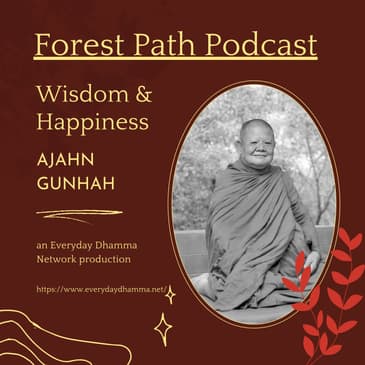

This episode is a short dhamma talk by Venerable Ajahn Gunhah Sukakhamo. The talk is called “Wisdom and Happiness”. It comes from the book Jai Dee - Jai Sabai - Delivery 2019. These talks were given to a mostly Thai lay audience and have been translated here by Samaneri Viveka at Wat Pah Subthawee Dhammaram.
[00:00:00] - [Speaker 0]
Welcome to the forest path podcast, a podcast sharing the teachings of awakened meditation masters of the modern era. This episode is a short Dhamma talk by the venerable Ajaanganha Sukakamo. The talk is called wisdom and happiness. It comes from the book delivery 2019. These talks were given to a mostly Thai lay audience and have been translated here by Samaneri Viveka at Wappa Suptawi Damaram.
[00:00:31] - [Speaker 0]
May you all benefit from hearing this gift of dhamma. Wisdom and Happiness by Ajangana. May all of you understand that we have eyes, ears, a nose, a tongue, a body, and a mind to become clever. We study for being clever, and we also practice dhamma for becoming clever. When we are clever, we have to put this cleverness into practice and renounce.
[00:01:09] - [Speaker 0]
Then there will be goodness that turns it into merit and skill. From now on, from this moment on until our last breath, we have to use this life for practicing dhamma. We have to give importance to the dhamma and establish ourself in it. We have to renounce when we work. We have to be diligent and persistent, take responsibility, endure, be firm and stable, and have sati and panya.
[00:01:40] - [Speaker 0]
We have to depend on our practice instead of clinging to happiness and comfort or changing into being a lazy person who dwells in carelessness, happiness, and entertainment. When we are happy, we will have wisdom. When we have wisdom, we will be happy. Sila, Samadhi, and Panya will merge into becoming one. If we have wisdom but don't renounce, happiness can't arise.
[00:02:09] - [Speaker 0]
The way we lead our life day and night has to become a matter of practicing dhamma. We will get to practice dhamma and look after our business and duties at the same time. We will develop both our body and our mind simultaneously. Then we won't fight with other people because we are fighting with ourself, our laziness, and our drowsiness that is attached to happiness, comfort, and taking it easy. We have to understand the word renounce.
[00:02:40] - [Speaker 0]
The meaning of renouncing is to let go of laziness. The inner instance of laziness that is dwelling in our heart is a vidya, the root of delusion. This is the clinging that is dwelling in everyone's heart. We have to apply wisdom, put it into practice, to let go of selfishness, and develop our Indriya and Parami to make them mature. Don't become deluded and attached to happiness and comfort because we were born to cultivate our Parami so that Maga, Pala, and Nibbana will arise.
[00:03:17] - [Speaker 0]
We will get to fulfill our human potential, go to heaven and attain Nibbana and reach happiness and the ending of suffering before we die instead of hoping that death will be far away. We will get to become a noble one then. An important part of the Noble Eightfold Path is Samasamadhi. Our heart has to be strong, firm, and stable, not unstable and wobbly. We have to be determined and established in being heedful all the time.
[00:03:51] - [Speaker 0]
The Lord Buddha wants us to focus on the present because the present is the base and foundation for the future. The future will come from the present. When the causes are good, the results will be good. When we think good thoughts, our mind will be good. When we speak nicely, our mind will be good.
[00:04:14] - [Speaker 0]
If we are diligent, take responsibility, and are good at patient endurance, our mind will be good. We have to establish ourself in goodness like this in the present moment. The past that has gone can't be retrieved. It is like broken goods that can't be used anymore. If we make a good plan and we practice well in the present, the future will be good.
[00:04:41] - [Speaker 0]
The Lord Buddha wants us to be happy in practicing well and correctly in the present as best we can. When you are practicing, don't expect anything in return. Otherwise, you will get stressed and developmental problems and neuroses because there is hidden selfishness. We have to apply wisdom and make it work for us. Don't let wanting and aveeja sneak in so that you start thinking and proliferating, and worries about the future arise in our heart.
[00:05:15] - [Speaker 0]
Whenever we worry, our mind immediately becomes confused. The Lord Buddha taught that the formations arising from proliferation are the worst suffering. When we are stilling these formations, it is the greatest happiness. The Dhamma must not get stuck in the books and remain limited to the tipitaka. It has to be in our heart and mind as we lead our daily life.
[00:05:44] - [Speaker 0]
Dhamma is not a philosophy. We have to practice it and renounce and keep focusing on the present moment. Don't think that you are clever and smart. If we think that we are clever and smart, we are dwelling in carelessness and delighting already. The dhamma has to become part of our every moment.
[00:06:05] - [Speaker 0]
Then there won't be any proliferation, but there will be sati and panya in every present moment of our reality. Our indriya and parami will develop and mature. This dhamma does not belong to the monks. It belongs to everyone. Monks and laypeople practice in one and the same way.
[00:06:27] - [Speaker 0]
For instance, we breathe regardless of whether we are a monk or a layperson, stay at home, at the temple, or at are at work. Everyone is breathing wherever they are. We have to use seela, sati, and samadhi to combine working and practicing the dhamma at the same time. There isn't anybody who will breathe for us, eat for us, or go to the bathroom and toilet for us. Every one of us has to practice for him or herself.
[00:06:57] - [Speaker 0]
Reflect on this well. If we don't think good thoughts, how can our mind be good? If we don't speak well, how can our mind be good? If our manners are bad, how can our mind be good? If we are not diligent, patient, renouncing, and taking responsibility, how can our mind be good?
[00:07:20] - [Speaker 0]
We have to be determined to practice for ourself and focus on Sila and arouse the intention to abstain from thinking, saying, and doing anything that is not good. Sila and good behavior have to come first, then our Samadhi will turn into Sama Samadhi, and our Sila, Samadhi, Panya will become natural, pure, and free from Dittimana, that is the view of I and self. There will only be happiness and the ending of dukkha in every moment. That concludes the Dhamma teaching wisdom and happiness by the venerable Ajahn Ganha. I want to thank all the supporters of this podcast over the past year because your generous contributions via Ko Fi have provided me with the funds and inspiration to keep this podcast going all through 2025 and beyond.
[00:08:22] - [Speaker 0]
Thank you all so much. May you all experience insight and peace.