

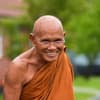
This episode is a talk given by the forest meditation master Ajahn Liem and is titled “Watch Your Mind and Escape Mara’s Snare” . It was published as part of the publication “Santi - Peace Beyond Delusion”.
---
You can view this episode and the original text Forest Path Podcast website.
If you have enjoyed this podcast and you'd like to support the free distribution of these teachings you can support the Everyday Dhamma Network via the Ko-fi creators platform.
[00:00:00] - [Speaker 0]
Welcome to the forest path podcast, a podcast sharing the teachings of awakened meditation masters of the modern era. This episode is a talk given by master Ajahn Liam, and it's titled watch your mind and escape Mara's snare. It was published as part of the publication, Santi, peace beyond delusion. I'd like to say thank you to Nanda Biku who got in contact with me to share this Dhamma teaching by Arjun Liam. And I'd also like to thank all the recent donors to the Everyday Dhamma Network that are helping to keep this podcast going.
[00:00:38] - [Speaker 0]
And if you'd like to become a supporter, click on the Ko fi link in the description below. May you all benefit from hearing this gift of dhamma. Watch your mind and escape Mara's snare by Arjuna Liyam. The principal teachings of the Lord Buddha are indeed vast. Let us simply see them as skillful means or tools for practice.
[00:01:12] - [Speaker 0]
In my case, I was fortunate to be able to rely on the spiritual qualities, the parami, of our venerated teacher, Lung Po Cha, from the year 1969 onwards. This was the year I entrusted myself to become his disciple. When one is too weak to be self reliant and does not have enough mental energy to help oneself, one needs to find someone to lean on. So I came to fully rely on Ajanchara in that year, not only relying on the teachings and advice he gave, but also on the place that he maintained in the order for us to be inspired and motivated in our practice. I joined in for the RAINS retreat at that time, having come from a rather troublesome search with many obstacles.
[00:02:03] - [Speaker 0]
I had been on quite an unsatisfactory journey without a clear destination and was now really trying to change my direction to be in line with the principles of the Buddha's teachings. I had been looking for Kruberajans in many places, with the question of what I truly wanted to do with my life. I had seen quite a bit of the life of people in the world with my own relatives. They kept getting involved with the same old things over and over, and I couldn't see anything getting better. Seeing that the circumstances of their lives were rather confused and that there was a lot of delusion involved, I realized that I should try to lead the life of a monk in order to eventually put an end to such conditions.
[00:02:52] - [Speaker 0]
So I tried to find a teacher, a master, or at least study the various methods that were generally available in the communities I lived in. Together with my monastic friends, I started studying the scriptures, especially the Abhidhamma, and gained some knowledge in this field. Because the Abhidhamma is based on clear principles and facts, its structure and outline lends itself to study. Having studied it, one can easily speak about it. But although I was able to speak on Abhidhamma for myself, I still felt utterly confused and stuck in a state that was not at all free.
[00:03:34] - [Speaker 0]
My studies left me feeling unfocused and depleted of energy, so I decided that this was not in keeping with my aspirations, and I came here to Ubon province. Before that, I had gone to train in the monastery of Ajahnmi of Wat Pha Ntsong Nguyen. He was a meditation monk, but already quite old. When I arrived in his monastery in Korat province, he told me that his strongly deteriorating physical condition wouldn't permit him to teach. I should search for some other place where, perhaps, I could meet a suitable teacher.
[00:04:15] - [Speaker 0]
I stayed with him for a while, but after a short time, I returned to Ubon. Coming here, I heard about Lumpur Cha's reputation and wanted to have a look at his monastery. When I visited Ajanchar for the first time and paid respects, I saw the monastery with its rules of conduct and was very pleased and inspired. I thought, these are really the correct standards of practice. I returned to my former teacher to take leave and handed my duties back to him so that he wouldn't have to worry any further what I was doing.
[00:04:53] - [Speaker 0]
He issued a letter transferring me to Ajanchar as evidence that I wasn't a vagabond trying to run away after some inappropriate action. Ajanchar said, let's see first. You have come with the wish to practice, so see how it goes with the practice. We don't know each other. I don't know who you are or if you have any problems.
[00:05:19] - [Speaker 0]
But he let me stay and arranged a kuti for me, so I had a place to stay that provided shelter from the sun and the rain. It was very far away from the others, though. There was no bathroom, and when I needed to go to the toilet, I had to walk quite far. At that time, in Wat Nong Phapong, there weren't many toilets at all, only two or three for all 40 of the monks and novices. In that year, if I remember correctly, there were 47 monks who spent the rains retreat at Wat Nong Phapong, and I didn't know anyone.
[00:05:57] - [Speaker 0]
I wasn't interested in anyone. I assumed that all these monks had come to do what they had to do in their practice by themselves, so I took no interest in them. I didn't even know their names. I really wasn't interested. All I was interested in was my own tasks and duties, the ways of practice, and the observances.
[00:06:19] - [Speaker 0]
This is what I felt inspiration for and was motivated to do. When the time to enter the ranged retreat came, Ajanchar gave advice and teachings to guide us in our practice. All the monks were keen on developing their conduct and changing their habits. Ajahn Chah had us work on ourselves through performing our duties and communal obligations. He had us do various chores and practices.
[00:06:48] - [Speaker 0]
In those days in Wat Pha Phong, on the seventh and fourteenth day of the lunar cycle, All the leaves were to be swept. Sweeping was one of the obligations that you couldn't miss. We had to finish within two hours. Actually, the area wasn't as big as it is today, only about the area in front of our present sala. We merely swept the sala area up to the ordination hall.
[00:07:14] - [Speaker 0]
There weren't many trees and only small ones, so it was finished quickly. There was a bell at four in the afternoon for the monks and novices to come together for meditation. Usually, for the meditation sessions, Ajahn Chah would come thirty minutes or an hour earlier to sit. I saw the meditation sittings as something I was happy to do. I was well motivated to sit as I had already been practicing meditation before once a day for at least an hour or a little more.
[00:07:46] - [Speaker 0]
So I sat. I sat, but I didn't get much out of it because my mind was usually in a state where it liked to proliferate. It never settled in itself and kept producing thoughts all the time. Still, most of the time, I came to the sala before the others. There was another monk, Ajan Mahasamran, who came at the same time that I did.
[00:08:12] - [Speaker 0]
The two of us started sitting early, regularly. Ajan Mahasamran came roughly fifteen or twenty minutes before the bell, and I practiced the same way continuously. It was good to sit ahead of the bell. There weren't any further duties to do, so from the time we started sitting around four or 04:30 until the beginning of the evening chanting, we had more than two hours, which was just right. The sitting sometimes hurt a little, but I didn't pay attention.
[00:08:45] - [Speaker 0]
I was only interested to keep on training myself all the time. I never had any interest when the occasional sweet hot drinks or herbal medicines like s'mores or muck and bomb were were offered. These things stimulate one's bowels, and to have to go to the toilet at night could cause quite a bit of inconvenience. I felt no need to take anything like that, so I didn't join the others when they had them. After evening chanting, went straight back to my kuti.
[00:09:16] - [Speaker 0]
I didn't have much contact with my friends in the monastic life. Not really wanting it, I'd think, I'd rather go back to my kuti, the dwelling place that I have been assigned. I never went to other places such as the kutis of other monks. I simply stayed in my kuti. When I left the kuti, it was to walk to the sala.
[00:09:38] - [Speaker 0]
When I left the sala, it was to walk to my kuti, except for going to the toilet or cleaning. This was all I did in my daily routine. It was good that I didn't speak with the other monks. In return, they didn't start chatting with me. This created a sense of being free.
[00:09:57] - [Speaker 0]
I cut off the problems that can come from socializing with others. Nobody came after me, and I had the chance to do my practice on my own. The daily chores of cleaning and maintaining the monastic dwellings were usually done after returning from the dining hall. The meal was over at about ten in the morning. Returning to my kuti right after finishing in the dining hall and starting to clean it was a nice and relaxing change.
[00:10:26] - [Speaker 0]
It helps to overcome the usual drowsiness after having eaten. Actually, I didn't eat as much as the others, and I was usually finished ahead of them. I found that eating a lot would give rise to the typical hindrances to one's awareness that arise in meditation. One would feel sluggish and inert throughout the day, so I ate just enough to be able to keep my body going. Thus, one feels light, at ease, and energetic.
[00:10:56] - [Speaker 0]
I tried to keep the maintenance of my dwelling up to the standards laid down in the monastic rules, but no more. I kept a kettle filled with drinking water. I had one spittoon, my robes, and my bowl. That was all. In those days, not much development had taken place in terms of roads or traffic.
[00:11:17] - [Speaker 0]
All there was was the sound of a regular pickup truck passing Banh Glang Village around two or three in the morning. This was the sign to get up. Alarm clocks weren't available. Having no alarm clocks, the monks would develop a sense of constant alertness. They needed to listen to the sounds of animals like the forest chicken or the night owls to tell the time.
[00:11:41] - [Speaker 0]
Sometimes one would get the time wrong. Thinking it was three in the morning, one would get up at two or one. One would then simply continue and not go back to sleep. This created a sense of diligence in the practice and supported the spirit of the monastic life where one needs to be in control of one's mind day and night. Though I did all these things from time to time, I was still insecure, and worries and critical thoughts would come up.
[00:12:11] - [Speaker 0]
When one lacks experience, these things can happen. If I had let my awareness slip, feelings of insufficiency would arise. So before going to sleep, I would firmly establish mindfulness and prepare myself for waking. Whenever I became aware of waking, I would immediately get up. I found this to be a really good practice.
[00:12:35] - [Speaker 0]
It makes you independent from clocks. You need to maintain the simple feeling of being ready to do things at the appropriate time straight away without preferences. Each day, I spent at least an hour or an hour and a half doing walking meditation. Referring to the sunlight, I'd stop only when my shadow was directly over my feet. Practices like this made me feel motivated to keep up the training observances, my personal daily practices, and the monastery schedule all by myself.
[00:13:09] - [Speaker 0]
After having practiced for some time in Wat Pha Phong like this, one day I heard Leng Pho Cha give a Dhamma talk on the three characteristics, impermanence, unsatisfactoriness, and not self. The emphasis contemplating the three characteristics because he found that they counteract the three vipassadamas and the misjudgments that can come up in meditation when one has nimittas Visions. Nimittas can confuse people and lead them into delusion and can have them deviate from the teachings and lose the correct path. Lumpur Cha gave advice on this for more than an hour, and when we dispersed after eight in the evening, I was thinking to myself, the three characteristics are good principles to take as one's foundation. They are a good basis.
[00:14:03] - [Speaker 0]
No matter what happens, I will ground my attitude in the three characteristics. So I made a firm determination to practice meditation unremittingly. After the daily chores, when it was time to come together, I meditated. Back at my kutti, I put down my personal things, and I meditated. A good sense of seclusion developed.
[00:14:27] - [Speaker 0]
When there were sounds, I heard them, taking them merely as sounds. The usual emotional reaction ceased to proliferate, and there was a sense of nothing being there. This is how the experience felt. Mindfulness, in the sense of an awareness that there are things happening according to causes and conditions, was, however, present. But I kept myself established in the thought that this experience is not a sure one.
[00:14:54] - [Speaker 0]
There may be changes. Other experiences may come up. This is the attitude I mindfully upheld. Regarding the daily routine, when I was going to rest or to sleep, I determined to do just that. But whenever the time was ripe to get up again, I would immediately get up.
[00:15:15] - [Speaker 0]
At one point, I made a specific practice of alternating the time for going to sleep. Being used to going to sleep at 10PM, I would move the time to say around 8PM and then would get up again at 11PM or 1AM. Or sometimes I would take 1AM as the time to go to sleep and then wake up again at 3AM. I trained to surrender again and again, not to get stuck in a pattern, not to get used to having a rest or deriving happiness out of sleep, not even allowing the excuse that this practice was ruining my health. I had my thoughts about this and practiced accordingly until I felt determined in myself to such an extent that I was able to say, today, I'll sleep two or three hours, and not overstep the set time by even ten or twenty minutes.
[00:16:07] - [Speaker 0]
Most of the time, it ended up being within about five minutes of the set time. This was a good thing to do. To train oneself like this is for the sake of feeling wide awake in the practice. In fact, in that year, things went very smoothly. I was able to do all these things without much concern for the external world.
[00:16:28] - [Speaker 0]
Even regarding people that I had known closely before, my relatives or friends, I didn't experience symptoms of wanting to relate to or even think of them. I was as unconcerned as a person who has relatives, no friends, no mother or father, like someone who has nothing left in this world and simply exists, relying solely on himself the whole time. I don't know how these worries fell away to the point of being distant memories, but it was a good opportunity to train entirely by myself day and night, so I kept doing this. I didn't have much opportunity to go to Lumpur Cha's Kutti. Usually, after the evening chanting was finished, some of the monks and novices would go to Lumpur's Kutti to pay respects to him.
[00:17:17] - [Speaker 0]
There were times that he would even inquire where I was, but still I never went. I saw that most of the time, the reasons for monks to go was to get some contact and be close to him. I didn't think that that was right. I thought the correct way to be close to Lumpur means to take on his standards of conduct and practice. So I really didn't go and see him very much.
[00:17:41] - [Speaker 0]
Sometimes he would ask, where did that monk that came from somewhere else go? I never see him here. He asked, but I didn't go and seek contact with him. Rather, I relied on my own motivation to practice, asking myself, why did I come here? What do I really want?
[00:18:00] - [Speaker 0]
Do I want friendship or closeness to a teacher? In fact, I came because I wanted to practice. The place here is supportive of seclusion in every way, so I should go ahead practicing that way. If anybody says I'm unfriendly, I don't mind. I just understand that to practice in this way is an obligation, a duty that we need to fulfill.
[00:18:25] - [Speaker 0]
That's what all of us wanted to do in the first place anyway. My practice developed steadily throughout the second and third month of the RAINS retreat. With the beginning of the second month, some of the things that occurred seemed quite good. Good here meaning some parts good and others not so good. I noticed in myself that sometimes I felt good about things and sometimes not.
[00:18:51] - [Speaker 0]
So I asked myself, why are there always these states of good and bad? I posed this question to myself and realized it's because if one likes things being a certain way, one calls them good, and if one doesn't, one calls them bad. Are only the things that one likes right and all the other things wrong? What I did was question and investigate myself in order to get to know what desire really was. The ways desires express themselves are characterized by these feelings of good and bad.
[00:19:27] - [Speaker 0]
Feelings of good and bad arise from wanting. So I concluded, why bother with these feelings of good and bad? One should take the attitude of not getting involved with these things at all. What one should really take on is the practice of simply having mindfulness in and of itself. So this was the motto I upheld and kept putting into practice.
[00:19:51] - [Speaker 0]
At the beginning of the second month, all my experiences were falling into place. I saw my own mental attitudes and knew the state of mind I was in, both the good states of mind and the bad ones. I saw the states of mind in relation to the mind and saw the mind in relation to the states of mind. In this manner, I saw that the mind was one thing and the states of mind were another. Being able to distinguish the way one feels, separating states of mind from that which is the mind, and in this way knowing and seeing one's mind and one's states of mind as separate, one sees the one who knows, sees the one who knows the mind and who knows the states of mind.
[00:20:37] - [Speaker 0]
This made me experience everything that was happening in a wakeful manner, feeling aware and alert both when I was sleeping and awake. I was witnessing my own experience all by myself. It was not as if I were escaping to some other place or being aloof, but instead, I was following up on these things all the time, both the good experiences and the bad ones. That's the way I saw it. I didn't see this experience as anything particularly good.
[00:21:07] - [Speaker 0]
I simply understood it as something I did that was good enough for keeping myself alert. That was all. This experience reminded me of a passage in Dhamma. It made a strong impression on me when I studied it for the Nagatam exams. I have frequently mentioned it to you in the past.
[00:21:27] - [Speaker 0]
I learned many other passages, but this one I remember particularly well. It comes easily to mind. Whoever watches his mind will be freed from Mara's snare. How does one become free from Mara's snare? By watching the mind.
[00:21:46] - [Speaker 0]
This is exactly what I thought, so I established my mindfulness in the observation of the modes of what I was feeling. At the same time, I continued to give attention to a Samadhi object of meditation. It is not that I neglected this. It is necessary to hold on to a samadhi object as well. I didn't seek for anything more distant than the in and out breath.
[00:22:11] - [Speaker 0]
To watch the breath has an impact on the mind. It enables it to overcome defilements and cravings. I observe the samadhi object, and I observe the modes of the mind, both unwholesome and wholesome. Knowing the samadhi object and the modes of the mind, these two were joined together and didn't separate, whether walking, standing, sitting, lying. There was the experience of awareness all the time.
[00:22:40] - [Speaker 0]
Sometimes there were states of depression and discouragement. This was also part of the experience. I thought, not facing any obstacles is impossible in this world. One cannot have everything go smoothly all the time. One has to bear with these obstacles.
[00:22:58] - [Speaker 0]
Whatever happens, one has to endure and pull oneself together. There is no other way. So I tried to become aware of this and patiently endure things. Sometimes I was overcome by the hindrances. They were quite strong.
[00:23:15] - [Speaker 0]
If one were to give a comparison, it was like being a football that is kicked around. When kicked hard, it shoots off quickly. I couldn't pin it down. The mind kept proliferating here and there, thinking about business, the chores, going on arms around. The mind was in such a state, but I actually didn't make much of it.
[00:23:37] - [Speaker 0]
I just saw that this is how it feels and upheld that these are all just states of the mind that arise, stay a while, and then cease. I saw it as an experience, a symptom that the mind displays. Seeing how this feels in the mind, I thought, this is what the Buddha actually meant when he said, the mind is like that. It has to express good and bad. One can't blame it for this.
[00:24:05] - [Speaker 0]
One can't say that it's all bad, and one can't say that it's all good. So I continued observing these things mindfully. If something came up that was really beyond my capacity to endure, I thought, it's again. If one can't fight it anymore, one just tells oneself, and let's go of it all, letting it be. So this is what I did.
[00:24:36] - [Speaker 0]
Sometimes it was good in that a feeling of inspiration and having patient endurance would arise from time to time. But I didn't make anything of it. I just considered that this was part of the back and forth of the struggle between coping and not coping. Then, after maintaining this practice for a continuous period, constantly and unremittingly, the various conditions eventually start making sense. Sometimes I had strong feelings of pity, rapture, and bliss, regardless of whether I was walking, sitting, or lying down.
[00:25:11] - [Speaker 0]
I was aware that this didn't really mean much even though it could be all day and night that I was in this mode of piti, feeling very happy, whether walking, sitting, or lying down. I don't think I was misguided by these feelings of happiness. I kept establishing mindfulness in myself, and, just like Longpore had said in his Dharma talks, I directed my mindfulness towards the principles of the three characteristics. I had a good memory and could easily recall these teachings. They were also part of what I had memorized in the context of my studies of nagtam and Navidhamma.
[00:25:49] - [Speaker 0]
I sensed that these were really the principles to take on as one's reference point, the ground to stand on when battling with such experiences. So I used these principles of the three characteristics as the criteria for gauging the happiness one feels within such an experience. I also told myself that happiness is merely happiness. It is a condition that is subject to change. During this period, mind states that are aroused by sensuality and triggered by contact with the senses didn't arise.
[00:26:23] - [Speaker 0]
They didn't occur. It was just like a tree standing still without the wind moving, absolutely quiet in itself. The eyes were merely eyes, and the ears were merely ears, the waves of sensuality having no impact on them. I took them as specific modes of the mind, and I didn't react strongly towards them or give particular importance to their features. I kept practicing like this, but not without sometimes having a rest.
[00:26:54] - [Speaker 0]
But whenever I rested, it actually felt like I wasn't resting. I was in a state of readiness all the time. I continued to practice like this. Eventually, the happiness that I experienced when the mind was in this state for days also changed. Sometimes, there was no feeling at all, and I thought this could point towards liberation.
[00:27:16] - [Speaker 0]
It then turned towards suffering and having feelings of depression, where everything seemed black, like when one travels in the darkness and can't see one's way. But I maintained awareness, simply that. There was suffering, whether standing, sitting, walking, lying down. I don't know where it all came from or why it was happening, but I kept asking, what is this suffering? Eventually, applying the principle that I'd used before the experience of happiness, I thought, this feeling of suffering has arisen, so it must also cease.
[00:27:53] - [Speaker 0]
Thinking in these terms, I was mindful of these conditions for a day or two, and then it was over. I didn't know whether to laugh or to cry, so I took it as an experience by itself, just part of the to and fro of the struggle for power. So I practiced with it. I didn't let go of the monastic routine and daily personal duties and chores. I took them as my refuge.
[00:28:20] - [Speaker 0]
Continuing to practice like this, the changes came by themselves, mostly around four or five in the afternoon. Things seem to change when one feels that the day is over and the night is coming. The change comes suddenly in a single moment, but I didn't take it as something special. I just saw it as an effect of the practice itself. I didn't give a thought to anyone, and in the monastery, there wasn't anything happening, so things couldn't have happened in relation to anyone or anything external.
[00:28:50] - [Speaker 0]
I was living in real seclusion and kept on practicing. When there was suffering, I looked at it, following, observing, and watching it, knowing its arising and knowing it as it was there, but I didn't get deluded into taking it as something special. I saw everything simply as an expression of suffering, suffering that had arisen and had to cease due to its transient nature. I came to the point of feeling only halfway in control of myself. I asked myself if I was going insane, but that couldn't be, because I was fully aware.
[00:29:26] - [Speaker 0]
So I kept on doing the practice by myself. Lumpur Cha then announced that the monks and novices should have a break from morning and evening chanting. This came at just the right time for me. He reminded everybody that when there was no morning or evening chanting, they should spend their time like practitioners. Now there weren't any communal activity except for water hauling from the well, which we used to do in those days, hauling and carrying water together.
[00:29:57] - [Speaker 0]
I never spoke with anyone when carrying the water. When it was time, we would simply take the poles and tins for carrying, help each other fetch the water from the well, and then carry it to fill up the jars in the restrooms for flushing the toilets or to fill up the drinking water. Afterwards, I would go have a shower at one of the bathing places and would then carry on with walking or sitting meditation. At times, while I was doing walking meditation, it started raining, and I was tempted to stop. But then I thought, just let the rain rain.
[00:30:32] - [Speaker 0]
I will keep on walking. Things get wet, but they also become dry again. One shouldn't even be thinking about whether it's going to be sunny or rainy. I don't know where the faith I had came from. I had no worries about what was going to happen with me.
[00:30:49] - [Speaker 0]
I was fully dedicated and pleased with what I was doing. There was continuous interest and motivation. I didn't shy away from possible obstacles. I wouldn't question or analyze where I was at when I was doing walking meditation. Usually, when doing walking meditation, I wouldn't wear my upper robe in the formal way, but would wear only the small shoulder cloth.
[00:31:13] - [Speaker 0]
But from time to time, I robed up completely, somehow afraid that my standards were insufficient, putting on my upper robe and laying the outer robe over my shoulder. During this phase of practice, another change occurred. This change, speaking in proper scholarly terms, might be described as the experience of Vipassanupaketalesa, experiences which defile insight. I had a feeling of bliss and bright radiance within myself, lasting days and nights. The bright light is not like the light of the sun or any source of light, but it is something you feel inside that has these radiant qualities.
[00:31:58] - [Speaker 0]
I didn't get carried away with it thinking that I was something special. I merely saw what happened as an experience within the practice, happening in and of itself. Things like this can happen. So for my part, I was determined to be mindful and not get lost identifying myself with being this or that. If one harbors these feelings of self importance, one is almost sure to go crazy from such an experience.
[00:32:27] - [Speaker 0]
This is what happens to some practitioners at this stage. They start feeling special and superior to others, seeing everybody else as inferior to themselves, for example. These feelings can occur, so I was determined to have mindfulness and awareness and not let myself get involved with feelings of wanting and giving things personal importance, constantly telling myself experiences like this having arisen must cease again. I had mindfulness with regard to this, and focused in this way on what I was experiencing day and night. These experiences can happen.
[00:33:08] - [Speaker 0]
The Buddha even gave them a name: defilements of insight, Vipassanu pakalesa. They all occur within the scope of Vipassana. It seems like when one enters the realm of Vipassana, one has to also enter the realm of Vipassanu. That's the way things happen. But I didn't get lost or deluded.
[00:33:31] - [Speaker 0]
I didn't get carried away with myself. All I saw was of arising, existence, and change. I still kept up all the daily routines. Most of the time, when I sat down meditating, I didn't sit all that long. During this phase, I sat for only a bit more than an hour.
[00:33:51] - [Speaker 0]
This seemed to be conducive for my body, and I never had any physical problems, no pains or other frustrating symptoms. Not having health issues, one can practice with ease. I did not develop feelings of self importance regarding the things that arose in my practice. I kept doing the communal chores, keeping to myself while doing the work, looking at my own mind, my own feelings, just the same as before. I was consciously aware of myself, observing and trying to watch myself not only when I was awake, but also when I was asleep.
[00:34:29] - [Speaker 0]
As I was practicing with unremitting effort, yet another change came. I reached a low and dark spot, feeling that I was under attack again. Sexual desires would flare up every now and again. Other than watching these symptoms suddenly come up, I didn't have any tools to add to my practice. These feelings were displaying themselves, but I didn't develop worries and concerns because of them.
[00:34:56] - [Speaker 0]
I simply stayed alert and was very careful. Whatever happened, one had to be careful, to be on the watch and always suspicious, just as though one were watching wild animals. One sits quietly and composed, as wild animals constantly run back and forth. I was always on the watch, not trusting the situation, in a way that kept me wide awake and well aware. Physically, this was actually quite tiring at times.
[00:35:26] - [Speaker 0]
I felt exhausted and weak. It was like constantly being in a state where there is no room for relaxation. But I kept doing the practice. Then, on one of those days, things changed again. They were perpetually changing anyway.
[00:35:45] - [Speaker 0]
Certain questions came up in my mind. The question arose, this practice, what do we do it for? I was stunned when the answer came, as if the silence itself was answering, this practice? No need to ask. We practice for the sake of practice.
[00:36:06] - [Speaker 0]
This is the way the answer came up. These words appeared expressing something in a certain form, and there was nothing more to it. The answer was there. That was all. The problem was gone.
[00:36:19] - [Speaker 0]
When I got up in the morning, I continued doing my personal chores and routines. I never abandoned the communal work and tried to maintain my personal routine. When a new day came, I did my job. But then another change happened, an experience of a new kind that I didn't anticipate. Something happened that made me feel very energized.
[00:36:43] - [Speaker 0]
My mind felt strong. The body was light. When I walked, it felt as if I wasn't walking. When I sat, it felt as if I wasn't sitting. The body felt indescribably light.
[00:36:57] - [Speaker 0]
Again, I didn't see this as something special. Probably, it wasn't. If I were to pin down the experience in scholarly terms, it may not have been anything beyond experiencing the qualities of piti. In fact, the Buddha speaks about many types in which piti can manifest. So I didn't feel concerned about what was happening.
[00:37:19] - [Speaker 0]
I didn't feel I had to analyze it. I simply did what I did, thinking merely that this was what was happening in my experience. One can say it like this. In whatever situation one may have a certain feeling, by the next day, it will have changed. And in fact, the next day things did change again.
[00:37:40] - [Speaker 0]
There were many changes. Both happiness and suffering were alternating chaotically, and with the experience of some happiness here and some suffering there, I didn't know what this happiness and suffering meant. To say that it had a definite cause wouldn't hold up. What it was was simply feelings at work. On that day, I was doing walking, meditation, just like I used to every day.
[00:38:08] - [Speaker 0]
The evening came and the sun set, and the sound of the cicadas announced the coming darkness. I had no torch or anything, only matches and candles for some light at night. In my kuti, there wasn't much apart from my inner and outer robe, my bowl, and a bathing cloth. That's about all except maybe two or three candles. If I wanted to do some walking meditation or had any other urgent reason for using light, I decided to sit and walk meditation, practicing Samadhi in the same way I had done it every day.
[00:38:42] - [Speaker 0]
I sat in order to relax a little before going to sleep and felt I was continually observing and watching. On that day, I was physically quite tired and exhausted. My limbs felt pain painful, and my feet felt as if they were bruised. So I took the opportunity to rest a little in meditation, giving my mind a break. I sat in equanimity, and that was it.
[00:39:07] - [Speaker 0]
I sat not experiencing anything at all, exactly like someone that had no thoughts, only experience of sitting, sitting with nothing, with no thoughts at all, exclusively possessed of consciousness. The body felt very light, light in the body, light in the mind. What happened felt like being in a certain state of experience. I wouldn't even call it good. It was simply something that was happening.
[00:39:35] - [Speaker 0]
It felt very cool and soothing within the body. It felt like my brain, or to put it in better words, my head, was cool. The experience was one of feeling completely empty, cooled down, and light. It lasted all day and all night. Whether I was standing, walking, sitting, or lying down.
[00:39:58] - [Speaker 0]
In fact, I was completely indifferent towards the various feelings that I had been subject to all the time before since long, long ago. Aversion, anger, love, for example, all having kinds of fantasies and proliferations, seeing things either positively or negatively, didn't exist. I was in a state of equanimity. There was no experience of any expressions of liking or disliking. To say that these things were good or bad, I wouldn't say that.
[00:40:32] - [Speaker 0]
I can only say that this is experience of how one feels without classifying it as good or bad. The conditioned phenomena of the physical body are recognized as merely phenomena of the material world that eventually have to arrive at the point where they disintegrate and dissolve. The thinking mind, or what we call Sankaras or mental proliferations, don't manifest at all. There is only the faculty of seeing seeing things in accordance with the truth. Anything which manifests appears the way it really is.
[00:41:10] - [Speaker 0]
Viewing things in line with truth means the end of problems. This experience has lasted continuously. Since that day, I haven't seen feelings of happiness or suffering occur, or any symptoms of aversion coming up. There is the experience of being in one's own natural state, living lightly and silently, at ease in one's mind. This is how it is without having to force it to be that way.
[00:41:38] - [Speaker 0]
I didn't force anything. It is an experience in and of itself. I understand that this arose and became manifest due to the practice, but I don't consider myself as good or superior or being somehow special. I see this as a mode in which the qualities of the dhamma become evident as a result of one's actions. Leaving everything up to its original cause, one understands physical manifestations in terms of what actually happens, that is arising in the beginning, change in the middle, and disintegration in the end.
[00:42:15] - [Speaker 0]
I see my own form and that of other people and beings in this way. I understand that seeing things in this way means having the view of dhamma. When seeing things as dhamma in this way, there aren't any proliferations. There is no activity of Sankaras or worldly objects of the mind that arise. Understand this as truth, correctness, or an expression of the tranquility and seclusion of my own experience, but I don't attach or identify with the state in any way either.
[00:42:50] - [Speaker 0]
This is just what I've been doing in my practice. This experience continues to this moment. It manifests as a feeling of being grounded in knowing or an experience of living in the dhamma, nothing else. The experience of feeling cool and tranquil in the body was ongoing for two or three years. It was something that happened by itself.
[00:43:13] - [Speaker 0]
I hadn't been anticipating it and wasn't making anything more out of it. I upheld that I might as well leave these kinds of things up to their comic flow. Thinking in this way, wherever things go, one can let them follow the stream of how things feel in themselves. No need to interfere with planning, arranging, or seeking all kinds of things. Things unfold in their own way, and one should consider any fruits that arise as the result of these processes in and of themselves.
[00:43:47] - [Speaker 0]
If the resulting kamma is to be of use to the world, it necessarily needs to be the fruit of wholesome action. This is what I uphold, although I am not thinking too much about it. Should there be a cause for one to change locations, one still keeps the way one feels grounded in its original state and does not develop strong reactions. Practice not to force anything whatsoever by yourself, but act in accordance with the dhamma. That means not allowing biases and prejudices to arise and affect you.
[00:44:23] - [Speaker 0]
Keep to the principle of always watching yourself. See where the prejudices are developing, and look at others and the society around you in a completely unbiased way. Seeing things with equanimity, acting with equanimity, not just expressing feelings of liking or disliking. This will give rise to feelings and experiences that are very supportive to living in the dhamma. This indeed is something very good.
[00:44:52] - [Speaker 0]
From this time on, I haven't spent much time thinking about practice. I just live from day to day. Whenever Lungpu Cha told me to go to some other place, I went because I wanted to give something back to him out of gratitude. He had supported me, and I wanted to repay him to the best of my capabilities. As long as the cunning situation I was experiencing would allow, I wanted to to do my part.
[00:45:19] - [Speaker 0]
After the rains retreat of 1969, he didn't send me anywhere. I simply stayed here until the time came when he recruited all the monks and novices to go to Wat Tam Xiang Piet. Recruiting is actually the right word. Lung Po said he would open up the opportunity for anyone who had some strength to go and help building up this new place for practice. When he himself went for a month or two, I also took the opportunity to go and help.
[00:45:49] - [Speaker 0]
After this occasion, Lungpu had me go to various other places, and I always followed his wish. I didn't go anywhere because of my own ideas, so I never faced any problems. I wouldn't have known anyway what would have been helpful for the Sangha or of benefit to Buddhism on the larger scale. So I just followed his advice. In 1970, he sent me to Wat Srathong in Laos together with a monk from Laos, another Thai monk, and a Samanera from Songkhla.
[00:46:21] - [Speaker 0]
Two of them have since disrobed. It was good being in Laos. In addition to helping to organize and look after the monastery buildings and making repairs, I also taught the laypeople. At the end of the next rainy season, I received a letter from Lungpu asking me to return, but there was no immediate opportunity. I wasn't able to go straight away.
[00:46:45] - [Speaker 0]
A little while later, I was able to return. After that, Lungpu Cha didn't send me anywhere, so I've stayed at Wat Nong Phapong ever since. So I have been helping Lung Pho, but in fact, I wasn't really helping him all that much. All I did was keep the standard monastery rules. That's all.
[00:47:06] - [Speaker 0]
Nowadays, my physical condition has gotten to the point of being quite old, so I sometimes choose to quietly withdraw. Most of the time, I will not join in with the other monks to lead the chanting or to perform other such activities. I understand that this kind of routine must depend on each monk's own individual effort. Of course, I could still sit with you, but these days, I feel that this would prevent you from becoming more self reliant. Many times, the attitude develops, if the teacher doesn't do these things, we won't do them either.
[00:47:40] - [Speaker 0]
But you should really ask yourself, why should we stop doing the practice just because the teacher isn't around? Lumpur Cha himself actually didn't lead the meditation all that often. Sometimes he did, but not always. Of course, it is good in one way to rely on a teacher and to let him guide you, but in another sense, it isn't good. To practice like this merely relies on faith and a sense of being afraid of the teacher.
[00:48:08] - [Speaker 0]
This, however, is not the kind of faith that supports one in being able to depend on one's own parami. One should rather incline one's practice towards developing the kind of faith that supports one's own self reliance. This is done by observing one's monastic duties and by doing them consistently, regardless of the difficulties that may come up. Whether there are difficulties actually depends on our own strength. When we aren't strong, there are a lot of problems, but with increasing strength, problems diminish.
[00:48:44] - [Speaker 0]
One can see, for example, that in the periods where we have strong faith and are pleased with our practice, the hindrances aren't a problem, and there are no obstacles. But whenever our faith faculty is weak, it is like everything is twice as difficult. It feels like we don't have anything to fall back on for help. In this practice, we really need to train by ourselves. If we are going to rely on the teacher, we should do this by taking on his methods and standards.
[00:49:16] - [Speaker 0]
We should take these standards and equip ourselves with them, making them our own regular practices. Here, we are not talking about much more than simply observing the daily schedule and routines. But in our attitude towards these things, we need to maintain our mindfulness, hold on to being mindful as a principle. Yet our faculty of memory is such that it may occur that we sometimes are forgetful or deluded about things. That's fine.
[00:49:48] - [Speaker 0]
Let's allow this to happen and yet keep our awareness perfectly ready and be fully alert. I would say if we can keep ourselves alert in this way, what we experience is what we call ready wit, one of the facets of insight. That can be an excellent refuge for us, even if only the level of allowing us to be able to question things for ourselves. Question those proliferations that arise and deceive us, appearing to be a problem. Just like when somebody approaches us in a threatening way, we can face him and ask him to reveal his intentions.
[00:50:28] - [Speaker 0]
With mindfulness and alertness, we are able to question ourselves and inquire about the things that arise. If one can inquire about things, one can also stop them. That's the way it is. When problems arise, let them give you the answer by themselves. Revert to peace and tranquillity, and things will speak for themselves.
[00:50:52] - [Speaker 0]
If a problem can arise, it can also be solved. When obstacles come up, they can be overcome. This is the way to approach things. The solutions are there. It's not that there are no solutions.
[00:51:06] - [Speaker 0]
Just like in the saying of the Buddha, whenever there is darkness, light also has to exist. We have to look at things in this way. If no light had existed at all, the Buddha would not have taught. If it was the case that no one could manage to do these things, the Buddha would not have made the effort to teach and guide people. Those people that are not good, he teaches to be good.
[00:51:33] - [Speaker 0]
Those people that do not know, he teaches to know. Please understand it in this way. Don't just wait to be totally dependent on others. That's not the way. One has to rely on oneself, training yourself to be self reliant.
[00:51:51] - [Speaker 0]
Whatever concerns other people, let it be their problem. Whatever concerns one's physical condition, let it just be that. We try not to object to our physical limitations. If the body is weak or it shows signs of deterioration, then we see this as natural. We know the way the body is and react appropriately.
[00:52:13] - [Speaker 0]
We adapt and train ourselves to keep making adjustments, but we should always maintain knowledge and understanding. Really knowing, developing this all the way until true knowledge arises as is referred to with the word Buddha or Buddho, the one who knows, the awakened one, the blissful one. Then, eventually, all the various problems will disappear. No suffering or drawbacks of any kind. All that is left is freedom.
[00:52:45] - [Speaker 0]
One experiences the freedom of being one's own soul refuge. The body, however, still relies on external conditions. No absolute freedom in this sense exists. The body still depends on nature. It still depends on certain conditions for support according to its age.
[00:53:05] - [Speaker 0]
One needs to see this independently. Not seeing the physical condition independently means not to have understood it yet. Our experience needs to differentiate these aspects. Everything else depends on how our spiritual potential unfolds, on how much energy we have. If our spiritual powers have matured and reached a certain level of completion, they will find ways of erupting, breaking loose, and manifesting by themselves.
[00:53:36] - [Speaker 0]
It is like an egg that cracks open when the temperature becomes just right for it. A chicken egg that is fertilized and is watched over in the correct way will break open at whatever time the right temperature is reached. When it is time, the chicken destroys the eggshell and comes out. That's the way it is. It overcomes the situation of being confined, constrained, and hindered.
[00:54:01] - [Speaker 0]
It pierces the thick shell, cracks the case, and comes out. So we too must undo things that hold us back and free ourselves in a process that is self evident. Eventually, this will culminate in an experience of becoming one's own master. So seeing the practice in this way, we know if all of us truly and sincerely keep up our efforts in the training with practice, eventually there has to be liberation. That is why the Buddha praised this training, conduct, and practice.
[00:54:38] - [Speaker 0]
It is because of this practice that the true dhamma still exists as a counterpart to the world. If there wasn't this training, the true dhamma could not remain established in the world. The same holds regarding ourselves. As long as there is this honesty and sincerity in us, the truth will eventually have to manifest. Without honesty and sincerity, there is no truth.
[00:55:04] - [Speaker 0]
This is why the Buddha praised making effort in practice. This applies to all of us. If this potential for perfection exists, we can't say we are not ready. All of us are ready. Each person, each monk, each and every one of us is well equipped, but will have to do the job of building things up by themselves.
[00:55:25] - [Speaker 0]
Look at your spiritual potential, look at your faculties, and observe uninterruptedly what you are experiencing. Is your awareness continuous? Does it follow-up all the time? If not, don't try to force it. These things cannot be forced.
[00:55:44] - [Speaker 0]
In the story of venerable Ananda, we can clearly see that the problem that arises from forcing the practice from grasping at one's goals. Ananda put forth a lot of effort in the practice but was driven by forces of craving. This originated from the prediction made by the Buddha that he too would attain arahatship. Venerable Ananda upheld this in his mind, and his desire overtook his practice. In everything he did in his practice, he was walking the path of one overcome by craving.
[00:56:17] - [Speaker 0]
He didn't practice using the power of awareness or putting things down, so a lot of obstacles overcame him until he was finally too physically weak and exhausted and thought of having a rest. The simple thought that now the body was too weak to practice caused him to abandon his craving and put down his efforts. When he was just about to lie down, his feelings changed. This enabled him to relax and let go of his clinging to the importance of all that he held onto. Eventually, he experienced the state of freedom.
[00:56:52] - [Speaker 0]
It all depended on him letting things be, on his putting down the feelings of grasping at his goal, which were driven by tanha craving. Craving has been alongside him all the time. When he was able to let go of it, nothing was left. He experienced a state of purity, brightness, clarity, and freedom which was complete in and of itself. Contemplating this story, even though it is a description from the textbooks, can serve as a simile, a parable for our own practice.
[00:57:27] - [Speaker 0]
So this is the way all of us should practice continuously. If we practice continuously, our practice will show signs of growth and development by itself. We can compare it to the work of maintenance and caretaking. We have a duty to maintain and take care of the standards of practice, going about our routines in a continuous way so that it becomes Sama Pattipada, complete practice. This will bring about certain qualities by itself, including strength and energy.
[00:57:59] - [Speaker 0]
The experience will let one know for oneself that this is Sama Pattipada. If we keep practicing in this way, there comes a day, there comes a time, where we too must eventually come to the point of liberation. If one keeps travelling, it is impossible not to arrive at one's destination. If we keep walking without stopping, this has to be the case, but we need to set our aspirations towards freedom. That concludes the Dhamma teaching.
[00:58:39] - [Speaker 0]
Watch your mind and escape Mara's snare by the venerable Arjan Leyam. If you'd like to hear more talks by Arjuna Liyam and other masters of the meditation tradition of Theravada Buddhism, subscribe to the forest path podcast using your favorite podcast app. The forest path podcast is part of the everyday dharma network. If you go to everydaydharma.net, you can discover more about other podcasts on the network also. Thank you for listening.
[00:59:09] - [Speaker 0]
May you all experience insight and peace.