
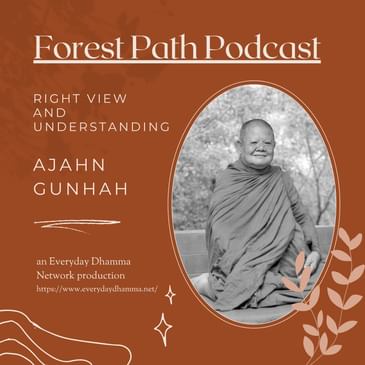

This episode is a short dhamma talk by Venerable Ajahn Gunhah Sukakhamo. The talk is called “Right View and Understanding”. It comes from the book Jai Dee - Jai Sabai - Delivery 2019. These talks were given to a mostly Thai lay audience and have been translated here by Samaneri Viveka at Wat Pah Subthawee Dhammaram.
[00:00:00] - [Speaker 0]
Welcome to the forest path podcast, a podcast sharing the teachings of awakened meditation masters of the modern era. This episode is a short Dhamma talk by the venerable Ajanganha Sukakamu. The talk is called right view and understanding. It comes from the book delivery 2019. These talks were given to a mostly Thai lay audience and have been translated here by Samaneri Vuvekar at Wat Pha Sabtawi Damarang.
[00:00:33] - [Speaker 0]
May you all benefit from hearing this gift of dhamma. Right view and understanding. Mayajangana. Every human birth can be regarded as precious and truly excellent. It gives us time and opportunity and the good fortune to train ourselves to attain path, fruit, and nibbana.
[00:01:04] - [Speaker 0]
The most important thing for us is to have the right view and right understanding. Everyone who wants to achieve excellence has to practice in accordance with the path, the teaching of the noble Sama Sambhutta. Our day has twenty four hours. We sleep seven or eight hours and are awake seventeen or eighteen hours. During these seventeen or eighteen hours of being awake, humans have to accumulate goodness, parami, and cultivate virtue so that we are the happiest person in the world in our daily life.
[00:01:41] - [Speaker 0]
Be really and truly happy that we get to practice in accordance with the dhamma, the teaching of the Buddha. The dhamma of the lord Buddha will lead us to enter the noble path, namely maga, pala, and nibbana. The lord Buddha had a lot of true spiritual happiness. Just after his enlightenment, he experienced the happiness of liberation for forty nine days, seven days sitting, seven days standing, seven days walking. He was happy all the time from his enlightenment until he left behind the to enter.
[00:02:24] - [Speaker 0]
Out of loving kindness, he taught and instructed us to give us a practice for reaching happiness and the ending of suffering while leading this precious life. He taught the noble eightfold path for us to practice. The four kinds of Samana, that is monastics and recluses, are in this eightfold path. The four kinds are Sotapana, Sakadagami, anagami, and arahant. We have to give importance to the dhamma as we are leading our life and make it our foundation and way of life.
[00:03:01] - [Speaker 0]
We have to follow the noble path. If we follow our desires and needs and the instincts of delusion, such as selfishness and clinging to our ego, the selfishness will be the cause and condition for our rebirth in the cycle of samsara, the cycle of birth and death. We will be stuck endlessly in this or that existence in our daily life. It is if as if the mind is going down to hell right here and now. We haven't died yet, but are falling into hell alive.
[00:03:37] - [Speaker 0]
The lord Buddha wants us to follow the middle way of neither indulging in central pleasures nor tormenting ourselves, and to develop our heart at the same time as making progress in business and technology for the happiness and comfort of body and mind. There are still wrong views and wrong opinions in what we have thought, seen, and understood so far. It is not yet samadhiti. Samadhiti is right view, right understanding. We will get to practice correctly.
[00:04:11] - [Speaker 0]
If we have wrong view and understanding, whatever we do will also be wrong because it comes from a foundation and an origin of Avichar, wrong view, and not knowing things as they really are. It is not a process, not a current that will lead us to muga, pala, and nibbana. Practicing dhamma means right view and right understanding. Practicing for things to be correct, for being happy around the clock. If we are happy and at ease, have satisfaction, our heart will be at ease, and our body will also become relaxed.
[00:04:54] - [Speaker 0]
Our body will be strong and recover from being sick and unwell. We will have a long life. Whatever we undertake will flourish, and we will be happy in body and mind at the same time. May you understand that we have to be mentally happy, happy in doing our work and in renouncing from early morning until going to bed when we lead our daily life. When we wake up, we practice in a way that working and practicing Dhamma really become one and the same thing.
[00:05:27] - [Speaker 0]
Doing morning and evening chanting, bowing to the Buddha, doing sitting meditation, and cultivating insight are also good and correct, but this is not enough yet. The lord Buddha wants us to combine working and practicing dhamma continuously around the clock except when we are sleeping. He wants us to have chandha, satisfaction, in practicing dhamma and in doing our work. When we take the noble eightfold path and apply it, put it into practice, our indriya will ripen. May you be happy when you are practicing and working.
[00:06:09] - [Speaker 0]
Dhamma will become something we can take in and consume. Our heart will be happy, and with the practice comes both physical and mental happiness. We will fulfill our human potential, go to heaven and attain in our daily life before we die. If our mind is not happy, the dhamma, the teaching of the Buddha, is still in the books, in the Tapitaka, we have to take it, apply it, and practice it to make our heart and mind happy. Dhamma has to be something that we can take in and use in our daily life.
[00:06:45] - [Speaker 0]
Our mind has to be happy and at ease all day long so that the dhamma becomes a continuous process that doesn't stop flowing. It is like water that is dripping drop by drop. It is not yet equal to flowing water. If it is a continuous stream, the water will be able to flow to the ocean. Reflect on it.
[00:07:08] - [Speaker 0]
Assume that we breathe only in the morning and in the evening, and during the day, we don't breathe. Can we stay alive like this? No. We can't stay alive. Practicing dhamma is the same.
[00:07:23] - [Speaker 0]
We have to practice day and night until we fall asleep. When we wake up, we continue to practice. The more we get into it and practice, the happier we become. If we stop as soon as we get just a little bit happy, it won't be useful. This is what the lord Buddha calls still dwelling in amusing oneself carelessness.
[00:07:47] - [Speaker 0]
Even when we are attached to happiness and comfort just a little bit, it is called dwelling in carelessness. It is like working one day and then taking several days off. Like this, we are just living on old merit and old goods. This is called still dwelling in amusement and carelessness. The lord Buddha taught that the majority of humans who enjoy happiness and comfort like this will be born in hell once they run out of merit because of their dwelling in amusement and carelessness.
[00:08:20] - [Speaker 0]
The majority of devas, heavenly beings, who are attached to happiness and comfort will be born in hell once their lifespan has expired. The lord Buddha wants us to be practitioners, workers, producers, givers, and create the causes and conditions to establish ourselves in continuous effort free from carelessness. We need a strong heart, sati and panya, and have to focus on practicing. Don't be someone who dwells in amusements and delusion and is attached to consumerism. When we are happy, we must also have wisdom.
[00:09:01] - [Speaker 0]
When we have panya, we will be happy too. As we lead our daily life, there will be a combination of wisdom and happiness. Generally, humans are deluded by and attached to physical and material happiness. This physical and material happiness is really and truly impermanent. It is born, ages, gets sick, dies, and gets separated.
[00:09:28] - [Speaker 0]
Even when we eat, sleep, maintain it, everything will leave us in the end without exception. Look at developed rich countries that are well organized and progress on the material level and in technology. Their development follows the principles of science and materialism, but they don't develop their happiness and wisdom at the same time. This leads them to having more mental problems and neuroses than our country. These days, children develop mental problems and neuroses before they are 10 years old because their parents have these conditions.
[00:10:07] - [Speaker 0]
The children inherit these from their parents. Above the age of 10, most of them have mental problems and neuroses, and this is because people are short of mental happiness. We have only developed on the material level in technology, but not in combination with cultivating the mind to have sati and panya. When we look at the general picture of the world across all countries, there is an increase in dukkha. Our development has to follow the middle way.
[00:10:37] - [Speaker 0]
There has to be a combination of developing technology and developing the heart at the same time. Our way of life will lead to happiness and the cessation of dukkha that is complete and made of samadhiti, right view and right understanding. Our practice will have both happiness and wisdom at the same time. If we are pleased, at ease, and happy with renouncing and doing our work as well as thinking, speaking, and doing good things, this is called sugatou. Regardless of whether we are staying or going, everything will be well because our heart has samadhiti, right view, and right understanding.
[00:11:20] - [Speaker 0]
If our heart is good and at ease, we will be happy. The various kinds of bad kamma that we have created in former times or any revenge or retribution because of these things will not be able to catch up with us because our heart is happy, has power, and an aura that protects us. The bad kamma, the results of intentional deeds of body, speech, and mind, won't be able to stick hard on our heels because our heart is good and at ease. When we reach vimutti, liberation, the old karma that we have made in former times won't be able to push us towards doing new bad deeds. Let's look at an an example.
[00:12:05] - [Speaker 0]
Look for example at venerable Anguli Mala. He had already killed 999 people, and only one more person was missing to complete 1,000. He heard the dhamma of the lord Buddha and reached happiness and the ending of dukkha, and his heart was good, at ease and free from dukkha. He entered the dhamma and became an arahant. Let's look at the example of the thief, Redbeard.
[00:12:32] - [Speaker 0]
His job was to be the king's executioner from young age until he retired. Venerable Sariputa taught him the dhamma so that he would understand, focus on the present, and be happy and at ease. The bad past karma he had made from youth to old age could not catch up with him because he was happy and at ease. He attained vimutti, liberation. The old karma and its consequence could not stick to him any longer because he had reached the dhamma.
[00:13:03] - [Speaker 0]
The karma had no chance. When we become rich, clever, and smart, all of us will develop mental problems and neuroses if we are not happy. We work and practice dhamma simultaneously to be happy and wise. It is like eating delicious food. If we keep eating, we will soon get full.
[00:13:24] - [Speaker 0]
Reaching the Dhamma is the same. Because we get into being happy and ending suffering, we will know ourself just like those who eat food. The dhamma of the lord Buddha works according to the principle of cause and effect, which can be studied by scientists. The dhamma goes beyond the scope of the scientists because scientists only develop material goods for the comfort of consumers. The lord Buddha takes further steps than the scientists.
[00:13:56] - [Speaker 0]
The Buddha developed his heart and mind for the arising of Panya in combination with happiness. Because it is possible to train the human heart and mind, excellence is a matter of training them in one's daily life. Train the heart to fully reach Buddha, the knower, the awakened one, the blessed one, while leading this precious life. Scientists only develop on the material level until they get mental problems and neuroses. They are still full of greed, hatred, and delusion and have wants and needs.
[00:14:32] - [Speaker 0]
The lord Buddha wanted all people to understand that they have to practice the dhamma at home, at work, in the factory, and at the market, in the fields and offices, and in the family. We have to be happy wherever we are. When you go back home, may you be happy with your family and relatives. Be happy and at ease keeping five precepts, bowing to the Buddha, chanting, doing sitting meditation. If we don't keep the precepts and do these practices to give our mind a break from greed, hatred, and delusion, and clinging, our heart will drop down to the level of an animal, elephant, horse, cow, buffalo, pig, dog, crow, or chicken, who just lie down to rest after eating.
[00:15:22] - [Speaker 0]
We will have the same status as as them and continue to drop into the cycle of birth and death. There will still be clinging, delusion, and delighting in gain, fame, and praise. Whatever our work and profession is, we have to be happy with doing our work. Our profession should not cause other people or beings suffering. We have to give importance to selah, ethics and precepts, and to dhamma, the laws of our country and to society.
[00:15:54] - [Speaker 0]
We have to dwell in the Brahma Viharas and not take the way to hell by drinking alcohol, using opium, heroin, marijuana, amphetamine, ecstasy, and ice. These intoxicants cause the stability of the central nervous system, sati and punya, to be destroyed. These faculties are the constituent factors of a precious birth as a human being. The lord Buddha taught that even when we consume alcohol, opium, heroin, marijuana, etcetera, unknowingly, it nevertheless is a transgression of the precepts for everyone. Why is this a transgression of the precepts for everyone?
[00:16:36] - [Speaker 0]
Because these things destroy the central nervous system, sati and panya. They are destroying the security of the excellence of our human birth. We study for having sati and panna. We have eyes, ears, a nose, a tongue, a body, and a mind for getting sati and panna. May everyone understand this.
[00:16:58] - [Speaker 0]
Even when the whole world is consuming it democratically, but it is destroying the stability of the human brain, sati and panna, every human being has to develop him or herself to reach the state of democracy. Don't be a womanizer because this causes problems for the family as an institution in the same way it causes problems for the big politicians who like to have playmates and young mistresses. When we have one wife, that is sufficient. We are not going to be that foolish because we are also parents for our children and grandchildren to look up to and respect. The lord Buddha does not want us to become lustful and gamble.
[00:17:44] - [Speaker 0]
We have to be diligent, honest, frugal, and make a plan for spending our money to avoid falling into debt. We have to become self sufficient like his majesty the king who was foremost in renouncing in this world. He practiced for us to look at him as an example, a role model, because being in debt is the worst dukkha in the world. If we are diligent, honest, frugal, and grateful, we will be rich and fortunate. For us, the word poor will not exist.
[00:18:17] - [Speaker 0]
Those who are parents are the examples for their children and offspring because they regard us to be their domestic family arahant. The parents are the arahants for their children, so we have to be the domestic family arahants. Then the children will respect and revere us for being role models. If we are happy and at ease and have and dhamma, our children and grandchildren will follow this example. When the parents are good, have and virtue, the children and offspring will be rich, fortunate, and prosperous.
[00:18:54] - [Speaker 0]
The dhamma, the teaching of the lord Buddha, is deathless. It is still with us all the time even though he already left behind the khandas and entered parinabhana. After hearing the dhamma, we have to be inclined to take it up and take it to heart. In practicing the dhamma, the lord buddha wants us to focus on the present. He does not want us to think about the past that is gone because it has passed, and we can't improve anything about it.
[00:19:26] - [Speaker 0]
If we think about matters of the past, it can be compared to eating old, rancid, rotten food that is not fit for consumption anymore. If we think about the past, we will cause ourselves dukkha and will surely get mental problems and neuroses. The lord Buddha also does not want us to think and worry about the future. He wants us to focus on the present. The present means practicing dhamma and working.
[00:19:56] - [Speaker 0]
We have to be happy in the present moment when we practice dhamma and work because the present will be our future. However, our present is like, this is what our future will be like because it is one and the same. At the time of the lord Buddha, there was a Brahmin who asked the Buddha if there will be rebirth or emptiness after death. The lord Buddha said that the Buddha does not answer this question because it has nothing to do with the ending of suffering. It can't solve our problems.
[00:20:27] - [Speaker 0]
We have to practice to realize our human potential, go to heaven, and reach Nibbana before we die. Dhamma has to be something that we can take in. It means to be happy in leading our daily life so that we will be happy and at ease all the time. Then the Dhamma of the Lord Buddha becomes really, truly, and utterly excellent. Even hearing the name of the Buddha will bring great fruit and merit.
[00:20:56] - [Speaker 0]
If we practice in accordance with him, we will attain even more happiness and an end of suffering. There will only be happiness, sati, and panya in our life, and everything will be profitable and beneficial. Our body is also beneficial when we use it for developing parami for maga, pala, and nibbana. The food that we eat, our lodging, our vehicles, and the comforts of our life will also have merit. We will get to reach Maga, Pala, and Nibbana before we die.
[00:21:30] - [Speaker 0]
The lord Buddha arose to lead us towards taking up the dhamma and practicing it. Thailand and many other countries haven't truly taken up the Noble Eightfold Path. This means complete happiness in the way that the lord Buddha taught it and practiced it in their daily life. They are only paying respects to the Buddha, do chanting, sitting meditation, contemplate dhamma, and attend meditation courses from time to time. We have to practice around the clock in all postures.
[00:22:02] - [Speaker 0]
We need to have wisdom and right view. Wisdom is very important. We study for wisdom and happiness to arise. Everything we do is for getting wise and happy at the same time. The lord Buddha asked venerable Sariputta, Sariputta, do you believe that the dhamma that the lord Buddha is teaching?
[00:22:25] - [Speaker 0]
Sariputta replied, I don't believe it yet because I have only a little wisdom unlike the Buddha. If I see it by using sati and panya, I will believe it. The lord Buddha nominated venerable Sariputta as the foremost disciple in Satti and Panya and made him his chief chief disciple on the right side, the best in wisdom. Everyone has to develop wisdom. There are no Harads who are stupid, blurred, and confused.
[00:22:55] - [Speaker 0]
They are all clever and smart, both in their IQ and their EQ. The lord Buddha nominated venerable Mogalana as the foremost disciple in psychic powers and made him his chief disciple on the left side. There is the question, if we practice dhamma all the time, won't we get stressed and become neurotic? The answer is if we practice dhamma day and night, we will only be happy. We won't get stressed.
[00:23:26] - [Speaker 0]
If we are just happy, how can we become crazy and neurotic? Here is another approach to get wisdom. After the Buddha had left behind the Kundas and entered Parinibbana, the Arahants held a council on Dhamma Vinaya. For joining the council, only Arahants were selected. An important monk was venerable Ananda.
[00:23:49] - [Speaker 0]
Ananda was not an Arahant yet. He was merely a Sotapana. The Arahants asked venerable Ananda to make an effort to become an Arahant. Ananda was determined to practice with full power. But no matter how hard he tried, he was still not able to reach Arahantship because there was the desire, the need to become a Narahunt.
[00:24:13] - [Speaker 0]
Ananda was incapable of reaching the dhamma and becoming an arahant until he made up his mind and said to himself, never mind that I can't get there. I'd better lie down and rest. As he was in the process of lying down, he succeeded in becoming an arahant before his back had touched the ground. Because he was not having any desire or need, he became an arahant. After he had succeeded in becoming an arahant, he used his psychic powers to disappear and appear among the assembled arahants who were waiting for Ananda who was striving.
[00:24:50] - [Speaker 0]
Ananda appeared in the midst of the assembly, raised his hands to pay respects to the arahants, and said, Ananda is here. The council can take place. May you understand the practice. May you have right view and right understanding. Then the practice will lead all of you to attain maga, pala, and nibbana.
[00:25:21] - [Speaker 0]
That concludes the dharma teaching right view and understanding by the Ajahn Ganha. I want to thank all of the supporters of this podcast over the past year. Your generous contributions via Kohai have provided me with the funds and inspiration to keep this podcast going. Thank you all so much. May you all experience insight and peace.