
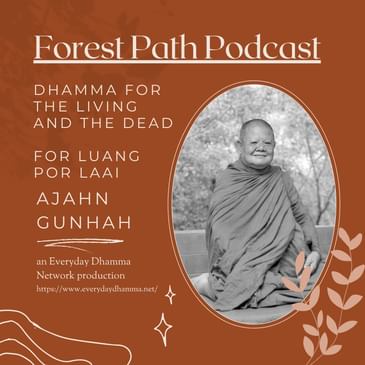

This episode is a talk given by Ajahn Gunhah Sukakhamo in commemoration of one of his senior disciples, Niphon Upakaro Bhikkhu, also known as Luang Por Laai. This talk comes from a booklet called “Dhamma for the Living and the Dead” which commemorates senior disciples that have died.
Luang Por is an honorific meaning “Venerable Father”. Luang Por Laai was a senior bhikkhu at Wat Pah Subthawee. He was 62 years old and had 26 rains retreats as a bhikkhu. He had had cancer for a long time and spent the vassa at a different place. One evening in mid-September, Luang Por Laai phoned Luang Por Gunhah because he was still afraid of dying. Luang Por Gunhah instructed him on how to separate body, feeling and mind, so that the mind would remain peaceful even though the body was dying. This teaching became the theme for many weeks during and after the funeral chanting.
---
[00:00:00] - [Speaker 0]
Welcome to the forest path podcast, a podcast sharing the teachings of awakened meditation masters of the modern era. This episode is a talk given by Ajangandhas Ukakamu in commemoration of one of his senior disciples, Nippon Upakaru Biku, also known as Lungpu Lai. This talk comes from a booklet called Dhamma for the Living and the Dead, which commemorates senior disciples that have died. Lungpu is an honorific meaning venerable father. Lungpu Lai was a senior bhikkhu at Wat Pha Subtawee.
[00:00:40] - [Speaker 0]
He was 62 years old and had 26 rains retreats as a bhikkhu. He had had cancer for a long time and spent the vassa at a different place. One evening in mid September, Lungpu Lai phoned Lungpu Ganha because he was still afraid of dying. Lungpu Ganha instructed him on how to separate body, feeling, and mind so that the mind would remain peaceful even though the body was dying. This teaching became the theme for many weeks during and after the funeral chanting.
[00:01:29] - [Speaker 0]
Lungpolai. Tonight, the Sangha, the Kruberajan, and relatives are making merit for Lungpolai, whose has said goodbye to and laid down the Sankara and finished this birth. Lumpur Lahi was a very good monk who practiced well and correctly in accordance with the Dhamma Vinaya and the code of practice. He was loved and revered by the bhikkhus, the fully ordained monks, and the Samaneras, the novices, as well as the laypeople and everyone else. He was trusted by the Khrubaajan.
[00:02:13] - [Speaker 0]
He was vigorous and strong and was an example and role model for the bhikkhus and Samaneras. Those who ordain to become bhikkhus and Samaneras have to adhere strictly to practicing the holy life to concentrate exclusively on maga, path, pala, fruit, and nibbana. They have to abstain from the five cords of central pleasure and strictly have to remove any trace of them from the heart, even perceptions of heaven. The Lord Buddha didn't allow this either in those who followed the holy life. He didn't want them to enjoy forms, sounds, odors, flavors, gain, fame, and praise.
[00:02:59] - [Speaker 0]
He wanted them to focus on Nibbana only. Those who are not ordained, the Lord Buddha wanted to be diligent, renounce, take responsibility, and not do anything unwholesome, only wholesome things and accumulate merit by giving dhana, keeping the five precepts, and practicing meditation. All people need to keep the five precepts. If one doesn't keep the five precepts, one's heart is not human. One is only a human being on the physical level, but the heart is not human.
[00:03:36] - [Speaker 0]
The five precepts are everyone's treasure of being a human being. In keeping the five precepts, the Lord Buddha wants everyone to focus on their intention and attention and maintain an intention in the heart like this: I will keep the five precepts completely pure. I won't let them get blemished, defiled, and flawed. If I'm uncertain and doubtful if something is right or wrong, I definitely won't do it. In case of uncertainty or doubt, the lord Buddha didn't want us to go ahead anyway.
[00:04:13] - [Speaker 0]
If you insist on doing it, it will surely break the precepts because there is still lingering doubt. The five precepts are very good, especially good. They can close the door to hell, and after leaving one's body behind, one won't be born as a peter, ghost, yaka, Mara, azura, beings from the lower realms, or an animal. The five precepts are like a motorboat that is very good, excellent. It is an engine with five powers and special abilities.
[00:04:47] - [Speaker 0]
It can be used as a vehicle for crossing the great oceans in safety. The waters of the great oceans are wide and vast. It is impossible to see the far shore. Nobody can swim across unless they use a good boat, then they can cross it. The Lord Buddha used the water of the great oceans as a simile for us to understand something, namely, the five cords of central pleasure, which are forms, sounds, odors, flavors, gain, fame, and praise that people are being deluded by.
[00:05:25] - [Speaker 0]
But the Lord Buddha didn't find any substance in. He wanted us to understand that the word kamaguna, which means rupa vedana sankara that are being combined to form our body. The Lord Buddha taught that rupa, vedana, sannya, sankara, and vinyana are not us. They are not our self. The body is one part, the mind is another part.
[00:06:02] - [Speaker 0]
Vedana is one part, the mind is another. Sankara is one part, the mind is another. Vinyana, that acknowledges things, is one thing. Our mind is another. They are different from each other.
[00:06:19] - [Speaker 0]
They are not one. The body that we use to work here, it is beneficial for us. When we use rupa, vedna, sannya, sankara, and vinyana, we have to use them with sati, mindfulness, and panya, wisdom. We apply them only to proceed in our quest for maga, pala, and nibbana. If we don't understand the matter of body and mind, we won't be able to separate the mind from the body.
[00:06:50] - [Speaker 0]
The Lord Buddha wants us to lead our lives by following the noble path. People have to follow the dhamma, the teaching of the noble Samasambuddha, the awakened one. The five precepts are the foundation and basis for the arising of Samasamadhi and Samasamadhi is the foundation for the arising of Panya. Sila Samadhi and Panya are the basis for the arising of Dhamma. All of us are very selfish.
[00:07:27] - [Speaker 0]
Everybody's life is based on selfishness. It is our livelihood. It is based on exploitation, on causing suffering for our fellow human beings and animals. Animals. Where is this exploitation coming from?
[00:07:43] - [Speaker 0]
It comes from being deluded with regard to sensual pleasures, from pursuing and obtaining them through seizing and exploiting. Our ancestors are rooted in delusion, delighting and carelessness, and are passing this on to us. It is inherited by many generations. The Lord Buddha developed the buddhaparami, perfections, for four uncountables and 100,000 great kalpas to awaken to become an arahant, a fully enlightened one, the teacher of devas and humans. It took a long, long time, many millions of lifetimes.
[00:08:26] - [Speaker 0]
He came to teach and instruct us on leading our lives according to the noble path. We don't have to create any evil, bad kamma, make enemies, or dig traps for ourselves. He wants us to use the precious birth in this human body for accumulating goodness, parami, and virtue. We have to use our mind to bring our indriya to maturity. How are we going to develop our Indriya?
[00:08:58] - [Speaker 0]
To develop the Indriya, one has to renounce, give dhana, keep the precepts, and cultivate samadhi and panya in daily life so that dhamma can arise in the heart. We practice dhamma while we are working and earning our living by using the body and the four requisites to our advantage and benefit. The Lord Buddha taught that the physical sense pleasures are an advantage and that the four requisites are beneficial. If we are deluded and dwell in delighting and carelessness, these things will be harmful to our mind. The Lord Buddha taught that there is only one noble path, namely, the Noble Eightfold Path.
[00:09:43] - [Speaker 0]
This path is divided into eight aspects. For the understanding of those who practice, what are these eight? These aspects are namely: one. Samadhiti Our view is not correct yet. We still hold the view that the body is ours and regard the body and the mind to be one and the same thing.
[00:10:08] - [Speaker 0]
But in fact, the body is one thing and the mind is another. They are different from each other. Two. Sama Sankapo Our intention is not yet correct. We are still deluded by sensual pleasures, by forms, sounds, odors, flavors, gain, fame, and praise.
[00:10:31] - [Speaker 0]
We are deluded by the karma goona. If we don't get things according to our needs and desires, aversion and ill will will arise. We are dwelling in carelessness and delighting and continue to create evil, bad kamma, make enemies, and endanger ourselves both directly and indirectly. Three, Samavacha, right speech. Our speech is not correct yet.
[00:10:58] - [Speaker 0]
We still tell lies, scold, use divisive speech. Our mouth ignites bombs, shoots like an automatic rifle or a machine gun. We are sarcastic, flatter people, gossip about and criticize other people. Four, right action. Our actions must not break the precepts, go against the dhamma, or break the law.
[00:11:24] - [Speaker 0]
They have to be rooted in what is wholesome and meritorious and not exploit other people or animals. Sama Ajivo. Write livelihood. Our livelihood must not be based on the suffering of other people or animals, for instance, through exploiting people or animals. Six, Samavayamo, right effort.
[00:11:49] - [Speaker 0]
We have to make an effort not to let unwholesome things arise in our mind and make a continuous effort to remove unwholesome things that have already arisen so that these come to an end. Samasati We need sati, panya, knowing, being awake, and being holy at all times in all postures. We have to practice like this all the time because practicing dhamma has to be a matter of knowing, being awake and being holy at all the time. We have to know body and mind, no feeling and mind, sankara proliferation and mind, no Vinyana acknowledges and the mind. Our satya and panna have to know fully so that we are not deluded and confuse the body with the mind and mistake the mind for the body, because the five khandas and the mind are different from each other.
[00:12:48] - [Speaker 0]
They are fulfilling their function, and our mind also has to do its duty. Then we will be able to develop our heart and mind to take the next step. Eight, Samasamadhi. Right concentration. Most people don't have any Samadhi at all.
[00:13:08] - [Speaker 0]
They only have the five hindrances that are in everyone's heart. Our Samasamadhi has to be very strong, has to be outstanding, to keep us from the hindrances that are with us all the time in all postures. We need Samasamadhi at all times. In a simile, the Lord Buddha compares Samasamadhi to a big, clear, deep, wide river. We see the water flowing slowly.
[00:13:36] - [Speaker 0]
It is flowing slowly, but it is deep, wide, and big. Sama Samadhi is a kind of Samadhi that contains Panna, and Panna contains Samadhi. We need this type of Samadhi at all times. The Lord Buddha compared the Samadhi from sitting in the morning, during the day, and in the evening with a river and the great oceans. When they are so wide, big, and vast that it is impossible to see the far shore, then they are called a great ocean.
[00:14:10] - [Speaker 0]
The depth of the great oceans is immense. Nobody can penetrate and understand it. In the end, everything is flowing down into the great oceans, and they are able to receive everything, regardless of whether it is clean or repulsive. Just like Samar Samadhi, the great oceans receive everything and are not perturbed by whatever comes flowing in. Everyone has to undertake getting Samhasamadhi because Samadhi means a heart that is free from the hindrances.
[00:14:43] - [Speaker 0]
Also, it is necessary to do sitting meditation in the evening before going to bed in order to rest the mind and the brain, to repair the body and the brain. This will train our mind to become peaceful, cool, and powerful. For all of us, the body is one part, the mind is another. They are different from each other. You have to develop Samasamadhi a lot and practice it continuously.
[00:15:12] - [Speaker 0]
Then your practice will be fruitful. May the special merit that the Sangha and the laypeople made be given and transferred to Lungpul Lai, and I'd like to invite Lungpul Lai to rejoice in partaking of the great merit shared with him. If he has any dukkha, may he be relieved from all suffering. If he is happy already, may he experience the highest and eternal bliss and enter Maga, Pala and Nibbana on this occasion. That concludes the Dhamma teaching by venerable Ajahn Ganha.
[00:15:56] - [Speaker 0]
If you'd like to hear more talks by Ajahn Ganha and other meditation masters of the forest tradition of Theravada Buddhism, subscribe to the forest path podcast by using your favorite podcast app. The forest path podcast is part of the everyday dharma network. If you go to everydaydharma.net, you can discover more about the other podcasts on the network also. This podcast is produced and narrated by Solhana. If you like these audio resources that I'm making available for free in a convenient podcast format, you may wanna become a supporter of the everyday dumber network via the Ko Fi creators platform.
[00:16:37] - [Speaker 0]
There are links in the description below. Thank you for listening. May you all experience insight and peace.