
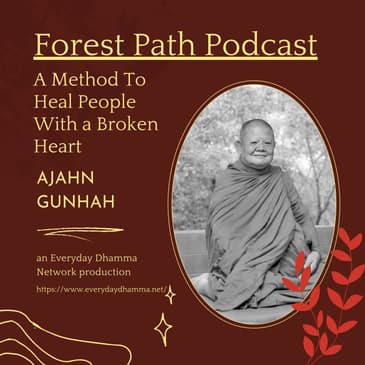

This episode is a talk given by the forest meditation master Ajahn Gunhah Sukakhamo and is titled “A Method For Healing People With A Broken Heart”. It was published as part of Jai Dee - Jai Sabai - Delivery 42. You can find links to the original text in the description below.
---
[00:00:00] - [Speaker 0]
Welcome to the Forest Path Podcast, a podcast sharing the teachings of awakened meditation masters of the modern era. This episode is a talk given by Achan Ganhasukha Kamo, and it's titled A Method for Healing People with a Broken Heart. It was published as part of Jai Dai Sabai Delivery 42. You can find links to the original in the description below. May you all benefit from hearing this gift of dhamma.
[00:00:40] - [Speaker 0]
A method for healing people with a broken heart by Ajangana. Practicing the Dhamma is an important matter for everyone. Nobody is exempt from this. There are no special cases. Everyone should regard it as an important matter in their daily lives.
[00:01:01] - [Speaker 0]
Tiredness and difficulties see them as something good. They make you resist, abstain, endure, and make an effort. The Lord Buddha wants you to check and diagnose yourself. Do I have any shortcomings? Is my practice defective in any part?
[00:01:20] - [Speaker 0]
Are any of my precepts broken and blemished? Am I developing sati, practicing samadhi, developing wisdom well enough and continuously so that my dhamma flourishes and grows as best as possible? Is my heart peaceful or do I send the heart out to external things until I change into being a distracted bhikkhu, a distracted samanera, a distracted nun, layman or laywoman? A person whose heart and mind is broken who is not peaceful? As a method to repair this, the Lord Buddha taught to turn inward and to look within yourself.
[00:02:02] - [Speaker 0]
He wants you to return to your course of practice, not to socialize with other people or the community. He wants you to try to be with yourself, practicing Samadhi a lot. Samadhi means peace. To become peaceful, your heart needs sitting meditation and walking meditation, not socializing with other people. Don't look at and watch other people.
[00:02:29] - [Speaker 0]
Watch your own body, speech and mind. People study. In the beginning, in kindergarten or grade one, they don't really know anything. When they don't give up studying and learning, they naturally come to know things clearly and accurately in their lives, until they can even complete a doctorate. Your practice and those who practice are like this too.
[00:02:54] - [Speaker 0]
You have to gain understanding and put it into practice. When you don't stop practicing and developing yourself and investigating causes, effects and the practice, When you truly follow the path of the Lord Buddha, then everyone will reach Nibbana. There is no exception. The tamma of the Lord Buddha is the science of cause and effect. Develop it until you are beyond cause and effect, a place that science can't reach.
[00:03:25] - [Speaker 0]
The Lord Buddha taught that these things are your responsibility, they are your duty. People who practice have to be calm and peaceful, not getting excited about people or external things. Never mind what arises in your daily life. Bring it to cessation and stillness, even your moods. Likewise for your mind.
[00:03:49] - [Speaker 0]
The Lord Buddha doesn't want you to follow your thoughts and moods regardless of what arises in your mind. Because otherwise, you will be a person without any Samadhi. You will be someone who falls under the sway of auspicious things or excitement about news or reports. The Lord Buddha wants you to train your heart to make it strong. Do not follow your emotions and your thinking.
[00:04:15] - [Speaker 0]
You do not really have any problems, but you follow your emotions, your thinking and your desires. What is a problem is that you are still alive, not yet dead, but you are being burnt alive. What is burning you? It's your wanting, that you continue to be deluded by thinking and emotions. You have to train the heart so that you can be peaceful and cool.
[00:04:42] - [Speaker 0]
The mind wants to think, to talk, to do something, yet you don't think, talk, or do anything. And if it doesn't want to do something, you still do it. If it is good, it is because the dhamma that the Lord Buddha taught. It is a dhamma that goes against the world, against the current, against your heart and mind. Practitioners have to make an effort to correct things in their heart and improve their actions and behavior.
[00:05:14] - [Speaker 0]
Try to withdraw from the notion of ata, self, that something is I, something is mine. You have a lot of ego. If you haven't developed and reflected on this, and you have been ordained for many years, your chalices will be equally experienced. When you are clever dhamma talkers and smart teachers, your chalices will be equally clever and smart in this. Whatever you do, your chalices will stick to you and follow you around like a shadow.
[00:05:45] - [Speaker 0]
Investigate it. Your kalesis really are like this. If you can't be the leader of the chanting, you don't even want to enter the sala because you don't get to be the leader of the chanting. For instance, if you are not really a great dhamma teacher, sometimes the krubarajan doesn't ask or allow you to give the dhamma talk or teach, and you don't even want to go to the sala. Can you see it?
[00:06:11] - [Speaker 0]
Can you see your chalasis? You have a lot of ditimana and want to show off with them with your good deeds, but don't want to do them when nobody is looking. Whatever it is, defilements get puffed up and exuberant. If someone doesn't act on them, they become despondent. These are symptoms of the heart and of the chalasis.
[00:06:37] - [Speaker 0]
You have to try to improve yourself. Your heart or your course of practice or good things belonging to you will progress and develop. When you experience tiredness and difficulty, you still have to abstain and endure in order to make an effort to prevent evil that has not yet arisen from arising, to abandon the evil that lies in your heart, in your disposition here, so that it is gone. Whatever you are doing or practicing, the Lord Buddha wants you to bring up the dhamma and not to bring up Atta which is something that is not good, not beautiful. It is not right and proper.
[00:07:18] - [Speaker 0]
Whatever you are doing, you have to be determined to do it well. This is in order to reach the complete satti sampajanya so that you can do good to the highest degree by not being careless. Monks and laypeople who like to send their heart outside have to return to the body, both in body and mind. This is called moving on after a mistake. Don't do it again.
[00:07:46] - [Speaker 0]
If you do it all the time because you have no satti, you become a crafty, deceitful person. Your kalesis deceive you, and you go on to deceive others. The Lord Buddha doesn't want you to run errands and to fuss over external things. Out of loving kindness and compassion, he emphasized pursuing your path of practice. Because this practice is important, it means progress in the Lord Buddha's dispensation.
[00:08:14] - [Speaker 0]
It is not about being famous, material wealth, fame and praise. It is important that you meet the standard of being bhikkhus, summoners, and laypeople. Most of you can't meet the standard, and when you can't do that, there aren't any examples and role models. There are just counterfeits and fakes. A decline in weakness like this is dangerous for you and others.
[00:08:41] - [Speaker 0]
More than forty years ago, someone published a book for laypeople to know what a real monk is. The weak and corrupt senior monks bought, burned, and threw away as many books as were printed because they were afraid people would recognize evil, recognize their behavior. That these senior monks or those who train new monks have these characteristics because their course of practice did not meet the standard. Their words and teachings would suggest incorrectly breaking the rules doesn't matter. One must not cling to them too much.
[00:09:17] - [Speaker 0]
This is michadhiti, wrong view, a grave danger for the behavior and the practice when you are still young and new to it. The Lord Buddha wants you to practice seriously and wholeheartedly to acquire the manners, behavior and character that make someone a disciple of the Lord Buddha. When you don't meet the standard, you don't reach the heart and mind. Thus, we see senior monks having problems with women, with deceiving the people. This affects the Lord Buddha's dispensation because your dhamma practice will not be continuous.
[00:09:54] - [Speaker 0]
When you have just a little gain, fame, and reputation, you already forget yourself. You forget a lot. When you want to go on arms round, you go. On days when you don't want to go on arms round, you don't go. When you want to go do chanting and sitting meditation, then you go.
[00:10:13] - [Speaker 0]
When you don't want to, you don't. The chalices are increasing all the time. The Lord Buddha taught you, both new and old monks and the laypeople in society, not to forget your body. Your practice has to be wholehearted and continuous all the time, never following your desires or your chalices. The Lord Buddha taught that this is good, a precious thing.
[00:10:39] - [Speaker 0]
You are smart and clever people. Obtaining happiness and the ending of suffering from other people is probably neither possible nor right. You have to get happiness and the end of suffering from yourself by not following these kalesis. The Lord Buddha says that it is very good and correct when you set such priorities for yourself. He wants you to look for dhamma and vinaya and not engage in external things in body and mind.
[00:11:10] - [Speaker 0]
That's neither good nor beautiful. In the past and future, you were controlled by the chalices. You have to be able to respect yourself and win the trust of people near you so that they can love, respect and revere you, earning their trust until there is no doubt or suspicion. What I have explained here is the noble dhamma of the noble Sama Sambuddha, who was taught: Bhikus, having warned you already, I shall warn you again, so that you can follow the correct path, follow the Dhamma Vinaya, so that you don't make mistakes and lose the path, which is a stinging, burning danger to the holy life, to virtue and goodness. I think this is enough explanation of the teaching of the Lord Buddha for today.
[00:11:59] - [Speaker 0]
Allow me to end with just this much. That concludes the dharma teaching, a method for healing people with a broken heart by the venerable Ajahn Ganha. If you'd like to hear more talks by Ajahn Ganha and other meditation masters of the forest tradition of Theravada Buddhism, subscribe to the forest path podcast using your favorite podcast app. You can also go to the website everydaydhamma.net for more. Thank you for listening.
[00:12:37] - [Speaker 0]
May you all experience insights and peace.