
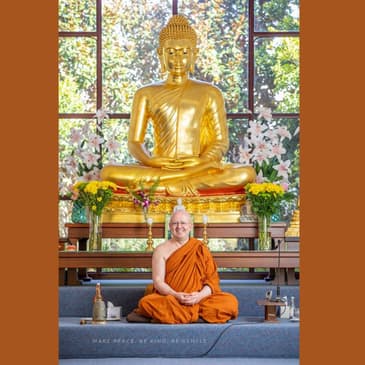

This guided meditation by Ajahn Brahm was originally recorded in 13th March 2010. It includes a talk about some aspect of meditation followed by a 45 minute guided meditation.
This guided meditation has been remastered and published by the Everyday Dhamma Network, and will be of interest to people who have started meditation but are seeking guidance to take it deeper.
These talks by Ajahn Brahm have been recorded and made available for free distribution by the Buddhist Society of Western Australia under the Creative Commons licence. You can support the Buddhist Society of Western Australia by pledging your support via their Ko-fi page.
Okay, well, I might as well start now. It's 3:00. And welcome to this afternoon's meditation session. And again, this is the ongoing class for those who've meditated before. Usually begins with about 15 minutes focusing on some subject concerning meditation, and continues with a 45 minute sitting. And that'll be finished with a 15 minute further discussion of questions and answers as, uh, as required. And I know that sometimes that people find it hard to sustain their attention on one thing for long periods of time, and that's an essential part of meditation. If the mind wanders backwards and forwards, it tires the mind out in the same way that if you sort of run backwards and forwards, you know, doing this and doing that, after a while, your body becomes worn out and the mind can be looked upon in a similar way. If you're always having to think about this, work out that problem, always running around backwards and forwards. There's no way that the mind can rest, and the same way the body can rest when it's still. You put it in an armchair, on a bed, or sit somewhere and you can just keep it still for a while. Then the body can relax. In the same way, we've got to try and find a way to keep our mind still so it doesn't sort of keep going backwards and forwards. But we have to keep it still in a pleasant position rather than holding it forcefully still, because even keeping the body forcefully still is no relaxation there. There's no sort of regeneration of the body's energies. So we find a way of meditation to sustain our awareness, to keep it still the same time, just too gently. And that is a trick of meditation and the way that is achieved to sustain attention on one thing for long periods of time is to gradually bring the mind into stillness, too little by little, to take away the more extreme forms of agitation in the mind, and then go to the less powerful forces of agitation and little, little, little by little, calming the mind down stage by stage. And it is because of knowing this, the way this mind works, the major thing which causes the mind to wander backwards and forwards is one's perception of time and one's, uh, attachment, the things of the past and one's fear of things, of the future. The attachment to the past means that somebody said something to you, which you didn't like, and you can't let it go. Some event happened earlier today, and we can still not forget it. And after a while now we can find that it's not that hard to let go of the past. All we really need to do is, number one, say it's allowable. Number two. And it's a very pleasant thing to do. And knowing it's allowable, it's okay. Nothing's going to go wrong. In fact, that your life is going to become even more successful when we let go of this past. It means we know we can be free. Uh, I often describe the past as like a prison whose cell door is open. In other words, you can actually leave whenever you want. You're not sort of have to stay in that prison of the past. So what we need to do is to know that it's possible to let go of the past, and then just to do it, and to be able to do let go of the past. We need something else which is more pleasant. And so the obvious place is the present, the present moment. When we stay in that present moment, it means the past is gone. And as far as our fear of the future is concerned, because people always plan and worry about what's going to happen next and where are they going to go, and whether it's all going to work out correctly, where they're going to make a fool of themselves, whether it's or are you going to get there on time, all that worry about the future, what's going to happen next can be overcome by just remembering what I say every week. That now, this moment, the present moment is a place where your future is being made. So by staying in this present moment, it means that you are doing your very best to create a pleasant, healthy, successful future by focusing on where the future is being made. I keep saying this because this gives you the incentives a reason to be in the present moment, which means that you are not going to, uh, have to keep wandering into the past and the future. And so after a while, you can sustain your attention in this present moment. Sustaining this attention in the present moment means you've let go of a lot of mind movements, a lot of remembering the past, worrying about the future which causes the mind to be tired. That's just the same way the body gets tired when you move around, so the mind gets tired when you move into the past and the future and backwards and forwards. So that first level of rest is to let go of past and future and sit comfortably in the present moment. Now, what happens when a person first decides to stay in this present moment is it's a bit uncomfortable for a person. It's almost like you have to hold yourself there, because the mind just wants to follow its old habits and go to past and future, to worry, to plan. But our job is just to hold the mind there as gently as possible in that present moment, but enough to keep it there until the mind settles in this present moment. Because after a minute or two, it settles in this present moment, and as if the mind recognizes, yeah, it's not a bad place to hang out, if that is very pleasant. The simile which I developed to explain this experientially is this present moment is like a seat on your long journey of your life where you can actually sit down and rest. In other words, a place where you don't have to keep going backwards and forwards on the journeys of your existence. It's a seat in someplace where you can rest, the only place where you can rest on a journey. And the problem is that present moment when you first sit on it, it's like a cold, hard, stone, lumpy seat. So I suppose you can sit down, but it's not that comfortable. However, if you remain sitting on that seat, just miraculously, the longer you sit on it, the more comfortable it becomes so that the seat evens out. So it's not lumpy. It gets softer, it gets warm, and if you stay on that stern seat long enough, it becomes like the most pleasant of sofas. And that's what the present moment does at first. When you are in the present moment, it's not that comfortable. If you continue to stay on that present moment, the longer you stay, the more comfortable, comfortable it feels. All that's really happening there is because you're still because you're resting. It's just the pleasure of rest. That the fact that when you're not having to go around doing this and doing that, it's such a relief. The mind starts to enjoy. The mind starts to appreciate. The mind starts to respect, the ability to stay in one place in the present moment. And it's that joy and happiness which comes with each of these stages of meditation, which really is the glue which can sustain your attention in that one place. So after a while, just to have bearing with in the beginning and realizing it's going to get easier and more pleasant, and the longer you stay in as a moment, present moment, present moment, then you will soon find that it's so easy to do and it just becomes as natural. You don't have to force yourself. The present moment becomes so comfortable. You like being there. And the reason that many of you come every week for the meditation and you meditate at home is because it is a pleasant experience as being in the present, you're staying in one thing. It's a place you can rest. And then when you're sort of comfortable in the present moment, that's us. Uh, okay. The next level of agitation, which happens in the mind is this thinking. And that thinking is obviously what can sometimes trigger off you going into the future. In the past, again, the thinking starts to create all these problems which need to be solved from your history. It starts to create all these fears and plans for the future. And the next thing we have to somehow overcome is the thinking mind, so we can sustain our attention in silence. And for many people, they think that it's almost impossible to be silent. But I think that each one of you have meditated long enough. You know it is possible. You can be sighted. You can just hold your attention just in what I call the place before thoughts arise. You're about to sort of say something inside your head. The word is about to come, but just at that point before it comes, it's a place of knowing, bit of silent, knowing where you can experience. But no name comes up in your head. It's like that silent, knowing and at first holding the mind in that place before the words begin in your head is. Sometimes you feel a little bit unnatural. Sometimes you feel it's a bit uncomfortable. You just stay there for a little while, because the longer you hold your mind in that space between the thoughts, in that calmness before, now the mind starts thinking again. The longer you hold it there, the more pleasant it feels. Which means that after a few, maybe a couple of minutes, the mind recognizes silence is so wonderful that that sustains the attention on the silence. Not because you're forcing, not because you have some idea. It's bad to think and think it's naughty if you're all sort of guilty, if you start thinking it's not through fear and not through that, um, that, uh, strictness of meditators, but it's just being there long enough and seeing just how enjoyable it is and allowing that pleasure of silence just to take you into long periods of a mind which hardly thinks at all. And here the mind is resting even deeper. It's not just going to the past and future. It's not creating all these labels and all these arguments and concepts based on the first words which come up in the mind. You hold it the very before the thought begins. That's why we call it sub verbal or preverbal consciousness. And once you get used to that, you've got the, the basic ingredients of what we call mindfulness and meditation. There's mindfulness is awareness. The awareness which isn't the only awareness which is really worth anything is the awareness right now in this moment. And the awareness which is before thought, because you can think about something, you can give it a name, but that's not the thing. That's just a word. You can either watch the words, the labels, or you can watch the thing. You can actually go to the museum and you can read the description on the of the exhibit, or you can just look at the exhibit, you can look at the brochure, or you can actually look at the thing itself. It's up to you which one you want to do. You can read the menu or you can eat the food. Which one do you want to do? And I understand what I mean. The menu is all these thoughts. The food is the experience itself. So we get this beautiful side of mine. We stay there. Now, sometimes people experience dullness when they first get into that silence and that present moment awareness that is par for the course, because it's just the mind recognizing that it's tired. But all one needs to do is to remain there, trying to do as least as possible in just the same way, when you keep your body still after a while, the energies can come back. You keep your mind still. It does become energized. Little by little, the mind wakes up and has huge stores of energy. My bliss gets stopped. It's an important part of the meditation. If you're going to take the meditation more deep, you have to have that strong mindfulness to know exactly what's going on inside. It literally is turning up the lights inside of your mind. At an earlier, later period. Sometimes people even try and make them do that. That way they get a bit restless and so it's easier. It's helpful for a person to get give them something to do, something just to hold on to while they're going into this present moment. Awareness and silence. Which is why we've introduced the breath sometimes earlier, that it would happen naturally. So you get to a certain point in your meditation and you think, well, look, if I'm not going to have something to to focus on, I'm just going to wander around and all this other stuff is just going to keep coming up and start closing me agitation again. So instead of having anything to think about, we wander, we contemplate and not contemplate. We focus on our breathing, the feeling of the breath as it goes in, the feeling of the breath as it goes out just that much. And again, just like all those other two stages of meditation, the first time you watch the breath, it is uncomfortable. Stay with it. Even though it's uncomfortable at first, if used to stay with it and hold it there for a little while. It becomes more pleasant. This is what happens in life. Even when you sat on your chair when you first came in here, it was not comfortable. Now you are comfortable on your chair, on your cushion. You settled in, are all settling in. Takes a little bit of time. Even when you are with your breath at first is not comfortable. Doesn't matter. Settle in there. And after a couple of minutes, you'll find your breath is very comfortable. And if you have taken the awareness of the rest not to. Not too soon. If it's too soon, you won't be able to hold it. You do that present moment, awareness and silence enough so you can hold the breath and it doesn't want to go anywhere. Your mind just stays with it. And of our course, a few extra little tricks to be able to remain with the breath. And the main trick is the kindness. Uh, what many meditators their mistake is for they assume that they are in control of the breath. And literally, they regard their breath as a slave, as some servants, they can order around. And because the attitude they have to the breath when you start doing breath, meditation is one of a master or mistress unto their servants. The relationship means that the first opportunity of breath is going to run away. It doesn't like you because you don't treat it well. So if instead you change your attitude towards your breath, it's not one of a master with a slave, but as a friend, a friend with a companion. This is almost like a being. You anthropomorphize the breath as if it was a being who served you and looked after you. And you have so much gratitude and so much respect and so much love for your breath. You literally stay with the breath as you would stay with a good friend. You hang out with her. You spend time with him because you love each other's company. And when you get to that attitude, of course, it's extremely easy to stay with the breath for long, long periods of time. And because it's a very pleasant experience. Now you're really getting into the meditation, being able not just to look at the breath for no 6 or 7 breaths in a row, not just for a minute, but sometimes ten, 15, 20 minutes. You're with the breath, not missing any breath. Why? Because it's fun to do. And you feel this great feeling of peace inside of you. And that feeling of peace, that feeling of clarity, that feeling of mental joy again is what keeps you sustained on that breath. But at the same time, not only does it serve to sustain your attention on the breath for a long period of time, it also serves the purpose of increasing the energy flowing into your mind, because you're not having to do so much, because the mind isn't sort of frantic with all its responsibilities, the past and the future and all these jobs. You have to do all these lists of stuff. You've let all that go so you feel totally free. So by sustaining your attention on the breath, it is like moving your body to a place of vacation, to a resort, to a holiday where you can really relax not just for an hour, but for seven days or fortnight or whatever. You really get into it. So as you learn how to meditate in this way, you sustain your attention on these things and after a while the mind gets more and more peaceful. You re-energize the mind, the mindfulness increases, and with it the peace, the enjoyment and the beneficial results. To sustain the attention on one thing is important. An essential part of meditation. And that's how it works. Bear with it at the very beginning. It will get easier to do. And once it really gets easy to do, then sustaining your attention is the simplest thing in the world. Why? Because it's so much fun to do. That's just a little piece of information on sustaining attention. So now we can actually start the meditation. And again, once again, as I say every week, this is the ongoing task. So those people who came in late who were looking for the introduction to meditation class that's being held in the room from my right. So if you're not used to sitting for 45 minutes, it might be too much for you, because now we're going to start about a 45 minute meditation period. So if you'd like to get yourselves comfortable sitting on your chair, your cushion or whatever, and then we can begin. To close your eyes. Where we do long 645 minutes or longer. Spend plenty of time at the very beginning making sure your posture is just right. How you make sure the position of your body is correct for you is by feeling it from inside. Closing your eyes, you're giving more space in your brain to feel the sensations of your body. When the brain is mostly mostly taken up with sights and processing the visual images, it doesn't just doesn't have the time, it doesn't have the space. So now, with your eyes closed, when I become quiet, you'll have more space. Just to feel the body. As you feel the body. You see anything? Feel anything which is uncomfortable. Please move to adjust the body to find your individual perfect posture. Don't move away from the body yet. I still have things to tell you on how to be more comfortable. You want to adjust the body? Please do so. Any irritation inside an echo of pain which cannot be overcome through movement. And put your mindfulness inside that feeling as if you are right in the middle of it and from the middle of it. Spread out this beautiful forces of kindness. Kindness. Compassion. Softness. Lessen the tightness which contributes to the pain. Being kind relaxes the much of the irritation. Not all of it, but much of it can vanish. Leaving you more comfortable to begin your meditation. When the body is really relaxed, then you can let it be. And to sustain attention, put a lot of importance on present moment awareness. Revising the past in the future is the first big obstacle sustaining the attention. This one keeps on moving backwards and forward. Has his own garden. And as the place is being made. Keep your mind in that point between the past and the future. The present. The now may feel uncomfortable at first, but persist. In the present moment will become the present moment. Once you're in the pleasant awareness. And you can go deeper into the silence. Be able to sustain your attention without a thought arising in the mind, because you hold in that place with all sorts of eyes, knowing you don't need to give things a name. Read. I see the commentary is not needed. Whenever you want to watch the breath, go ahead. The. Getting very close to the end of the meditation now. How do you feel? What's there like inside and why? How much peace? How much clarity? How much stillness have you generated? As we use the last couple of minutes of meditation to reflect on how far we've come and how we've come here. And I guarantee, ring the gong three times when the meditation. Please listen to every sound from the gong. The end of the third ringing of the gong. Open your eyes and come out for your meditation. And when you do sustain your attention, you shall find in the mind. Does feel a sense of peace. And after a while you can recognize what that peace feels like. You can also recognize the clarity of the mind. In other words, the mindfulness gets very precise and very strong. If you're more awake than you shall not less awake. And with that energy which comes from sustained awareness, you finally get a sense of joy. It's what we call the pleasure of peace. The sheer joy which comes up when the mind becomes still, which is always associated with stillness in the mind. Its mind is truly still. That energy, that power and that joy always come up. So it's one of those great signs you can know whether you're meditating well or not, just how much joy arises in the mind. How much energy is there? Sometimes people say, oh yeah, they were very peaceful, very still, but they've been half asleep, which means afterwards they haven't got that sharpness, that joy, that sense of power. And once you start getting enough of that strong mindfulness. Then it becomes very clear what you're doing or why you're doing it. It's one of those difficult things about meditation that the mindfulness is clarity of the mind is precise. Awareness is necessary to be able to go into deeper meditation, but to allow that mindfulness is very difficult to can't do it just through willpower. You do need it by the following of this ancient path of letting go of the past and the future. Silence. Focusing on something like the breath to keep the mind still enough for long enough that the mind really wakes up because you lose so much energy through doing things. With thinking things so much movement is waste. The energy of the mind keeping the body still and the mind still means the energy builds and builds and builds. Like damming up the stream. You get a huge pool of water and just by keeping the mind from wandering backwards and forwards, you are damming up the energy of the mind as it gets strong and you are clear and you are powerful. When the mindfulness starts, it gives you the feedback. So you know you're meditating and you can see from mindfulness how things are changing. You're clear enough to see whether you are becoming more peaceful, more awake, or just more asleep, more negative. So you can find out just the mindfulness tells you you are going in the correct direction. The simile I gave a long time ago. It's just like being on top of a mountain. When the mist comes down. You don't know what's north, south, east or west because in the mist on the top of the mountain, all directions look the same. You can't see far in front of you. And that happened to me as a young man in Scotland. I found the solution knowing that if I always went downwards, sooner or later you'd come below the mist. I found a little stream a little bit below it, and followed it as I went further and further down the mountain, and as I went further down, the mist got less and less. And soon you got to that point where you just went below the cloud, and then you could recognize your directions, you know which way to go back to the hostel. I use that as a simile in the beginnings of meditation. You don't really know which way you're going. At least you can have some indication. If you feel a little bit more clear. A bit more peaceful. It means you are going in the correct direction. If I'm going in that direction of greater peace, greater clarity, greater sense of ease, and then you get to that point where the mindfulness really wakes up. You've been below the mist. You know, you see exactly what you're doing and where you're going in the meditation. You know what letting go is? You know how to focus. You know the joy of stillness. Because when the meditation gets to that point, the mindfulness is clearing up. And of course, once that clarity of mindfulness is there, it's very easy to find your way. And you know, you're finding your way to go down into the beautiful, peaceful, joyful states of deep meditation. That's actually how the meditation works. So, you know, it's working because the mindfulness gives you the information. It's changing in the right direction. It feels more peaceful. It feels more free. It feels more still. Okay. So are there any questions or comments about today's meditation? Yes, this. Okay. There is a progression. There is peace comes first. You make peace with things, which means that you don't interfere. You don't agitate the world. So peace comes first and that creates stillness. Peace is something you do. First of all, you make peace. You are peace, which means that the world may be very agitated, but you are making peace with it. So you may have aches and pains in the body. You may have sounds outside, but you're not fighting them. You're not interfering with them, which is you're making peace through a piece of the world. You're not necessarily still yet, but when you're at peace, even with a mind which is moving all over the place, stillness will soon come. So that interpretation of peace is what gives rise to stillness. And the more still you are, the more energy you have, and the energy is to try. So I think it's, uh, a good way of looking at this. The peace to stillness. To joy. Of course. Then you get more peace and more stillness and more. Around whatever place that is doing. So I've got. It is true that it's much better to follow a natural way of just allowing the joy to develop by itself. But every now and again, you can sort of add a little bit of joy. You know that one of the great tricks is just sitting there and it's pretty dull. Smile. You just fake a smile. And just that physical action has a psychological counterpart. You do just feel that little bit more joy. And sometimes that could be the spark. We're just noticing there's a seed of joy in the mind. And that, again, that joy is what will allow stillness to be even more profound. Because why are you still. It's because you're enjoying it where you are. Restlessness is always a sign of discontent. You're not happy where you are. You want to be somewhere else. But joy means you're happy being here. You're having a great time. Why move? Yeah. Yeah. Yeah. And it's also stillness is, uh, it's this, uh, you know, that, uh, simile of the Russian Dolls. I remember you got me some Russian dolls once, and those are Russian dolls. The next one is inside. The next one is inside. The next one? Yeah. The joy is in there. Even the journeys are right inside this very moment. But they're wrapped, wrapped and wrapped and wrapped. And sometimes the joyful meditation is being so still that the wrappings just fall off as you go into this moment. It's a very wonderful way of looking at the present moment is in the middle of this time, right in the center, the center of the present moment, right in the very middle, you find silence. You don't need to sort of move to the breath in the middle of the side, and it's just the breath comes out. I've explained why because it's the only part of the body which is moving. Everything else is just disappeared because the brain can only notice movement in the middle of the breath. It's a beautiful breath. And when the beautiful breath breath disappears, you get an impetus in the middle of the impetus. That's where you find the journeys, the next journeys, in the middle of the last one. So so wrappings. So yeah, it's true. The choice in this moment. But sometimes people take a few wrappings off to find it. Any other question? Okay. Just one, two questions and then we'll leave because we've got an AGM afterwards. Yes, sir. And you see yourself falling asleep. Please let yourself fall asleep. Don't fight it because you deserve it. Because you're tired. And when that happens, at least you know you're letting go. You're not being a control freak anymore. And as I said, just make peace with that sleepiness because you're making peace with that sleepiness. You're allowing energies to come back. So know how long it takes. But usually if it feels safe, it doesn't take that long. In a 45 minute set you've got the opportunity to go through that. And usually by the latter half because you're just really let go. You haven't fought. It means that the energy start coming back. And the last part of the meditation is really clear and beautiful. But if you fight, you just have a terrible time almost fighting a battle you won't win. And if it does win, if you get tense afterwards, just make peace with it. Let it be. Yes. Yes there is. One. Two. One two. One, two. And so you're going to pack up now because in a quarter of an hour we're having our annual general meeting here. So pay respects to the Buddha Dam and Asanga and then Earth go to the toilet, whatever, so you can get ready for those who are staying for the annual general meeting. Stay for that.