
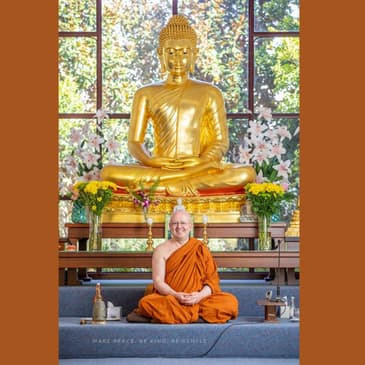

This guided meditation by Ajahn Brahm was originally recorded in 6th March 2010. It includes a talk about some aspect of meditation followed by a 45 minute guided meditation.
This guided meditation has been remastered and published by the Everyday Dhamma Network, and will be of interest to people who have started meditation but are seeking guidance to take it deeper.
These talks by Ajahn Brahm have been recorded and made available for free distribution by the Buddhist Society of Western Australia under the Creative Commons licence. You can support the Buddhist Society of Western Australia by pledging your support via their Ko-fi page.
[00:00:00] - [Speaker 0]
So welcome everybody to this afternoon's meditation class. And again, this is the ongoing class. So those who have come for the introduction to meditation class. The introduction class is a series of four talks for people starting out. Meditation is held in the room to my right.
[00:00:17] - [Speaker 0]
This is the ongoing class for those who've meditated before. Because on this class we usually sit for about forty five minutes, which is a bit much for people who just started. Of course, you can always meditate on the chairs which are quite comfortable. People can watch a movie for a couple of hours sitting comfortably on a chair, so I'm sure you'll be able to sit comfortably on a chair to meditate for forty five minutes. And every Saturday afternoon I mention another aspect of meditation.
[00:00:47] - [Speaker 0]
And the aspect I'm going to mention today is watching the breath and when you should watch the breath or whether you should just let the breath come up naturally. Because I've been meditating for such a long time, I usually let the breath arrive naturally, I don't go searching for it. But it's only because I know my mind and I've meditated for such a long time. But for many of you, if you just try the basic outlines of meditation which I've been teaching for many years. So first of all just relaxing the body and then bringing up the attention onto the present moment, deliberately letting go of all past and future and then going a bit deeper into the present moment to a silence of the mind.
[00:01:25] - [Speaker 0]
Then usually, you know, if you do that properly the breath comes up by itself. But for some people, sometimes that's not enough to keep the mind interested. When the mind isn't interested, you'll find it will wander off to other objects. You'll start going off into thoughts, fantasies, plans or memories of the past. Anything to fill up the mind because the present moment is yet to be interesting enough to hold the mind still.
[00:01:52] - [Speaker 0]
And so because of that it is sometimes quite useful to pick up the breath not forcefully, but deliberately. To ask yourself: am I breathing in? Am I breathing out? How do I know? To get the feeling of the breath and use that as an anchor for your mindfulness.
[00:02:11] - [Speaker 0]
But whenever you use any deliberate choosing of something like the breath to focus your mindfulness on, you must always remember to be very gentle and very kind. Because too often if a person chooses their meditation object, in other words deliberately saying now I'm going to start watching the breath go in go out, very often you'll find that when you start watching the breath it becomes uncomfortable. Before you're watching the breath, before you decided to watch the breath, the breath went in and out nice and smoothly without any problem at all. But as soon as you pay attention to it, we tend to interfere with it. It's something quite subconscious, we don't mean to do it, we just do it.
[00:02:52] - [Speaker 0]
And what happens is the breath becomes more uncomfortable, it becomes harder to watch it and we go wandering off again. Which is one of the reasons why so many people when they meditate, they watch the breath, they wander off, they pull their mind back again, they wander off, they pull their mind back again, and it gets endless and they get very fed up with always having to pull the mind back never being able to stay with the object. And that is one of the reasons why that I love doing the present moment awareness in the silence at least for a while at the very beginning, but you don't need to make it perfect. If you find that you've done present moment awareness and a bit of silence enough and you're starting to get a bit bored, go on to the breath. The sign that you need to go on to the breath is the mind starts to wander a little bit.
[00:03:36] - [Speaker 0]
It can't stay in the present moment. It's a sign that the mind is not really satisfied. It wants something to happen. You've got to acknowledge that whether it should be that way or should not be that way, that's what's happening. So at that particular time bring the attention onto the breathing.
[00:03:52] - [Speaker 0]
All you need to do is ask yourself: how am I breathing in, how am I breathing out? Just like now I ask that question. And you'll be able to be aware of some sensation in the body which is the feeling of the breath. It does not matter where that feeling is located. Tip of the nose, bridge of the nose or anywhere, it doesn't matter.
[00:04:10] - [Speaker 0]
In fact if you don't locate it on the body but just know it as a feeling anywhere, then you'll find it's much more productive because as long as you've got some awareness of your body, you'll also be aware of aches and pains and itches, heat and cold, and that will just disturb the meditation. So the best thing to do is just to know the feeling of the breath. And once you know the feeling of the breath, that gives you something to be aware of, something quite clear to be aware of. But again you have to make it so gentle and kind because when you're gentle and kind you'll find the object starts to relax. So the breast starts to go back to its smooth and easy way of entering and exiting your body again, just as it's doing now and you're not paying any attention to it.
[00:04:58] - [Speaker 0]
So that takes a lot of letting go, lot of ability to watch something without interfering. That's what we call like 'letting it go', letting it be. That's a difficult thing to do, but you can do it with a little bit of practice. And what I mean how you do it, how whenever you're meditating, the mindfulness, the awareness, you can feel the breath, you know it's either comfortable or it's not so comfortable. And just by doing a little bit of this letting go, you get a feedback straight away.
[00:05:24] - [Speaker 0]
You notice the breath get more smooth and more easy. Great, you're going in the right direction. But if you find that the breath gets more tense or you get more tense with the breath, you know that you're sort of forcing it too much, you're going the wrong direction. Mindfulness gives you feedback. So be aware of that feedback so you know whether you're going in the correct direction or not.
[00:05:46] - [Speaker 0]
If you get more tense, wrong direction, sort of stop it and do something else. If it's the right direction you'll find you're getting more peaceful and calm. So we can see the breath getting more and more still. Now one of the other ways of letting go, which really works, which keeps you in contact with that object, is just simple kindness. For a long time now I've made a very strong point of when you are mindful of something, always add kindness.
[00:06:15] - [Speaker 0]
Because if you're mindful with sort of a hard mind, you're really going to be mindful no matter what. The meditation never works, you get more stressed out. So your job is actually to be kind to whatever you're aware of. To be kind to it means, you know, in the language of that book, 'Open the Door of Your Heart' to say this moment now, this breath now, whatever this breath is, I open the door of my heart to this breath exactly as it is with no conditions, no judgments. You're just very very happy to be alive and to be breathing and just to be with this.
[00:06:47] - [Speaker 0]
And with that degree of kindness you'll find it's much easier to stay with the breath. I know that sometimes people find it hard to stay with the breath long enough to actually do the meditation to really get deep. You ask yourself why is that? Sometimes there haven't been enough preparation. Sometimes it's because when you have got the breath sometimes you forget the important qualities of present moment awareness and silence.
[00:07:11] - [Speaker 0]
So when you are with the breath, if you take it up early, keep on remembering present moment. Keep on remembering silence as you're watching the breath. By that I mean all you need to be aware of is this breath happening now. The last breath, who cares? The next breath, wait for that to happen.
[00:07:30] - [Speaker 0]
Just this one breath happening now is the only thing in the whole world for you. The only thing you're really concerned about. Just to be with one breath. And that degree of present moment awareness makes it much easier because a lot of time you'll find the reason we sort of haven't got enough awareness to really see these things clearly is because half our mind is off in the future wondering what we're supposed to be doing next. Or you know wondering what is going to happen next expecting, anticipating, wanting which is all about the future.
[00:08:00] - [Speaker 0]
So even if you take the breath early on in the meditation make sure you remember the breath happening right now. Just this one breath. And if you really get into it, just not any old one breath, even part of this in breath, part of this out breath happening right in this moment to try and really focus on the present moment. And secondly, no need to have a conversation about the breath. Keep it silent.
[00:08:23] - [Speaker 0]
You don't even need to think to yourself in, out, in, out, beginning, middle, end. Because you know it's beginning, you know it's middle, you know it's in, you know it's out. You don't need that commentary. You don't need to keep telling yourself these things. As soon as you start talking by saying in, out, in, out, you start saying boring, I don't like this, what am I going to do next, what am going to have for dinner this evening, I'm going to go out this evening, it's having good on the TV tonight.
[00:08:46] - [Speaker 0]
You go off into this long conversation, why don't you start? So it's much easier just to be with the breath without any commentary whatsoever. So even though you're going on to the breath quite early, just present moment awareness and silence all the time with the breath and also with that kindness. Another way of looking at kindness and I use this very often is sometimes if I'm watching the breathing and it's not really developing, it's not getting very deep sometimes I do a little exercise which I call just smiling at the breath. I imagine the breath is a friend and I just smile at it and I find that whatever I smile at usually smiles back at me.
[00:09:29] - [Speaker 0]
And if you smile at the breath, the breath smiles back and you have a much easier time staying with something which is nice to look at. See, like I'm smiling at you and you smile back, you can't help it, that's what happens. So if you smile at the breath, the breath smiles back to you and it's much more fun, it's easier to stay with. And of course this is what we need to do especially very beginning when we're watching the breath to keep it in mind for long enough that it stays there. And that becomes a little exercise which with experience we find it's not that hard to do.
[00:10:03] - [Speaker 0]
And once we get over that first minute or two with the breath and we can stay with the breath, that's the hardest part. Then what happens next is the breath starts to relax naturally and the breath starts to become peaceful and because your mind is not having to be bothered with so many more things, it's got more, if you like, more brain space just to be aware of the breath so you can actually see more. Imagine like your brain has got just a certain amount of capacity and when most of that capacity is used for thinking, for planning, you know, you've got hardly anything left to notice something like the breath. When all of that present, that past and future and thinking is all put aside, you've got your eyes closed, all you've got is a breath coming and breath going out. That's all your brain has to deal with.
[00:10:48] - [Speaker 0]
You've got all that capacity which means that the breath starts to become very clear and very full. So it's not just you see going in going out, you see the whole of the breath. This is just what happens as everything else the brain has to do is pushed aside and the brain has only got to focus on one thing breath going in and breath going out it actually sees much more of it. This is what we call full awareness of the breath. And this is where you see the breath from the very beginning of an in breath.
[00:11:19] - [Speaker 0]
You see it growing growing growing growing growing and then it falls away quite quickly. The peak of the breath is not sort of halfway according to time from the beginning to the end. It's sort of my bet anyway. So you breathe in, it reaches its peak and it falls away quite quickly. And then also because you've got more brain space you can even see this incredible place, the space between your breasts where nothing is happening.
[00:11:45] - [Speaker 0]
The pause and that's a great place for a person to become aware of. A place where nothing is happening but you're just being. Because this is one of the great places where you can find some peace and emptiness in life. It's being able to notice the space between things rather than the things themselves. And after a while that becomes a very very great spiritual observation to be able to see the space between things rather than the things themselves.
[00:12:15] - [Speaker 0]
After a while you can go into a room, you don't notice the people, you notice the space which is between people, which doesn't divide them but which connects them. You can notice the space between events in your life, the places where you can rest, when nothing is happening, when there's peace, space between actions, which is rest. And the more you notice that, the more you recognize peace, and how much peace there is around to be recognized. And then you can dwell with peace much more just when you recognize it as a space between things. The silence between noises, just the times of rest between activities.
[00:13:01] - [Speaker 0]
The space. So you can see the space between the out breath and the in breath and the in breath and the out breath. All that's happening is the brain is having more ability because it's got more space for this. So as you do this you'll find that the mind becomes more interested in this breath and once it starts to become interested in it then this whole meditation just takes off by itself. By taking off by itself it means you literally are the passenger.
[00:13:30] - [Speaker 0]
You don't have to do any driving. A lot of times you try to drive you just mess it up anyway so you tend to let go and just allow the meditation to bring you to great states of peace, clarity, energy and joy and also insights later on. But it's just getting to that stage when the breath becomes full and becomes very interesting. And these are just a few little tricks in order to get there. So for those of you who've been meditating here for a long time now, when you sort of start to get into the, always do the first steps, you know, maybe not as long if you want to get onto the breath pretty quickly.
[00:14:03] - [Speaker 0]
Always get into sort of relaxing the body, sitting on the chair, the cushion, the stool, closing the arch, feeding the body, making sure everything is okay, do at least some present moment awareness just to get the mind into the present moment because it goes against the way we usually use our brain in the world. We always have to sort of plan what we're going to do next. Keep an eye on the clock. We have to be creatures of time most of our lives, but in meditation we're not creatures of time. We live in the present moment instead where time disappears.
[00:14:35] - [Speaker 0]
So at least do a little bit of present moment awareness. And then do a little bit of recognising the importance of silence, which is like devaluing all the words and the commentaries, taking that importance away from always having to give things names and write reports about stuff. So spend a little time doing present moment awareness and silence and then if you want to pick up the breath, to pick up the breath, sure you haven't sort of got present moment awareness and silence totally down yet, but you've got it down enough. You can get the breath and continue that ability to settle in the present moment and be silent along with the breath. And then as you manage to settle down into present moment silence with the breath then you find that the breath becomes very peaceful very beautiful and this is a natural event which happens in meditation when the one object stays in your mind for long enough Because the brain has got filled with this one object and it's a simple object, not only does it fill the space of the brain, but the brain has got more energy.
[00:15:43] - [Speaker 0]
And very same way that you put a magnifying glass in front of the Sun outside, it focuses the energy and you can burn paper with the focused energies of the Sun. Same way, when all you've got is just a simple breath, it focuses all the energies of the mind, and you get some sense of power and energy, and that power and energy, you'll experience this meditation joy. I think it's really good and really nice, at the same time peaceful. So that's a little bit of instructions about just maybe going to the breath a little bit earlier than you would otherwise, and just what to do when you have that breath a little bit early, to learn how to relax it and learn how to still do a little bit of present moment awareness and silence along with your breath. Okay, any comments or questions about that?
[00:16:35] - [Speaker 0]
Okay, so once again for those people who have come to the Introduction to Meditation class, where we learned for the very first time about meditation, that's in the room to my right, this is the ongoing class for those who meditated before. So we can now get ready to sit for forty five minutes till 04:00 and after 04:00 have opportunity for questions. Already one question in the box here. Hope it's on meditation. Because the box questions here are only meditation, not about the meaning of life or any sort of Buddhist philosophy but just on meditation.
[00:17:09] - [Speaker 0]
So please get yourself in the meditation posture. There is no magic posture. Each one of you has your own unique posture which is best for you. And you may be in a posture which has never been in any book on meditation since the time of the Buddha. But if it works, great, sit like that.
[00:17:40] - [Speaker 0]
And then close your eyes. And with the eyes closed, bring the awareness to the body first of all. Give the body a few minutes. When you close the eyes, the eyes take so much space in your brain, the sense of sight. When you close the eyes, you have more space again, this time to feel the body.
[00:18:40] - [Speaker 0]
So you're not so distracted. You can really get to know some of these sensations, and do something about them. If there is any tight pieces of clothing, listen now. If your legs aren't properly adjusted, adjust them. And if there's any feeling inside the body which you can't access with a finger to scratch, you can't move, then send it kindness.
[00:20:41] - [Speaker 0]
With mindfulness together with compassion, you can learn to relax the inner parts of your body. And that will take away not all of the irritation or pain, but a significant part of the irritation and discomfort. As you learn, through focusing your mindfulness and compassion for a sustained period of time, minute or two, you find a significant relaxation. And when the body is lovely and relaxed, then start your present moment awareness, deliberately letting go of all the past, and telling the mind this is not the opportunity, not the occasion, for figuring out the past. The job of meditation is to let it go, And also remind yourself that this present moment is the place your future is going to be made.
[00:23:42] - [Speaker 0]
And any peace, any wisdom will only ever be found in the present moment. To inform the mind how valuable this moment is, and focus on the moment. Where there's no past and no future, what's left is called now. You know the present by what is absent. Until you can recognize this moment called now as an old friend.
[00:24:29] - [Speaker 0]
And be kind to this moment. Whatever sound, whatever feeling, embrace it as a a truth, as a reality, which is there to teach you as a friend. As you sit at the feet of the great teacher, the now. Again, enough time to establish yourself pretty well in the present moment. And in this moment, see if you can be silent.
[00:27:15] - [Speaker 0]
So whether it's the sound of the the worker next door or the sound of the crow, we know the noise without any complaint. Knowing these things without uttering a sound inside our own mind. As we develop that inner silence, a mind that can know this moment without any commentary. If you want to pick up the breath early, ask yourself, am I breathing in or breathing out? That should be enough for you to know the feeling of the breath.
[00:28:46] - [Speaker 0]
And you may notice as soon as you become aware of it, you interfere with it, and it's not comfortable anymore. Just bear with it. It will soon settle down again. By focusing on the breath in this moment, to the exclusion of all else, you're giving all the space in your brain just to the breath. And shortly you'll be able to see so much more of your breath, from the very beginning to the end, and even noticing the spaces between the breaths.
[00:29:31] - [Speaker 0]
With all the sounds and distractions a long way away, focus on the breath, and everything else is like on the edge of your mind, not in the center. And so I will become quiet now. Not. Okay. One.
[00:52:59] - [Speaker 0]
Bye. Yeah. It's very close to the end of the meditation now. How do you feel? How much stillness have you allowed to grow in the mind?
[01:02:35] - [Speaker 0]
On owing the gong three times to end the meditation, Please listen to every sound from the gong. When the last sound from the gong vanishes, then come out from your meditation. Okay. That's how you meditate. If you follow the instructions and keep the mouth quiet, any sound outside doesn't disturb you.
[01:03:59] - [Speaker 0]
As the teacher always said, it's not the sound disturbs you, you disturb the sound. The question here is a very simple question: Is there any frame times you should allow after eating before you meditate? No, no. You can meditate straight after eating. If you eat too much and stuff yourself, then you're going to fall asleep.
[01:04:22] - [Speaker 0]
But eating normal amounts, can meditate afterwards. Because the real art of meditation is there's nothing to do Well, it helps if you look after your body and if you keep it quiet beforehand. But really, skillful meditator just knows how to let go, and knows how just to watch this mind get more and more and more peaceful. And one of the most important things is when it does start to get peaceful, just to learn how to value that stillness. And again, even as you go deeper into the meditation, may get very, very peaceful, but the mind might wander off again because you don't value and feel that this stillness and peace is really, really important.
[01:05:07] - [Speaker 0]
It's one of the reasons why at the end of every meditation I ask people, how does that feel? What is that peace like? And after a while, you get like a connoisseur of those peaceful states of meditation. They've become so beautiful and so nice that you don't want to allow them to disappear by thinking about all these sorts of different ideas. Because sometimes that's what happens in your meditation.
[01:05:34] - [Speaker 0]
Sometimes the mind gets peaceful, it gets clear, it gets energized. You think, wow, now is the time I can start to work out all my problems. Because it's true that at particular stage in meditation you're going to think very clearly, much more clearly than your normal state of consciousness. Unfortunately, that you're really wasting that clarity by using it to solve problems, just leave those problems to way down the track. And instead just go deeper into the stillness.
[01:06:02] - [Speaker 0]
Just hold the mind there and enjoy the peace and enjoy the happiness of meditation. I always say that's really a great pivot point in meditation, those who want to go deep into meditation. They get to the point where the mind is just so bright and so joyful, you're just happy just to keep on meditating. And when the bell goes, you think, oh gee, why does he have to ring the bell? Why couldn't I have gone on for a bit longer?' you really are enjoying it.
[01:06:31] - [Speaker 0]
That's a sign that meditation is really going well. And as you go more into that joy and that peace, you'll find that joy gets very, very strong. And the more strong the joy, it's a sign of your mental energy growing. So the more mental energy you have, when it's focused and still, the more sort of joy and sheer pleasure you have in meditation. It becomes the most wonderful abiding, sitting there having a very peaceful, beautiful time.
[01:07:01] - [Speaker 0]
And of course that's what happens. You start off with just present moment awareness letting all of that busyness of life which is all to do with the past and all to do with your hopes and plans and dreams of the future Yeah, you have to do that sometimes, but please, in meditation, just put all of that aside. It's not necessary. You deserve a break, and in fact your future goes much better if you leave it alone for forty five minutes. As far as the past, you give it too much importance.
[01:07:33] - [Speaker 0]
And then you give too much importance to all these words as well. You bring it to silence. So there's not a word that goes on in your mind. So you actually feel, you hear, and even though it's the sound of a building. It's always amazing on a Saturday afternoon, doing the meditation, it's either the dogs or the lawnmower or someone building.
[01:07:53] - [Speaker 0]
But as soon as the meditation finishes, so does the building next door. That's a lie. So what happens is that we don't make a big argument about that. What I meant by that great saying is that it's not that the noise disturbs you, that you disturb the noise. Sometimes that noise is just a little sound, bang, whack or grind, whatever you're doing there.
[01:08:19] - [Speaker 0]
But it stops. And when the sound stops, you should stop with it. So you don't go thinking, oh, we shouldn't have done that. Why can't we get a more peaceful place? And go starting to think of all the different ways we could soundproof this room, and give personal air conditioners to every person.
[01:08:38] - [Speaker 0]
So I remember years and years and years ago thinking that we could have these little sort of ducts which can drop down, you can pull down to get your personal temperature, your personal air conditioner, and have like soundproof triple glazed windows or whatever. But the point is that that's not going to work anyway. It is the sound in the head which is much more noisy than any sound from outside. And that's the one we can deal a lot with, the sound in the head, which is just be silent. And so in the moment, in the silence, these things are just part of this present moment.
[01:09:15] - [Speaker 0]
We don't fight it, make ourselves one with it, we're at peace with it. Then that peace grows, because the peace grows, because we're not fighting, we're not waste our mental energy and negativity, the mind does brighten up. When it brightens up, the mindfulness is very easy, very easy to be aware of the breath when your mindfulness is very strong. And the breath becomes very beautiful. Just watching the breath go in with a feeling of joy and happiness inside.
[01:09:42] - [Speaker 0]
And when that starts to happen, then you're off into great meditation. Just keep on letting go, and you go into some very powerful and deep states which are incredibly good for you. Gets rid of all sorts of diseases and sicknesses and tensions and depressions and anxieties. It's a great sort of way of dealing with the mind, this meditation. So that's actually what happens.
[01:10:06] - [Speaker 0]
And as far as eating is concerned, you can eat before meditation, you can eat after meditation, just don't eat during meditation. Please in the class don't bring any biscuits in case you're a snack. So then you have a nice time. A lot of time you don't feel like eating after meditation or even before meditation. As long as you're not really hungry beforehand.
[01:10:29] - [Speaker 0]
Obviously if you're really hungry and especially if your stomach starts rumbling during the meditation, sometimes it's very disturbing to the people sitting next to you as it goes rumble, rumble, rumble. But as long as you're not sort of too hungry, and afterwards you feel quite satisfied. A lot of eating is either social or it's because you eat just because it's fun to eat rather than you need to eat. When you're very meditating, very peaceful, don't feel like you're eating all that much afterwards. You're just satisfied, you're happy.
[01:11:01] - [Speaker 0]
But if you do eat after meditation, on the subject of eating, you will find something very wonderful happens if you eat after meditation. And that is because that you've been peaceful and you've energized the mind. Your senses become enhanced. So just like imagine like your windscreen of your car, you've been out bushed and there's all this dirt and muck on it. And somebody gives you a really good windscreen cleaning.
[01:11:30] - [Speaker 0]
So you can actually see through it now and it's clear. And all the images and the colors outside are perfect. That's what happens when you meditate. It's like cleaning the windscreen of your senses. So what you hear is much deeper.
[01:11:47] - [Speaker 0]
What you see is brighter, and what you taste is more delicious. So if you meditate before going out to eat, you'll enjoy your food much, much more. So especially if you go out to an expensive restaurant, it really is to cost a lot of money. Please make sure you meditate beforehand to get your money's worth. And also, my advice when you go to expensive restaurants, if you go with your partner, please tell them once you start eating, shut up.
[01:12:24] - [Speaker 0]
Because you go there to pay for their food, not to pay for the conversation. Because every time you're having a conversation you're not being mindful of the food. They're distracting you. How can you be aware of what you're eating and putting in your mouth when you're talking with someone sitting next to you? So when you start the move, right darling, shut up, I'm eating.
[01:12:46] - [Speaker 0]
If you want to have a good conversation, then go to McDonald's or go to KFC or something, it doesn't matter what you put in your mouth, or when you're having really great food, shhhh, be quiet. And that's what happens. I noticed that when I used to meditate. Not when I used to meditate, I still meditate obviously, but when I was a layperson, I used to meditate. You meditate before a meal and the meal really tastes good, it really tastes beautiful.
[01:13:11] - [Speaker 0]
Simply because your taste buds are enhanced because of the power of your mind. So it really is worth it. And that way don't have to be a good cook to turn off the people you live with, just tell them to meditate beforehand so they really appreciate all the hard work I've done in cooking my food today for you. And when they do eat, tell them to be quiet, so be very mindful. And there's an old trick of, we usually tell this on retreats, if you are eating, see if you can do when you're eating even this evening, as part of a meditation practice, to do the one spoon or one fork or one chopstick at a time practice.
[01:13:52] - [Speaker 0]
What I mean by that is suppose you're eating with a spoon, usually what happens you find you see people they've got a morsel of food in their mouth which are chewing. They've got another one on their spoon waiting in line. They've got a third heaped up in a code on their plate, where they're looking around what's going to happen next. They're usually about three or four spoons ahead of themselves. So you try that tonight when you're having your meal.
[01:14:20] - [Speaker 0]
Just make sure you've got one mouthful in your mouth, and you're paying attention to that. You're chewing it, you're swallowing it, you're enjoying its taste. You're not worried about what you're going have next. Just one morsel at a time. So eat that first of all and swallow that.
[01:14:36] - [Speaker 0]
And only when you're finished, when it's down your throat, only then what am I gonna have next? So then you can put the next piece on your fork or chopstick or spoon. But don't be two, three or four ahead of yourself. Because that's what happens to you in life. You're always so far ahead of the now.
[01:14:53] - [Speaker 0]
You're never really in life. So you're never really tasting the food. You're thinking what you're going to have two or three or four morsels in front of yourself. Don't do that. Taste this food.
[01:15:03] - [Speaker 0]
This is really really nice. When finished then what we're to have next? See if you can do that. Just a little practice of being in the moment and enjoying your food even more. And I should know about enjoying food.
[01:15:17] - [Speaker 0]
Look at the size of me. You see, there's a trouble with monks. We get too nice food and we enjoy it too much because the power of our mind is so delicious.' Okay, so any other questions about food before we finish off this evening? Are you hungry yet? Okay, let's finish off now.
[01:15:38] - [Speaker 0]
Just an announcement that there is going to be a Sutta class tomorrow for those who want to come for three to 04:15 session. It's number 59. 59. 9. 59.
[01:15:52] - [Speaker 0]
Okay, let's see Sutta class tomorrow at three to 04:15. We don't usually have one on the first Sunday but because I cancelled last week because we had the big food fair, so this week we're having last week's Sutta class. Okay so those of you who want to exercise your tummy by bowing three times. It's sort of exercising it before you put food into it. Please if you like to bow three times.