
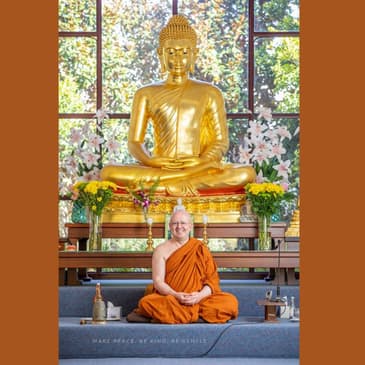

This guided meditation by Ajahn Brahm was originally recorded in 27th February 2010. It includes a talk about some aspect of meditation followed by a 45 minute guided meditation.
This guided meditation has been remastered and published by the Everyday Dhamma Network, and will be of interest to people who have started meditation but are seeking guidance to take it deeper.
These talks by Ajahn Brahm have been recorded and made available for free distribution by the Buddhist Society of Western Australia under the Creative Commons licence. You can support the Buddhist Society of Western Australia by pledging your support via their Ko-fi page.
[00:00:00] - [Speaker 0]
Good, so welcome everybody to this Saturday afternoon meditation class. This is for those who've meditated before, the ones who have come for the introduction to meditation class being held in the room on my right. Again, is a class for those who have meditated quite a few times, who know how to at least sit for forty five minutes, at least the body can be still, Although we don't know what goes on inside your mind when your body is still, whether you're meditating or whatever. Somebody again asked me a question during the week, which was an important question to do with meditation. It's all about, you know, should you control inside the meditation?
[00:00:43] - [Speaker 0]
For example, if you're, say, watching the breath, should you ask the breath to come back every time it wanders off? Or should you just let it wander off? And many of you who have heard me teach for many years know that I always favor the path of letting things go and not controlling at all. But that takes a lot of mindfulness to do that properly, a lot of awareness to see you really are letting go. Because what happens many times So what usually happens is that, say people whose breath is wandering off and they go and try and bring it back again, then it goes off again, you bring it back again, it goes off again, you bring it back again.
[00:01:20] - [Speaker 0]
You'll find by such a method you never find real peace inside the mind, because you're always doing something. And a way to understand what you should actually do if the mind goes wandering off, is to realize the reason it goes wandering off, the reason why it doesn't go to stillness, the reason why things don't calm down, is always because you are actually doing something. That you, your will, your actions, your inner choice, that inner instability is causing the mind to wander and to keep on moving. You make the mind move. If you can understand that you realize that the path of meditation, the only way you can meditate and find some stillness is to be able to keep your finger out of the water, to stop getting involved.
[00:02:14] - [Speaker 0]
Unfortunately stopping getting involved in the process of meditation is a very very difficult thing to do because mostly it's automatic for us to get involved. It's automatic for us to try and control things. And it's automatic for us, even when we're meditating, to do something rather than leave something completely alone. Every time that I've been traveling in somebody else's car, especially the last week when I was away in Malaysia, people go taking you from one place to another. There's always two or three people in the car and those two or three people all got a different way of getting to the destination.
[00:02:51] - [Speaker 0]
And they just can't resist but telling the driver the better way to go. They can't stop interfering with the driver doing the driving, even though they're only the passenger. Or as we say in English, the back seat driver. Now remember, if you're going anywhere, it's the driver's job to get you to the destination. And you have to trust that driver knows where they're going.
[00:03:19] - [Speaker 0]
And if you keep interfering, if you keep giving instructions to the driver, usually just make an irritation for yourself and also for the driver. But it's so hard to stop, isn't it? So hard to think that, to stop thinking we know better, we know the best route. That's a wrong way to go. Leave it up to us and we'll tell you what to do.
[00:03:41] - [Speaker 0]
And that's exactly the sort of attitude we have, if you could see it in your meditation. Even the meditation, you think you know better how to meditate. So you keep interfering with the mind's path to stillness. If the mind wants to wander off, I let it wander off. But I'm very mindful that I realize that I am not making it wander off.
[00:04:03] - [Speaker 0]
I'm not telling it to go left, to go right, to go straight ahead. I am being what we call in meditation the passive observer. So it's passively observing what's going on. Or the other way of putting it is the kind observer. And remember the kind observer is someone who says, the door of my heart is open no matter which way you go, mind.
[00:04:30] - [Speaker 0]
Mind, if you want to go and think about all sorts of things, if you want to fall asleep, the door of my heart is open to you, mind. This wonderful unconditioned kindness. Or sometimes I've called this unconditional mindfulness. We have like mindfulness, we sort of know what mindfulness is, but often your mindfulness has got many conditions on it. You say, okay, just mindful of the breath, nothing else.
[00:04:58] - [Speaker 0]
That's not unconditional mindfulness, that's conditioned mindfulness. You'll only accept the breath and nothing else. That's conditional. No wonder it never gives you any state of peacefulness. So instead of doing that, instead of being a backseat driver, you get in the car and all your control, the only thing you do to control your meditation is to tell the driver when you first get in where you want to go.
[00:05:27] - [Speaker 0]
So you tell the driver, we'll do some letting go, just make peace, be kind, be gentle. Okay? And I'm going for stillness. If you just tell the driver that, it will know what to do and now give it time to do it. And all you need to do is to be a passive observer.
[00:05:45] - [Speaker 0]
To be able to look at every moment of the mind and say, I'm just going to be unconditionally mindful of whatever happens. With no judgments, with no preferences, with no saying this is right and this is wrong. Just to be totally aware of every moment without doing anything. Now if you meditate like that, 100%, you'll find the mind does become still. Because the very reason the mind moves, because you're doing something, you're interrupting, is removed, is taken away, and the mind just becomes still because you're not doing anything.
[00:06:22] - [Speaker 0]
Sure it might wander around for a little bit at the very beginning, but that's just what I call a result of old karma. Your mind has been busy and this is still the reverberations of the busyness you've had before. It's just like the engine in your car is still hot after you park it. It takes a while to cool down. Your brain takes a while to cool down because you've been thinking and doing things.
[00:06:46] - [Speaker 0]
But if you leave it alone, it cools down. You stop doing things, things settle down. And that's how I've experienced my meditation for many years. Sit down, close your eyes, and just be unconditionally aware of whatever's happening right now. Not doing anything, not choosing anything, just totally letting go.
[00:07:09] - [Speaker 0]
But you have to have enough mindfulness, enough awareness to really do that properly. Otherwise what happens, you may get a thought or a fantasy coming in the mind. And if you're not aware enough, actually choose that, you grasp onto it, you follow that, that's interesting, wow, this is really nice, and you just waste your time. And it's not that you haven't let go. And the mind is still sort of moving and it's still agitated.
[00:07:35] - [Speaker 0]
The reason is because you've liked that, you've wanted that. So in order to assist, sometimes at the very beginning of the meditation we do give more instructions, just until we get that degree of awareness that we can truly let go. Until we are clear enough in our mind, we know when we're putting our fingers in the bowl, when we're taking them out, we're interfering, when we really are letting go. We have enough clarity of mind to know exactly what we're doing so we can truly let things go. And if you have that degree of clarity and mindfulness and you truly can let things go, let them go.
[00:08:15] - [Speaker 0]
Don't do anything and you'll find that's by far the best way to meditation. And the deeper you go the more important that instruction is to do absolutely nothing, to let go, to be the passenger, to be a quiet observer, to be totally passive. But as I was saying to the Eight Precept Group this morning, a lovely instruction which can help you, And I keep getting reminded of this instruction every time I sit here when the wind is blowing outside. Because where I'm sitting now you can see quite a heavy wind and all the leaves blowing backwards and forwards, moving really fast. But as I look outside, the branches are moving less, the trunk hardly moving at all, and as you go to the base of the trunk where the root is, no movement is discerned.
[00:09:12] - [Speaker 0]
And now my eyes have got a choice where I look. I can look at where the leaves are moving a lot, or I can turn my attention to the trunk and the base of the trunk where there still is. And sometimes I ask myself why do I always look where the movement happens? And why can't I move towards the trunk where the stillness is? And the reason is, is because we are attached to movement, to events, to excitement, to things happening.
[00:09:42] - [Speaker 0]
And that's one of the reasons why we create a wandering mind. Because we are attached, we like activity, we like things occurring. We just don't want stillness. However, in meditation you can turn the attention from the things which are moving to the things which are still. Because in that vision of a tree I can see the whole tree, and I have a choice where to look.
[00:10:11] - [Speaker 0]
In the same way that you have a choice where to look in your mind, that the still point is there, or the activity, which is alongside it. And if you give those instructions to your driver, please look at the still point, the base, the place where there is no movement, and don't look at the ends where there's huge amounts of movement, then your mind won't go wandering off. It will stay in the still point. But you have to want to be in that still point. You have to convince yourself that the still point is a place where you'll find peace, freedom and happiness.
[00:10:54] - [Speaker 0]
And perhaps that's my job to convince you that when you are meditating here, stay in that quiet stillness within. You'll find you have that choice to tell the mind to go wandering off into fantasy and dreams, or to stay in the stillness which is available to you. Please choose the stillness, Because it's in the stillness that our meditation works. Until, of course, you get to that place in a meditation, which I kept on calling the delightful breath, the beautiful breath, the place where the mind becomes so happy just meditating, really no more instructions are required. Just the happiness is so beautiful, so nice, that the mind refuses to wander off.
[00:11:41] - [Speaker 0]
The mind will only wander off when it's not feeling so happy, when it's not truly content. When the mind is content, it finds its peace, it finds its stillness, and you don't need to do much at all. So that's a little bit of instruction to begin this meditation. Learning how to let go, but getting enough mindfulness before you really let go. Otherwise you don't know really what you're doing, whether you're letting go or not.
[00:12:10] - [Speaker 0]
Not being a backseat driver and also seeing if you can incline towards the stillness, rather than the movement. Okay, so those of you not already in your meditation posture, if you like just to adjust your posture to get into your meditation position. And we can now begin. So closing the eyes and bringing attention onto your body. And with the mind focusing on the body, become increasingly aware of the sensations in your body.
[00:14:26] - [Speaker 0]
And as you settle into your body, should you experience any sensations in your body which you can soften by moving the body, please do so. And if there's any sensations deep inside, which you can do nothing about by movement, and send those areas of the body kindness. You may not be able to eliminate those disturbing sensations, but just through some kindness, through some compassion, you may find that you can lessen their impact and their disturbing value. But you have to maintain mindful compassion on them for quite some time. For maybe three or four minutes, for the relaxation effects to occur.
[00:18:58] - [Speaker 0]
And once the body is well relaxed, then take the attention away from the body, which in a weather such as this can be very tired and very heavy. And put it to the present moment just now. We should let go of every thought of the past, no matter how important. We let go all of our past. We let go all of our future too, except for the place this future is being made, now.
[00:19:41] - [Speaker 0]
We open our hearts and our minds to the content of now with unconditional awareness of this present moment. Whatever this moment is, painful or pleasant or boring or whatever, we open our mind to it, just knowing it, being kind, being gentle, and making peace with this moment. And thereby letting stillness grow in this moment, until this moment becomes a pleasant abiding. Making peace, being kind, being gentle to this moment is how that delightful peace can arise. It's close to the end of the meditation already.
[01:00:06] - [Speaker 0]
How do you feel? How much letting go have you really done? So use these last few minutes to contemplate and gain insight onto the nature of a peaceful mind and its causes. I'm now going to ring the gong three times. Please listen to every sound from the gong.
[01:02:21] - [Speaker 0]
At the end of the third ringing, come out from your meditation. So experience, we can find out how to calm the mind. Certainly if ever you're hot or cold, remember as a monk sitting in really hot places and very cool places. And as soon as you rest your body, relax it, and then leave it alone and go into the mind, you just don't even feel the body, don't even feel the cold or the heat. Some of those places, remember just in The UK, were incredibly cold.
[01:03:48] - [Speaker 0]
And all you can do is just sit down and really relax, take your attention away from the body. And after a while you couldn't feel your body anymore. The thing is because it got numb from the cough. You just couldn't feel it because you weren't paying attention to it. It looked after itself.
[01:04:05] - [Speaker 0]
And the same in the heat, if you feel very very hot, take your attention away from the body and then sort of become focused on the mind. When you come out afterwards your body is quite relaxed. And there's something about the body that the more one worries about it, the more one gets in touch with it and involved in it, the more it tends to ache and hurt. I've also told this to many meditators, and it's a strange thing that I'm getting old now and just the body is beginning to have more aches and pains, as will always happen. But after an hour if I meditate a bit stiff, but if you meditate for two or three hours you don't get stiff at all.
[01:04:44] - [Speaker 0]
It's as if when you get into Samadhi, in other words a deep stillness of the mind, it is amazing just how the body not only looks after itself, but looks after itself much better than if you try to do something yourself. It's as if when we really disengage from our body, we really let it go and go into a place where we can't feel the sensations of the body, then the body looks after itself. It looks after itself much better than even than in sleep. I know that sometimes I've read in newspapers that some people have great injuries, either they're attacked or have car injuries, and they're put into an induced coma. And in that induced coma their body tends to heal.
[01:05:28] - [Speaker 0]
Maybe that's something different, this is not an induced coma but a self induced deep meditation experience. But certainly a lot of sort of healing and lots of relaxation of the body occurs. So I know that when I meditate and get into some degree of samadhi, my body feels so good afterwards. It feels a lot of peace and relaxation. So if ever you are suffering from the heat and there's no air conditioner or no fan close to you, remember that's always something you can do.
[01:05:55] - [Speaker 0]
You can just sit down, make your mind peaceful and calm, and then get into some deep meditation. I remember as a kid, you know this was, well it was in nineteen seventy, sixty nine, seventy, the only TV programme which was even close to meditation or Buddhism was this TV series called Kung Fu, set in The United States Of America. It's a combination of a cowboy, you know, a western, with lots of guns and shooting, but also with this kung fu guy called, know, he's a different Mark Grasshopper. I remember one of the series when, because he was punished for something or rather, mostly just racist because the guys running the ranch or something didn't like the Chinese and they put him in this tin shed for two or three days. And usually it just it was a punishment but he came out just totally peaceful afterwards because he sat there meditating.
[01:06:53] - [Speaker 0]
And I thought wow that's really really good to be able to sit in this small teen shed and just meditate for such a long time. Just come out just perfect. And of course that really sort of inspired all the other people there that sort of stuff could be done. And a few years later when I was in Thailand you were doing the same thing yourself when Natchan Cha used to put you in this small it was the old Ulpocita Hall. It was just brick walls, very small building with a tin roof on it, no insulation, no ceiling.
[01:07:25] - [Speaker 0]
And you go in there after lunchtime, this was in the hot season in Thailand, and you had to wear all your robes, including your spare outer robe. And you were allowed to take extra blankets if you want to meditate for two hours in the hot. And that was like torture, know, if I did things like that Amnesty International would arrest me. I'd get sort of hauled up before the course of doing that to my monks. But at least you learn there that even though it's incredibly hot and even the Thai monks thought this was really hard to burn.
[01:07:56] - [Speaker 0]
Were a westerner, you know, born in England, in a place which would just use to cold weather. But to be going in there and just learn how to just to be at peace. And of course the only way to endure such incredible heat and sweatiness was just to stop thinking about it, to let go and just go inside the mind. Just watch your breath and just be very, very, very peaceful. Be in the present moment, be silent and start watching the breath and it works.
[01:08:25] - [Speaker 0]
So now those are the extremes of sort of heat and I always remember talking, I've never actually done this myself obviously, but this is what the Tibetan monks used to do. That they used to be able to bear extreme cold and their test, their final test to see whether they could you know get into such deep meditation they could enjoy the deep cold was they were taken out in the middle of the night in winter at midnight. This was in the Tibetan Plateau. It was all snow as far as the eye could see. And they go to the edge of a lake.
[01:09:04] - [Speaker 0]
And they take off all their robes and meditate without any robes on by the edge of the lake. Now you think that's cold? But listen what they did next. They got out blankets and they broke the ice and dipped them into the freezing water and wrapped them around the monks. Just to make it even more interesting.
[01:09:28] - [Speaker 0]
And those monks survived okay. At least I often say the ones who could tell the tale afterwards managed to survive. Those who didn't probably again die and never lived to tell the tale. But when I read stories like that or hear stories like that I thought well, you know, maybe that's a bit too much to believe. But, you know, you can sort of have comfort in an uncomfortable body which is cold, which is hot, by learning how to relax it, going deep inside and just meditating until you get to the point you can't feel your body anymore.
[01:10:05] - [Speaker 0]
Now that's the point, to be able to get to the point you can really let go of the body. And for many people that's very hard to do cause uncomfortable pain here, difficulty there, and it's hard for us just to leave it alone. Sometimes you can though. I've heard stories of people being in great pain because of injuries and it's sort of, remember this monk said it hurt so much it didn't matter so you could let it go. Sometimes people can do that.
[01:10:29] - [Speaker 0]
So see if ever it's too hot you can use your own air con by just going deep inside and relaxing. Okay, so anyone got any comments or questions about this today? We shall be buying aircon for this room. Any comments or questions about learning how just to let go of the body? You know it's a pain isn't it, this body?
[01:10:58] - [Speaker 0]
If it's not a pain yet, if you don't agree with me, four or five years time you will agree with me more and more as it starts to get old and sick. As a young man you could almost enjoy anything. As you get older it's more achy and painy but at least I know how to go into meditation and let this body just relax. Comment? Question?
[01:11:22] - [Speaker 0]
Going? Going? Oh, you've got one, Jacob. Oh yeah, the announcement for Sutta class. Tomorrow, as I think those with eyes and even a tiny bit of mindfulness will know, there's all these tents outside.
[01:11:38] - [Speaker 0]
There's a big event happening tomorrow, and it's our food fair. We usually do one a year. It's one way of raising money for this temple and the nuns monastery, the monks monastery, and Jhana Grove as well. So, you know, we can't really survive on just what goes in that donation box, you know, just a few coins or the membership fees. So we usually do fundraisers every year to pay for this place, and the big fundraiser is tomorrow, it's our international food fair.
[01:12:08] - [Speaker 0]
And so because that is going to go on from ten until two or three, it's going to be either too noisy or also too exhausted to have a suitor class. So that is being postponed by one week. So we're gonna have it, but not this weekend, the next weekend. So it's just a postponed Sutta class. But instead of coming to the Sutta class, can come to the food class.
[01:12:32] - [Speaker 0]
And the eating class will be happening between ten and 02:00 tomorrow. So please come along to support our Buddhist Society, and you'll be able to help out. So just there's plenty of people cooking. Now we need plenty of people to do the eating. So people cooking and selling food, so please come and do some eating.
[01:12:52] - [Speaker 0]
Please bring your friends along to also enjoy some of the food. And as my predecessor, Rajan Chakra, always used to say, because in those days we didn't have many people at all, he said, please bring your friends and don't forget also to bring your enemies as well, because we're desperate for as many people as possible. But please come along sometimes during the day. There's a lot of people here and just helps support our Buddhist society by getting some food, and it's very delicious food. It's all done.
[01:13:19] - [Speaker 0]
I should actually say for that food fair, all the people they never actually charge for all the ingredients, you know, they just buy the rice, the vegetables, whatever the oil, and that's their sort of donation. And so that all the food, all the money which gets, I think it must be about 95, 98, 99% all goes to a Buddhist society. There's a few expenses sometimes, but usually people don't charge for them. Sometimes a 100% goes to Buddhist society. So all the food you get here, people have just bought that themselves and they give it to the Buddhist Society and they cook it up and they work all day and they do that just for raising funds for this organization.
[01:14:01] - [Speaker 0]
So please come along and support them. And some of you I know will be doing the cooking, so if you can't do the cooking, please come along and do the eating.