
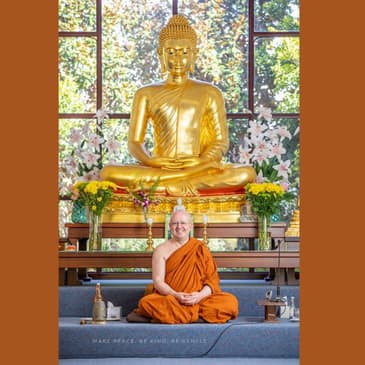

This guided meditation by Ajahn Brahm was originally recorded in 30th June 2007. It includes a talk about some aspect of meditation followed by a 45 minute guided meditation.
This guided meditation has been remastered and published by the Everyday Dhamma Network, and will be of interest to people who have started meditation but are seeking guidance to take it deeper.
These talks by Ajahn Brahm have been recorded and made available for free distribution by the Buddhist Society of Western Australia under the Creative Commons licence. You can support the Buddhist Society of Western Australia by pledging your support via their Ko-fi page.
[00:00:00] - [Speaker 0]
Hello and welcome to today's meditation session. We do about fifteen minutes of talking, followed by
[00:00:08] - [Speaker 1]
about a forty five minute sitting, and then fifteen minutes when I ask questions and usually very few people ask them. Nevertheless, every now and again I do get a question. If not, I ad lib as we go along. But, in order to develop your meditation, that you can understand that you are focusing on something, whether it's focusing on the present moment, focusing on silence, focusing on the breath, or whatever else is your meditation object. And I think you can appreciate, to be able to focus on something, you need to have some sort of glue to get you onto that thing and stay there for a long time.
[00:00:44] - [Speaker 1]
You need some sort of attractive force to be able to pull you on that object and stay there. And many times that people try and employ will, and they decide they're going to make themselves meditate and they focus themselves, say, on the breath. It doesn't work usually. Because what happens if you try hard to focus yourself on something like the breath, you just get tense. And that tension sometimes creates headaches, and people do.
[00:01:11] - [Speaker 1]
In some traditions when they meditate create headaches, and they create tension. And obviously that's not part of the calm, stillness and peace which meditation is supposed to supply. So instead of using the willpower to engage your attention on this object, you have to be a bit more skilful. The skillful means to engage with an object. And first of all, actually noticing what the obstacles to that object are.
[00:01:40] - [Speaker 1]
In other words, not so much noticing what you're supposed to watch, but what you're not supposed to watch. Understanding the, if you like, the forbidden zone of that part of meditation. When you understand what the forbidden zone is, and then to understand or to appreciate or cultivate the idea that that forbidden zone, where you're not supposed to pay attention to, is just going create you more trouble and more problems. So it's not that you're winning yourself on the object of meditation. You're realizing just the negative consequences of going to what's not the object.
[00:02:18] - [Speaker 1]
Examples say the present moment, you understand what is a forbidden area when you do present moment awareness. And that's obvious, the past and the future. But then you realize the negative consequences, you know, of focusing on the past and the future. You may do that all the time. And what does it do to your stillness, your tranquility, your peace?
[00:02:38] - [Speaker 1]
You know, it really upsets you. It just creates more agitation for the mind and takes you further away from the calm peace, stillness which you crave. So by understanding and making very clear what the forbidden zone is, and then understanding its negative consequences, that is a force which will be able to keep you on the allowable zone, in this case the present moment, without needing to push yourself on the present moment with willpower. So that's number one. Understanding the forbidden zone, understanding its negative consequences, and that will help you stay on the meditation object.
[00:03:22] - [Speaker 1]
The other part and the one which I usually use is actually developing the appreciation for the chosen object. An appreciation, gratitude, investing that object with some value also tends to engage your attention on that object, you know, without having to use willpower. You convince yourself it's worthwhile, it's wonderful, it's lovely to stay in the present moment. And obviously that those people who have done lots of meditation, when you have had experience of peaceful beautiful states of meditation, it's quite easy to convince yourself of the value of this place of focus for your mindfulness. But those of you who haven't had too much experience in meditation, sometimes you just got to do a bit of a marketing campaign for yourself.
[00:04:15] - [Speaker 1]
You know, to convince yourself that it's really beautiful in this present moment. It's a place of peace, place of freedom. And it's not that hard to do that because present moment awareness or silence of the mind or just watching the breath is a beautiful restful wonderful place for people to hang out. You just need to market it to yourself first of all. So that when you are starting a meditation please appreciate what the value of these stages of meditation are.
[00:04:46] - [Speaker 1]
Being in the moment, just resting in the here and now, you know having abandoned all this past and future business. It's so nice. It is like taking time out. It's having a break. It's giving yourself a sense of peace.
[00:05:05] - [Speaker 1]
Peace of mind only happens now. The future is born in this present moment. If you cultivate this present moment, you're cultivating success and happiness and health for your future. It's important. You value it.
[00:05:20] - [Speaker 1]
And I also like that putting value in silence. Because for many meditators is the thinking mind is the biggest obstacle. Obviously that you should know that the thinking mind obviously creates the future and the past for yourself. But the thinking mind is a big obstacle and even if you're in a present moment you start thinking about present moment instead of feeling it, instead of knowing it. And having made that distinction between the thought about something and the experience about it, being able to know what we mean by like a silent awareness of something and the verbal description about it.
[00:06:01] - [Speaker 1]
The next step is to just to understand the bare experience of something is far more valuable, far more accurate, far more profound in its meaning and even more happy in its flavor. So instead of actually as we usually say in the metaphor instead of going to a restaurant and eating the menu you eat the food. Eating the menu stands for just noticing the thoughts about what's going on. You know the verbal descriptions which go in your head. Instead of paying attention and giving value to that just we know what happens when we can experience something silently with attention in this moment as it's happening without this description of what just happened.
[00:06:49] - [Speaker 1]
A bare experience we know what that means and we value it more. When you start valuing the silent experience of now then it starts to remain. It stays with you. You don't use force, you know, to try and stop these thoughts invading your mind. You don't use willpower like, you know, some nightclub invite employing the bikies to stand at the gate and bash up the past or the future when they try and sneak in.
[00:07:22] - [Speaker 1]
This is not a violent practice, this thing we call meditation. It's someone which uses wisdom power rather than willpower, which sees this silence, gives it value, takes away the value from thinking, and thereby the mind will, as the Buddha said, leap to the silence. It will incline towards it of its own because it recognizes the higher value in the silent experience of life, especially during a period of meditation. Again you have to, to yourself, market the value of silence, so the mind will incline towards it. To condition yourself, even if you would say brainwash yourself, to value silence more than the thinking mind.
[00:08:15] - [Speaker 1]
And it's the same when you start watching your breathing. As I've mentioned here many times, the biggest mistake of many people when they do breath meditation is go to the breath meditation too soon when they're not ready for it, when the mind is too agitated, when it's running around too much in past and future thoughts and all sorts of other stuff. And if you try and put your mind on the breath too early, you will find it's too much of a task. The mind just does not want to stay there. It's got too much momentum with thinking and pondering the past, worrying about the future.
[00:08:47] - [Speaker 1]
You try and use willpower. Yeah. You can be able to stop it for a while, but it won't be able to last. You never sort of using the simile of, you know, riding a car. You never just slam on the brakes to stop.
[00:09:00] - [Speaker 1]
You just go down the gears, you stop gently, so you don't do damage to your car. In the same way, we slow our mind down gently, slowly. We do sort of that by doing practices like present moment awareness and silence first of all. But I make the point you don't have to have perfect present moment awareness nor perfect silence. You do these preliminary exercises to calm down the mind, to stop it running around so fast, to give it a sense of peace.
[00:09:35] - [Speaker 1]
Not absolute peace, but a sense of slowing down, rest, tranquillity so that when you pick up the breath it's not a difficult thing to watch. And you can start marketing the breath, investing happiness into it. Which is why we have all these skillful means of making the breath appear to yourself as important and valuable. And sometimes I use a simile of the breath being the vehicle which carries the air, the oxygen which is a gift from the plants and the flowers and the trees into your body. And after you use oxygen and turn it into carbon dioxide, that's the gift which the plants take up.
[00:10:22] - [Speaker 1]
So every breath is a gift from nature, and every breath out is a gift back to all that's green in the world. And just thinking like that makes the breath more attractive. Or you can have many other metaphors for yourself about the breath. But whatever it is, you know, people sometimes say that breathing in this beautiful golden energy and breathing out all this of the negative stuff which is in your day breathing in this fresh beautiful clean golden energy and light whatever called oxygen called the air and breathing out all the pain the sicknesses whatever else and by doing that you're actually investing the breath with some value it's important to you and when you do that you will find that because you've put value into the breath it's easier to watch. You have done your marketing campaign And don't undervalue sort of the power of those inner suggestions.
[00:11:25] - [Speaker 1]
It makes the meditation much easier. In a short while we could be sitting for forty five minutes, and when you're sitting for that period of time, you don't want to make it a struggle for yourself. You want to make it worthwhile and get somewhere in this meditation. And just marketing each of these stages by investing it with value, seeing its beauty, being grateful for it actually helps. He's just telling the mind, come on, this is worthwhile.
[00:11:51] - [Speaker 1]
Stop messing around with all these silly thoughts about what's going on the TV this evening or who said what to you on the way here. And when you market the meditation to yourself, you find the mind does engage not through willpower, it engages because it's worthwhile engaging in it. You want to. When you want to, you do. And when you do, after a while, you find that all of those marketing campaigns that actually do produce the good goods, the present moment is a very peaceful place to stay.
[00:12:26] - [Speaker 1]
The silence is awesome and the breath becomes so peaceful, so productive of this inner happiness, you really get into some wonderful meditations. The joy of the meditation is also important to develop. And also to look for that joy, look for that happiness. When it starts to happen, never be afraid of it. When it happens, well done.
[00:12:56] - [Speaker 1]
Encourage the meditation to be happy. Because in the end, it's the happiness which gives the greatest value to the experience of meditation. It feels good. It's nice. It's wonderful.
[00:13:09] - [Speaker 1]
And once you start to notice that part, that aspect of meditation, the happiness, when you notice that the happiness grows and grows and grows. And it's the happiness in the long term which grabs the mindfulness and keeps it attached to the object, keeps it fixed, keeps it still, and that generates more happiness, which creates more stillness. In the deeper stages of meditation, the stillness and the joy support each other, taking each other deeper and deeper into the profound depths of deep meditation. But to get there, the beginning steps, we have to market each of these stages to ourselves to create that engagement of mindfulness with the objects. So this is how we engage, focus, and get success in meditation.
[00:14:08] - [Speaker 1]
Any comments about what I've just been saying? Okay, so here we go then. For those people again who have come for the introductory class, apologies, it's the fifth Saturday, so of the month, so there's no introduction class today. If you are here for the first time or the second or third time, but you feel that forty five minutes is a bit long, what I would advise you to do if maybe after twenty minutes you start to feel a bit sore, without making any noise, you can open your eyes, change your posture so you don't disturb anyone in the room who's sitting for the forty five minutes. Maybe take two or three minutes just sitting here, just moving your posture, and then afterwards close your eyes and do another little session for yourself.
[00:14:53] - [Speaker 1]
That way you don't disturb the people who are sitting here for the whole forty five minutes. Okay, so here we go. So I'd like to get yourself ready and close your eyes and get in your meditation posture. Now with the eyes closed, pay attention to your physical body. It's important that you feel the body before you get into deeper meditation.
[00:16:29] - [Speaker 1]
Not only does focusing on the body generate present moment awareness, You'd also make sure that you have put the body in a good position to begin with. Those of you who have meditated many times know that you might get a pain or ache in the body which is very disturbing simply because you were not careful enough at the beginning with your posture. So spend these first couple of minutes just being with the body, caring for it, and if you find that this part of the posture which needs adjusting, adjust it. Stay with the posture a little bit longer. It takes a while.
[00:17:45] - [Speaker 1]
Don't rush. When we move to the present moment, please identify the forbidden zone, past and future. Understand why it's forbidden, the negative consequences of wasting time on things which can never be changed, have already happened. Or wasting time planning for a future which is so uncertain. And instead put all the value in this moment.
[00:18:25] - [Speaker 1]
Because how important it is to be now if you want to have peace. How all meditation is based in this present moment. Like a building has its foundations, the present moment is the foundation of anything to do with meditation. It's important. It's valuable.
[00:18:50] - [Speaker 1]
Convince yourself of that. It's also a place of rest, and you all need rest. So bring your attention here. No past, no future. Just now.
[00:19:12] - [Speaker 1]
And feel the peace of the now. Look for its freedom. Recognizing the forbidden zones, the why, and the value of being a meditation object. Open. Getting close to the end of the meditation now.
[00:57:43] - [Speaker 1]
Just know how you feel. Just pay attention to the quality of the mind, what this meditation has done for you, what peace feels like. Now ring the gong three times. When the gong finishes sounding for the third time, it's a signal to come out from your meditation. So we're at the end of the meditation.
[01:00:03] - [Speaker 1]
Hopefully, that people do see a change. We get closer and closer to the thing we call peace of mind, stillness, real mindfulness, strong mindfulness, happy mindfulness. Sometimes people come up and ask, well, was still in meditation. How do I know that I wasn't falling asleep? Or how do I know I was going on the right path?
[01:00:32] - [Speaker 1]
And one of the ways you can tell how your meditation went was how you feel afterwards, even when you open your eyes, how much energy you have. But not just the restless energy, which sometimes we know through our daily life, but the peaceful, strong, clear, powerful mind. That type of energy. The energy where you really feel that you can do things, you can think clearly, you can make decisions, you can see deeply into things. Because the mind which develops these meditations, especially when the mind gets peaceful and blissful, gets very powerful, and you can feel that power after the meditation finishes.
[01:01:16] - [Speaker 1]
In classical Buddhism we call this like overcoming the hindrances. We use the like hindrances to seeing clearly, hindrances to mindfulness, also the hindrances to stillness. Once those hindrances have been overcome, at least mostly, there's nothing really to stop the mind focusing, seeing clearly. Too often that if we want to follow a line of thought, we can't follow it very long, because our mind is too restless. It jumps off onto something else.
[01:01:51] - [Speaker 1]
We just can't keep the mind on track. But the training of the mind which we do in meditation, By training the mind to keep on track in the meditation objects on the path of meditation, you'll find that after you've emerged, especially if it's worked, the mind is very, very strong. It can take an idea and it can follow it through. It can look at a problem and not be deviated until you find a decent solution. And because of the mindfulness has been empowered, literally the mind can see more clearly, it can see deeper, using the old simile of the lights are being turned up, so there's not darkness or shadows anymore, everything is highlighted and clear.
[01:02:38] - [Speaker 1]
With a mind like that you can understand just how whatever you have to deal with in life you can see very clearly and very powerfully. It is the empowerment of mindfulness is one of the great causes of insight arising. Insight is not something you do and decide that I'm going to find out the nature of these answers to the questions of life. But insight is something which happens as a result of empowered mindfulness. And it's wonderful to investigate this quality of mindfulness with its different levels of power.
[01:03:18] - [Speaker 1]
And you'll find out just what you need to do to become wise and see things really clearly. Anyone who's developed a very powerful meditation come out afterwards to know the clarity and the power of the mind and recognize this is what I mean by the power of mindfulness when it's really energized. You know that why sometimes we waste time thinking about things and assuming just through the power of thought we can find answers. Even just this morning I was reading a newspaper, the Australian, and in a magazine there there was some philosophers who are answering questions on the nature of happiness and is there a God? And it was just crazy stuff by these are philosophers which you pay for because they're employed by the universities.
[01:04:13] - [Speaker 1]
I think they should get the sack. They can think but they can't see. In other words, their mind may be very rational and logical, but the mindfulness is not powerful enough. The mind is not strong enough to see deeper into the nature of these questions. And there's the what I read in the Australian magazine, weekend Australian, it was so superficial.
[01:04:44] - [Speaker 1]
There's no depth to it at all. And this is why that when a mind becomes powerful, you can get that depth. So the training you get in meditation, the empowering of the faculties of the mind, or the way you become more perceptive of the nature of things. Training the mind in academia, which is a lot of times training how to think instead of training it how to see, is not the way to find the right meaning. When you get very still and the mind brightens up and the mindfulness becomes powerful like a big searchlight, Wherever you point that, you can see so deeply into things.
[01:05:34] - [Speaker 1]
You literally got access to more data and a more powerful brain to sort it all out. Simply the mindfulness empowered by stillness. A classical way of getting insight from Samadhi, the stillness of the mind. You see things as they truly are. Through thinking, you tie the mind out, and the only thing you see is surface phenomena.
[01:06:09] - [Speaker 1]
This is the way of insight, stillness, power, deep seeing, and all the time, the mind is energized and happy. What a wonderful way to become smarter than the best philosophers who write silly articles in The Australian. Any comments or questions on this? I hope there's no professors of philosophy in the audience today otherwise I'm done for. Any comments or questions about that?
[01:06:45] - [Speaker 1]
Yeah, go on. Good. Very good. Told you so. It's true.
[01:07:06] - [Speaker 1]
Because remember all the things which I said, I try not to give too much instructions because you find this skillful means yourself. Know, the simplicity is one of the beauties of the meditation which gives it value. And once you see its value there, oh wow! And once you do get into the present moment and a bit of quietness, it's easy to watch the breath. For anybody who has trouble doing breath meditation or you think 'I can't watch the breath' it's because you haven't prepared the mind properly.
[01:07:44] - [Speaker 1]
And you're just forcing it. You're saying come on, you watch the breath or else. Just a control freak. And it never works. So you did a very wise thing there.
[01:07:56] - [Speaker 1]
The simplicity of just being in the moment. Oh, this is so nice. And once you get that, oh, this is really nice attitude of mind, then everything comes together. Well done. Yes, balance.
[01:08:14] - [Speaker 1]
Yeah. How, where it goes? Okay, it goes into these incredible beautiful lights in the mind. Just when the body disappears because whenever there is stillness things disappear. That's the result of stillness because the brain is only wired as they say these days to notice changes.
[01:08:42] - [Speaker 1]
Our sensory apparatus notices contrasts. So if there's a common sound, constant sound, it disappears after a while. In Zen monasteries you used to look at a wall, your eyes open, facing this ordinary white or whatever color wall, and you find the wall would disappear. With nothing mystical, whatever you stare at long enough, because nothing is moving, nothing for the brain to do. It just turns off.
[01:09:16] - [Speaker 1]
So when you're still, sight, whenever you close your eyes, the first thing you see is blackness, if you notice that. And after a while, blackness, nothing's going on, it's stable, and sight turns off. Hearing is a constant the traffic in the background. And after a while you can't hear it anymore. It's taste of saliva in your mouth, smell of the people around.
[01:09:45] - [Speaker 1]
We do have smell. Ask any dog. There's a huge amount of smell in this room. Because it's constant, we don't notice it. And then, the body, we keep it still.
[01:09:58] - [Speaker 1]
We don't move it. And after a while, if you're comfortably enough to begin with, and it's not with great aches and pains, after a while the body just disappears. Stillness means this big part of the burden of life. Dealing with sight, sounds, smells, tastes, and touches disappears. Time disappears Because you're still in the moment, brain turns off from time.
[01:10:26] - [Speaker 1]
There is no future or past for you. Which is why what happens when people get into meditation, they don't know how many how much time has passed. And then later on, the mind starts disappearing. The expanse is dead. It's the same as like, I always use the symbol of present moment awareness.
[01:10:54] - [Speaker 1]
Because this is a stage where many people have experience. When you get into the moment there's no time there at all. It's like you've been imprisoned in an impossibly small space between the past and the future. A millisecond, that's all there is in the now. Looking at that direction, you're squashed between the past and the future.
[01:11:14] - [Speaker 1]
But why don't you get in there to experience as if you've got all the time in the world? In no time, there's infinite time. I'm not just saying this to sound mystical. This is actually an experiential truth. In the moment, there is no time, no past, no future.
[01:11:31] - [Speaker 1]
You're squashed. But the feeling is you've got all the time in the world. It's expansive. The feeling of expansion is because there's no pressure on you. There's no boundaries.
[01:11:44] - [Speaker 1]
We create those boundaries, and in stillness, the boundaries also disappear. And just the perception comes afterwards of freedom. No boundaries, no problems, stillness, but not for stillness. It's beautiful, free stillness. Can't imagine holding yourself absolutely still.
[01:12:09] - [Speaker 1]
That's intolerable. But when you meditate, you're so still and it's natural, easy, free. It just happens. And that's only the start of the amazing things which happen in meditation. So this is where the happiness and the stillness, you get so incredibly still.
[01:12:32] - [Speaker 1]
More still than you could ever imagine possible. World, just not the world outside being still, but the world inside being still. And that's freaky. When I was a young man in London in the sixties, they used to have these rock concerts, and they used to call them freak outs. That was the word in the sixties.
[01:13:04] - [Speaker 1]
Used to go to the freak out in Alexander Palace in North London. It's crazy but that was nothing to do with meditation. It's really freaky, so still and powerful and energized. Okay. So there you go, the amazing power and joy and depth and oomph when you really get the meditation going.
[01:13:35] - [Speaker 1]
You know how to do it, just put the value in, get it going. You get to a certain stage in the meditation, and once you get there, that just takes over. And you just sit there and all these amazing things happen. But you just gotta get to that point where it starts to get very happy and joyful and just takes over. Then you're away.
[01:13:54] - [Speaker 1]
When that does happen, just go for it. Never interfere when things start going well. They're going well because you've let go, you've done all the right things. Well done. Shut up and enjoy the ride.
[01:14:15] - [Speaker 1]
Okay, so the ride is over today because it's gone past 04:15 so we now can pay respects to Buddha and Sangha. If you want to stay behind and ask some questions you're most welcome to.