
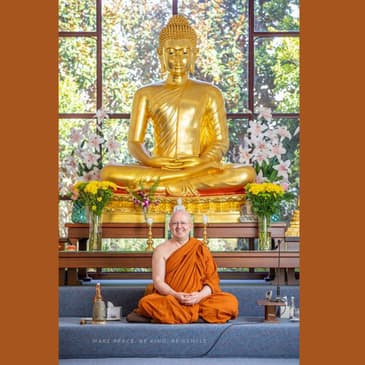

This guided meditation by Ajahn Brahm was originally recorded in 9th January 2010. It includes a talk about some aspect of meditation followed by a 45 minute guided meditation.
This guided meditation has been remastered and published by the Everyday Dhamma Network, and will be of interest to people who have started meditation but are seeking guidance to take it deeper.
These talks by Ajahn Brahm have been recorded and made available for free distribution by the Buddhist Society of Western Australia under the Creative Commons licence. You can support the Buddhist Society of Western Australia by pledging your support via their Ko-fi page.
[00:00:00] - [Speaker 0]
Now is the time for our ongoing meditation class. So this is the class for the super duper experts, the Olympic athletes of meditation, the elite of the elite. That's just actually the class for those who've meditated before. So those of you who have come for the first time for the meditation, the Introduction to Meditation class, that is being held in the room to my right. This is the ongoing class for those who've meditated before, and the main difference is that on this class we only focus on a small part of meditation, not the general overall picture, and also we meditate for forty-forty five minutes, which is much longer.
[00:00:45] - [Speaker 0]
And in the first fifteen minutes she always talks something about meditation. Somebody was asking me earlier about the posture and I was saying there is nothing magical about sitting on the floor or even having a straight back. And I said, this is not important to your physical position. What's really important is your attitude to meditation. And of course, you've heard me say many, many times, but I need to keep saying it again and again and again.
[00:01:12] - [Speaker 0]
The important thing is kindness, attention, and gentleness. You know, making peace, being kind, being gentle. And so this is what you do with your body, first of all, to make sure your body is comfortable. Because the comfort of your body is an expression of your, first of all, your awareness, you're actually sensitive to the needs of your body, you're aware of it. I do remember just the first years as a monk in Thailand, because we would go barefoot without shoes on, barefooted, I was going say barefitted.
[00:01:45] - [Speaker 0]
Which one is it, barefitted or barefooted? Because there was two of them, but there was two barefeet, I don't know anyway, without shoes all over the place, and we'd always cutting your feet or stubbing your toes. And so it had plasters and ointment all over your feet and cuts and scars. And when my teacher saw this, he said, you Westerners have got stupid feet.' There's a wonderful way of looking at it, because I always saw that other parts of my body were stupid, but never thought that feet could be stupid. It's a very wonderful way of thinking about it, your feet were stupid.
[00:02:18] - [Speaker 0]
In other words, you weren't aware of that part of your body, so you kept on injuring it. And some of you have got stupid backs. No wonder they keep on feeling aches and pains. So in order to get rid of the stupid feet and the stupid back, or the stupid whatever else you pains and aches you get in your body, we first of all pay attention to our body, the different parts of our body, having paid attention to those parts of the body, then we are kind to those parts of the body. And being kind to those parts of the body means if they do need to be adjusted, we adjust them.
[00:02:55] - [Speaker 0]
So you don't need to sit full lotus on broken glass on the floor. You don't prove anything to yourself except sometimes your stupidity. If you want to sit on a chair, wonderful, sit on a chair. And one of the reasons why chairs are designed like that, they've had chairs in our cultures for I don't know how many thousand years, and over those thousands of years the design of chairs has evolved to actually to be quite comfortable, otherwise they just don't get sold. So your chairs, the way they are just tilted backwards slightly, is because of comfort.
[00:03:35] - [Speaker 0]
And also, was reading an article which somebody sent me from a scientific journal, the most comfortable posture for your back, the healthiest one is about 15 degrees from the vertical, leaning back slightly. Just like your chairs over there. So they are the best posture. You don't need to take your back away from the chair, lean back until it feels comfortable, if that's what you want, if that's what feels good for you. So what we're saying here is your attitude which you begin with the way you sit is also the attitude which you have when you start to meditate.
[00:04:09] - [Speaker 0]
Now you're working with your body, it peaceful, making it kind, not trying to control it and having it in this ideal posture. What you think is important is not the outside, it's the inside. Your attitude. There's the attitude to be attentive and to be kind. And that is exactly what you do when you're meditating.
[00:04:30] - [Speaker 0]
It doesn't matter if you're tired, if you're restless, you know, if you've got these great lights going in the mind, if all these amazing insights come up, that is not as important. I'm saying this with seriousness, as your compassion, as your attentiveness to the whole process when it happens. So your job, just in the same way, you feel your body, having this body be more comfortable. You feel it, that's mindfulness. And you're kind to it, and I can see, you know, my body is aching, but I'm not going to move it.
[00:05:02] - [Speaker 0]
That's stupidity. It is aching is in the wrong position, therefore I move it and get it comfortable. And that's exactly what I do with my mind. I look at my mind when I start meditating. How is my mind?
[00:05:15] - [Speaker 0]
I'm attentive to it. If it's tired, I know it needs a rest. I don't work it too hard. I'm patient. If it's restless, again a lot of times it's because, you know, you've been working very hard and you again need time to allow it to slow down.
[00:05:31] - [Speaker 0]
Or if it's really restless, it's sometimes because you're not content enough, you're always wandering here, there and there, to find a more comfortable position for your mind. So you're kind to it, you know exactly what to do, just the same way I know if I'm aching this way I have to move that way. If I've got sort of an ache somewhere, I can sort of scratch it, can itch it, itch in my throat, I can cough it out. I know exactly what to do to calm the problem down, to settle it. So that's how I deal the mind as well.
[00:06:06] - [Speaker 0]
I'm attentive and I'm kind to my own mind. To find out how it needs to be adjusted, so it can be comfortable. And just like you adjust your body, make it comfortable so it can stay in the same position for the forty five minutes. So when you meditate, you may be saying on the breath, how can I adjust my attention with the breath, so it can stay comfortable for forty five minutes? So you don't feel this so called mental ache and pain, which drives you away from the meditation object.
[00:06:42] - [Speaker 0]
So the breath is actually comfortable. So you want to stay there. So it's fun to stay there. So this is how we adjust our meditation. And again, it's not what you're aware of, it's actually how you are aware is the most important.
[00:07:01] - [Speaker 0]
So as we are meditating, we have this awareness together with compassion at all stages. And just as there is no perfect each one has to find their own posture. So there's no perfect mind state. All the mind states you are in, whether it's clarity, whether it's peace, whether it's restlessness or dullness, each one of those mental states is karmically produced. Here it is.
[00:07:28] - [Speaker 0]
You can't sort of choose to get rid of it. All you can choose is to be kind to it, to make peace with it, to be gentle with it. That's all you can do. That's the only thing you're supposed to do in meditation. So the same way that we set up our bodily posture, the same way we set up our mental posture.
[00:07:48] - [Speaker 0]
This ability to hold whatever we have in our mind without causing too much negativity, mental pain or mental disturbance. So we can hold things and keep it still. And if you know how to keep your mental posture still, of course then all of the deep meditations just happen by themselves. Which is always the reason why I say this is a process, you just keep driving that car and eventually you reach the destination. Or even that was not the best of similes, because this is a passive journey in meditation.
[00:08:29] - [Speaker 0]
In the rest of your life you drive your vehicle, you control it, you direct it to get where you want to go. In meditation, you are the passenger. You are the passenger on the bus, on the train, on the aircraft. You just strap yourself in, look out the window, and enjoy the flight. And you'll find the more that you are relaxing meditation, and by relaxing it means you're not controlling things, the more you let go, which means you're not driving things, the more you renounce, which means you're renouncing your will, renouncing your desires to try and get somewhere or be something.
[00:09:11] - [Speaker 0]
The more you renounce, let go, give up, the more peaceful you get. Because it is this will driving, doing things, controlling things, that is the problem. That's what stops you being peaceful. As Ajahn Chah would often say, Your mind is like the leaf on a tree. It only moves backwards and forwards because of the wind.
[00:09:36] - [Speaker 0]
When the wind disappears, the leaf on a tree moves less and less and less until it stops moving at all and becomes absolutely still. That's the nature of relief, to be still. It only moves because of external forces. So your mind is like that. It only moves because of external forces.
[00:09:58] - [Speaker 0]
And after a while you see those external forces, your will, your choice, directing, wanting, all that sort of stuff is what moves the mind. So if you cut that out, and how do you cut that out? Just by kindness, by attention. So you don't cut the will by more will, saying, I'm going to be still'. That just makes more agitation.
[00:10:24] - [Speaker 0]
It's the kindness, the attention, the gentleness. That's what stops things. That's what letting go is all about. That's what making peace is all about. The kindness, the gentleness, the acceptance.
[00:10:41] - [Speaker 0]
The acceptance of this moment, not trying to change it, not trying to drive it to some other place. Acceptance, being with, and then after a while you find everything slows down and becomes still. And then you have the experience of meditation. The amazing states of stillness and peace and happiness which come with that peace, which is just wonderful to behold. It relaxes you, energizes you, and gives you a great insight into how happiness, inner happiness, or sometimes people call peace of mind, contentment, is right here in the middle of where you already were.
[00:11:25] - [Speaker 0]
All you need to do is to be more fully where you already were. Just to be here. Not trying to get anywhere, but just to be here. And be more deeply here, and more deeply, deeply here, in every moment, then that's called the path of stillness. That's the path of peace.
[00:11:48] - [Speaker 0]
That's your mental posture, which corresponds to the physical posture. And then you can hold that posture physically and mentally for long periods of time with utter contentment, with no disturbance. That's our path of meditation: to get the correct mental posture. Okay, so I have said those opening few words once again. For those people coming to the introduction to meditation, the first classes in meditation, if you come to the introduction of meditation, that class is being held in the room to my right.
[00:12:28] - [Speaker 0]
The introduction to meditation class, the room to my right. This is the ongoing class for people who've meditated before, because we're going to be sitting for about forty five minutes. So if you come for the introduction class, that's the room on my right. This is the ongoing class. We're now going to meditate for forty five minutes.
[00:12:47] - [Speaker 0]
So if you'd like to get yourselves comfortable, and remember, it doesn't matter how you're sitting, the most important thing is you're being kind and paying attention to your body and getting this beautiful comfortable posture. Not the ideal posture in thought, but the perfect posture in experience. So it's sitting down, closing the eyes. Bringing full attention, first of all, onto your body. And instead of thinking what the perfect posture should be, just think how you can make yourself more comfortable.
[00:14:00] - [Speaker 0]
And adjust the body accordingly. So you don't have a stupid back or a stupid bottom or stupid arms. And each part of your body informs you how it could be more comfortable. And you take account of that advice, act accordingly, and care for your body. Because you're going have to sit still for about forty five minutes, that's a long time.
[00:14:31] - [Speaker 0]
So it's worthwhile investing one or two minutes, so the following forty three minutes can be ache free. And don't rush for physical posture. You're establishing both mindfulness and kindness, using your own body as the tool to establish these meditation qualities of awareness and kindness. Until you get this posture for your body, which is comfortable, which you feel you can maintain throughout the whole of this meditation, without needing to move. A sense of openness, no tightness in the body.
[00:15:36] - [Speaker 0]
Because if there's a tightness anywhere, that's going to be a pain later on. Everything is as loose as you possibly can make it. With no tension, no knots. Relaxed and free. And you carry on experiencing that physical posture just a little bit longer.
[00:16:10] - [Speaker 0]
There might be minor adjustments needed. Once the bodily posture is as good as you can possibly make it, then set up the mental posture, a state of mind where you can relax for forty three minutes. State where you don't have to wander, just like your mind doesn't have to switch it backwards and forwards. State of mind where you can just be here, still, for all this long time. I think you can probably understand that that mental posture requires mindfulness.
[00:17:13] - [Speaker 0]
You haven't got a stupid mind. You're aware of the mind. And you're kind to it. Treating your mind like a friend. And just establish this mindfulness and kindness to whatever you're experiencing inside, every moment.
[00:17:44] - [Speaker 0]
As you establish your mental posture. There is no tightness or tension. The tightness and tension is all this desire and wanting. The knots of all this ill will I don't want. Release all of that, so you can develop this really comfortable mental posture, which can accept anything which the mind throws up in the next forty minutes, and can make peace with everything.
[00:18:20] - [Speaker 0]
It's kind to the whole mental world, with all the beings which inhabit your mental world. May all beings in my meditation be happy and well. As you set up your mental posture. You're in the present moment right now. If your posture is good, the present moment will stay with you.
[00:18:58] - [Speaker 0]
If you have kindness and awareness, and you respect this moment, by which I mean whatever you're hearing, feeling, knowing, whatever's happening right in this moment, if you're attentive to it and kind to it, it will stay. Just being kind to this moment, so you can sustain this present moment awareness, and don't feel your need to go off into the future, the past, or into fantasy. Just being mindful of the now. Eventually, you find silence. And after silence, you can go on to your breathing.
[00:27:31] - [Speaker 0]
Whatever the object, always make peace, be kind, be gentle. And maintain the proper mental posture. Getting close to the end of the meditation now. Just how do you feel? What's it like inside your mind?
[00:58:08] - [Speaker 0]
If you have peace, what does peace feel like as an experience? Why is it happiness to be at peace? I will now ring the gong three times to end the meditation period. Please listen to every sound from the gong. Only when the last ringing vanishes, only then come out from your meditation.
[01:00:31] - [Speaker 0]
Okay. When you experience peace in the mind and you know what it feels like, you know how delightful peace of mind is, why many people search for that throughout their whole life. And the few people who do find peace of mind usually find it in places like this. The real peace of mind, not the fake stuff, which lasts only for a few seconds or minutes. That deep peace of mind, where everything is just so tranquil, you're just so happy to be here, where you wouldn't want to be anywhere else in the whole world just staying in this moment, watching your breath or just experiencing peace itself.
[01:01:24] - [Speaker 0]
The most interesting thing is to recognize where this peace of mind comes from. This is as if it doesn't come from anywhere. It's always there. You just need to unwrap it, as it were. Just like you unwrap a present.
[01:01:43] - [Speaker 0]
You see that sometimes the presents which people get these days, you take off the wrapping paper, there's brown paper inside, You take off the brown paper, then there's a box. You take off the box, and inside's another package. There's so many wrappings in modern things present today. It's just like their peace. Their peace of mind is like wrapped up with so many things.
[01:02:10] - [Speaker 0]
And your job in meditation is not to think you haven't got peace of mind. It's just like to uncover it in this moment, to take away all these wrappings of time, past and future, all these wrappings of your thoughts. Take all these wrappings of sounds and feelings in the body just to go right inside. And inside you find the present, the beautiful peace of mind. So it's there all the time, so you don't have to do anything or go anywhere.
[01:02:42] - [Speaker 0]
So I've been teaching this meditation for such a long time. It's hard for people to get their heads around, simply because they think that to get peace of mind you have to do something. But every time you do something, you destroy peace of mind. How can you make peace by fighting a war? How can you get still by doing things?
[01:03:05] - [Speaker 0]
It's just a matter of letting go, with making peace, being kind, being gentle, and being patient as well. Giving this process a time for it to work. And if you are meticulous about making peace, being kind, being gentle, yes, you do have to establish mindfulness, to be alert, to be aware, so you know what you're doing, and you are making peace, are being compassionate, you are being gentle. As long as you have enough awareness to know that you are not interfering, you're letting things be, then the whole process works. You just sit there and just these states of mind come to you.
[01:03:50] - [Speaker 0]
You don't go chasing them. They come right to you. I remember one occasion once in a monastery in Thailand. Some of the monks in those days were just so little of anything of food, of drinks, of comfort. But whenever a monk was staying up all night to make their robes, especially for the dying of the robes made out of jackfruit dye, There was one occasion you could have some tea, some coffee, and you take it to the dying shed, and because you're staying up all night, you need your sub stimulants to keep you awake and also to keep you aware because you're boiling things on a fire.
[01:04:29] - [Speaker 0]
I remember just this group of monks were having all this tea and coffee. We used to get up at 03:00, and that day I woke up at quarter to three in the morning, and I thought, should I go over and get myself a cup of coffee? And I thought, no, that's craving, that's desire. So I got up and walked over to get my cup of coffee. And when I got to the dying shed there we go, that's what happens when you follow your desire.
[01:04:58] - [Speaker 0]
The place was deserted, but everything was warm. They must have just finished and packed up. So I went back to my hut and then to the morning chanting, and after the chanting was finished, the monks who were at the dying shed, they said, 'Where were you at 03:00 in the morning?' I said, 'I was just walking to the dying shed to get a cup of coffee.' He said, 'That's really strange, because at 03:00 we all walk into your hut to bring you a cup of coffee.' They just went on a different route. If I hadn't followed my desire, a cup of coffee would have come to me. And that was like a wonderful little lesson.
[01:05:34] - [Speaker 0]
Just let things be and things come to you. In the same way that if you just let things be in meditation, all these beautiful states of meditation, even the breath, it just comes to you. You just sit there. Stop your desiring and craving and want to be somewhere else. Because that's what causes stress.
[01:05:55] - [Speaker 0]
That's what makes the mind move by wanting to be somewhere else, wanting to get the state of meditation, not wanting to be where you are. That's the problem we're trying to overcome. Instead we get this beautiful contentment, peace of mind, just being happy to be here. And once you start to learn that trick, then you find meditation so easy. You sit here and all these things, they come to you.
[01:06:19] - [Speaker 0]
That's a beautiful way of meditating. You find, not only do you understand what peace of mind is, you understand how it's generated. How you can relax to the max, sitting here and enjoying all these beautiful states, as they come to you. And they all come because the still mind becomes a happy mind. Peace is the source of inner energy.
[01:06:43] - [Speaker 0]
And as long as we can develop that peace, the energy improves and improves and improves, the mindfulness gets stronger. You don't make the mindfulness stronger, you just sit there and watch the mindfulness get stronger once you realize you're not wasting energy by fighting your inner world. The energy gets stronger, the mindfulness gets clear, and as the mindfulness gets clear, you can let go even more. And as you let go even more, the mindfulness gets stronger, then you can sort of let go even more thoroughly, the mindfulness gets stronger, you get this beautiful what's it called, feedback cycle, where the mindfulness increases and increases, the peace gets more and more deep, and you enjoy the great benefits of meditation. For not only do you experience peace of mind, but peace of mind is always a great benefit for your health.
[01:07:37] - [Speaker 0]
It gives you more freedom in your body. And I can't resist telling the other story which I told last night and also this morning at the dhana. It must be because this one guy developed very, very good loving kindness meditation. He didn't hear this story last night. He told me that he was sitting outside an ATM in Europe, and he was actually developing loving kindness towards the ATM machine.
[01:08:10] - [Speaker 0]
He said, first of all, because I think he thought this had some sort of connection with the ATM because the first time he walked past it, so he said, the ATM sort of heard a sound like a gurgle. And he thought, oh, the ATM likes me. So he was sitting outside, and he decided to give a loving kindness towards the ATM. And sure enough, a €20 note came out. He said it was true.
[01:08:36] - [Speaker 0]
No one had pressed any buttons. No one had been there for two or three, four or five minutes beforehand. And so, of course, he took the €20 note after and spent it. So that's the power of meditation and loving kindness. So if you want to see how good your meditation is today, go and stand outside an ATM, say, May all ATMs be happy and well, I really love you and make peace with you and are kind to you and see what happens.
[01:09:00] - [Speaker 0]
Who knows? It might be a test of your meditation. Okay, it was a great story. Anyway, he said it was true. Even if it wasn't true, it's a good story anyway.
[01:09:13] - [Speaker 0]
Anyways, anyone got any comments or questions about the meditation today? Any meditation questions? About saying yes. Again, you don't fight it, and you can sit and sit until the drowsiness disappears. Good, yeah.
[01:09:45] - [Speaker 0]
Okay, as you bear to come back to the breath, but when you have drowsiness, you can see it was the heat, there's a cause behind it. There's nothing wrong with you, it's not saying I'm a terrible meditator, get drowsy. You know, you're born in Scotland, your genes aren't used to this type of phe. Same as if some of the Sri Lankans or Thais meditated in Scotland, and they wouldn't be able to meditate. They wouldn't be drowsy, they'd be restless, shivery.
[01:10:12] - [Speaker 0]
So it's just the external conditions. So what you did was anything you can do. You can't fight the heat. All you can do is make peace with it. And after a while the mind calms down, and the body accommodates to the heat and the drowsiness disappears.
[01:10:31] - [Speaker 0]
Oh yeah, when I was in Thailand, my goodness, it wasn't just hot, it was humid, we were malnourished, we were sleep deprived, you know, it was just a really weird lifestyle, when I look back upon it. Of course you were, you became very strong physically, but it was very hard to keep the mind still. And so what I used to do, being stupid, I would fight the drowsiness. And when I fought that drowsiness, you did have a strong will, especially as a young man, you'd break through the drowsiness, and you'd be restless. You couldn't stop thinking.
[01:11:07] - [Speaker 0]
So what you did next, you calm the thinking down, calm it down, calm it down, then you fall asleep again. And there was just the pendulum from restlessness to dullness. You couldn't find that beautiful middle way which we call meditation. And then I realized what I was doing after many years, because I was fighting the drowsiness. Number one: drowsiness means you have got little mental energy.
[01:11:33] - [Speaker 0]
And you were fighting, you were wasting energy. That's why it lasted a long time. And then if you did break through, because you were really fighting, that warrior, just like a soldier when they leave the army, they can't stop fighting. They can't just come back into the world and live a normal life, because they've been warriors for years, they've been fighting in wars. You know, this is one of the biggest problems when a war finishes.
[01:11:59] - [Speaker 0]
What do you do with the soldiers? How can you rehabilitate them, get them back into so called normal life? So as soon as I came out of my and I was still a warrior, a fighter, and thus I was restless. So the solution, after a long time, was just to relax. Let the sloth and torpor be.
[01:12:20] - [Speaker 0]
So I wasn't wasting any energy. So the energy, because I wasn't fighting, the energy started coming back. It didn't take that long. The sort of lifted like the mist in the morning. I decided to become more aware, slowly, slowly, slowly.
[01:12:37] - [Speaker 0]
And then when the dullness finished, it wasn't restless anymore, it's just peace. This is a brilliant thing to understand. You don't fight dullness, you make peace with it. You're kind to it. That's what I'm saying.
[01:12:48] - [Speaker 0]
It's just not the dullness or the restlessness. It's the posture. It's like how you're dealing with that. It's not you have to sit with a straight back, or leaning to one side, or full lotus, or half lotus, or whatever. That's not what meditation is.
[01:13:04] - [Speaker 0]
It's whatever posture you have, how you can be comfortable with that. How can you make peace with that? How you can make peace and comfort with dullness. That's right. Yeah.
[01:13:25] - [Speaker 0]
Lying down posture works. I'm getting some amazing meditations lying down, But usually the trick is, and I teach this on, especially on retreats, now there is a posture where you go to sleep. Some people go to sleep on their back, sometimes on their front, sometimes on the right side, sometimes on the left side. Now you find that's the posture where you start going to sleep. I usually go to sleep on my right side, probably I train myself because that's what a monk's supposed to do, like the Buddha always went to sleep on his right side.
[01:13:55] - [Speaker 0]
I turn over during my sleep, but that's how I start going to sleep. So if I try to meditate on my right side, just psychologically, my body would know this is sleep time and I just fall asleep. So if I do meditation, I like to lay down on my back. So I don't usually fall asleep on my back. I, on my back, that's how I meditate.
[01:14:18] - [Speaker 0]
Or there's another posture on my side, but with my elbow popping my head up, and that's quite uncomfortable. So I usually go on my back if I want to do meditation lying down. So you find a posture where you don't normally go to sleep. And then you do meditation that way. And then you find you don't go to sleep because the body says, this is not the way I go to sleep.
[01:14:41] - [Speaker 0]
So it must be something else I'm supposed to do. And it's your meditation. Especially when you're sick and you get old, you've got aches and pains all over the place. Then sometimes laying down is the only thing you can do. And also if you're in hospital, Especially, you're dying.
[01:14:59] - [Speaker 0]
Most people die when they're laying down. So it's nice to be able to meditate just when you're dying. Make it nice and peaceful. Have compassion for all those medics trying to keep you alive. Just let go, make peace, be kind, be gentle.
[01:15:17] - [Speaker 0]
Okay, thank you for that question. Any other questions anyone has? You got one, Jay? Oh, silence in meditation. That's almost just like part of insight, but it's also part of calm.
[01:15:42] - [Speaker 0]
You see that whenever the mind is moving and agitated, it actually generates these words and these ideas and these thoughts. Thinking is a sign of an agitated mind. Which is why when you're really agitated, the thing that's really upsetting you, people think a lot. When they're really content and they're very peaceful, hardly think at all. And in meditation, there's no thoughts go on at all.
[01:16:07] - [Speaker 0]
And that's that inner silence. And that silence, and you always notice, is such a holy place. And I mentioned that sacred silence. Which is why you go to quiet places like monasteries, or you go to the bush or in deep caves, there's silent, nothing moves there. And you know that that's really powerful.
[01:16:29] - [Speaker 0]
So the silence is also a place we get huge energies, huge peace. But what's more important, when you're silent, you see things more clearly. So the words are just one step removed from reality. The silence is where you experience reality. It's the difference between the commentary the reality.
[01:16:56] - [Speaker 0]
And if you don't want to understand what I mean, you go and watch a cricket match on the TV, or a soccer match, or a tennis match, and listen to it with the commentary on, and then turn the commentary off, turn the volume down, and just listen to it as it is. Well, there's one occasion when I was on an aircraft, and it was one of these aircraft that has this big screen, now the screen's coming down from the roof, and there was a movie on, and I didn't take the headphones. But I will always remember this movie, it was called Armageddon. And people were really getting into this movie, but because I didn't have the commentary, I was watching it in like silence, you can see this incredibly stupid movie. And it was absolutely ridiculous.
[01:17:42] - [Speaker 0]
And I enjoyed it because I was laughing so much when everybody else was on the edge of their seats. And I will never forget ever this one sequence where their spaceship was going to some sort of, what was it, some sort of comet or some meteor which was about to strike the earth. And it sort of, instead of landing, it sort of struck this mountain with craggy rocks and it turned over, there were sparks and there were flames, and it was careering down places, and then it came to a stop and it careered down something else. Imagine like a road crash on the sort of run of the freeways here, and this is a road crash happening for about three minutes without stop, banging this and crashing and sparks all over the place. And then it sort of finally came to a halt.
[01:18:29] - [Speaker 0]
And there was silence for about five seconds. And then just this hand appeared. And then someone pulled themselves out of the wreckage, and there was the hero. Perfect hair, no sweat, no cuts or soot at all. It was actually totally crazy.
[01:18:49] - [Speaker 0]
I burst out laughing. Now that's what happens when you turn off the commentary, because there's no music, you know, there's no sort of things to try and get the emotions going on. And it was just, you saw it as it truly was, this total ridiculous fantasy. And that's actually the difference between thinking about things and being silent. You see a totally different reality.
[01:19:17] - [Speaker 0]
So that's one of the great things with silence. It's in silence you get insight, not through thinking about things. Is that sort of sort of question you're asking? Is that good enough? Okay, thank you so much.
[01:19:31] - [Speaker 0]
Okay, so there we go, you've got an extra five minutes out of me for no extra charge. We're supposed to finish at 04:15, it's 04:20. Because of the great compassion of the Buddha, we don't charge you extra for the extra five minutes. Not like the government, they'll charge you on the bags especially, they charge you for everything extra. So, let's pay respect to Buddha's Dhamma Sangha and we can go.